Asset Depreciation Tax Deductions for Freelancers — The 2026 Guide
Crystal Harrison · April 24, 2026 · 9 min read
Asset depreciation tax deductions for freelancers: The 2026 guide
Most freelancers claim the obvious deductions. You probably already track your software subscriptions, mileage, and home office expenses. But almost nobody maximizes asset depreciation. It's one of the biggest deductions available to the self-employed, yet it often goes untouched.
A $3,000 laptop, an $800 camera, or a $2,500 desk setup could potentially be deductible in full during the year you bought them. Most people miss this because the word "depreciation" sounds like an accounting term that belongs in a textbook. It's actually a powerful tool to get your money back faster. This post explains how it works in plain English.
Why freelancers miss the biggest tax deduction in the book
For most freelancers, taxes feel like a defensive game. You try to keep enough receipts to avoid a massive bill at year-end. But when you ignore asset depreciation, you're essentially leaving a stack of cash on the table for the IRS to keep.
If you bought high-end equipment this year, you might assume you can only write off a tiny fraction of it. That's the traditional way depreciation works. However, the IRS has specific rules that allow small businesses to "accelerate" those deductions. This means instead of waiting five or seven years to get the tax benefit, you can take it all right now. We've seen freelancers save anywhere from $1,000 to over $5,000 in their first year just by tracking their assets correctly.
What is depreciation and why it reduces your tax bill
Asset depreciation is simply the recognition that business equipment loses value over time. When you buy a laptop, it's worth less a year later. The IRS recognizes this loss in value as a business expense.
Traditional depreciation spreads that deduction over several years. For example, a computer is typically depreciated over five years. If you spend $2,500, you might only deduct $500 per year. That's not ideal for your cash flow. Congress created accelerated methods specifically to help small businesses deduct equipment faster. For most freelancers, this means you can deduct the full purchase price of qualifying equipment in the year you bought it.
This provides a double benefit. It reduces your net profit, which lowers your income tax. More importantly, it also reduces your self-employment tax rate, which is currently 15.3%. By zeroing out the cost of a laptop in March, you reduce what you owe for the entire year.
Section 179: Deducting the full cost of your equipment upfront
Section 179 is the core provision for freelancers. It's an IRS rule that lets you deduct the full cost of qualifying business equipment in the year of purchase.
For the tax year beginning in 2026, the Section 179 deduction limit is $2,560,000. This is far more than most solo contractors will spend in a lifetime, but the rules apply whether you spend $1,000 or $1,000,000. It covers most things you need to run your business, including:
Computers and Laptops: MacBook Pros, PCs, and servers.
Cameras and Audio Gear: Lenses, lighting kits, and microphones.
Phones: Smartphones used for business communication.
Office Furniture: Desks, ergonomic chairs, and shelving.
Off-the-shelf Software: Programs you buy with a standard license.
The mixed-use rule for freelancers
One of the biggest hurdles for freelancers is the mixed-use asset. If you use your laptop for client work during the day and Netflix at night, you can still claim a deduction. You just have to calculate the business-use percentage.
If you use a $2,000 laptop 85% of the time for business, your deduction is $1,700. You must be consistent with how you determine this percentage and keep a record of it. If the IRS ever asks, you want to show that your calculation was reasonable. Using a tool to track these equipment deductions for freelancers makes this process much easier.
Profit limitations and carryovers
There's one catch: Section 179 cannot exceed your net business profit for the year. You cannot use it to create a business loss. If you had a rough year and your business is in the red, you cannot claim the deduction this year. However, the unused portion carries forward to future years when you're profitable again.
Bonus depreciation: Phasing down in 2026
Bonus depreciation is a separate provision that also allows for accelerated deductions. It's often confused with Section 179, but they serve different purposes.
The biggest difference is that bonus depreciation can create or increase a business loss. If your expenses exceed your income, bonus depreciation can make that loss even larger, which might offset other income on your tax return.
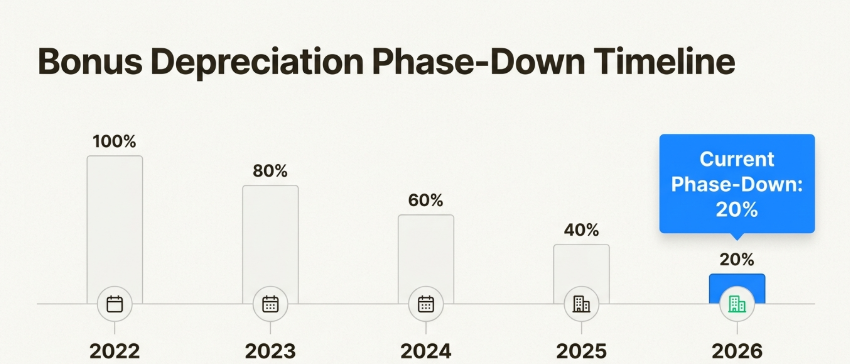
In 2026, the bonus depreciation rate is phasing down. According to current tax planning for freelancers guidelines, the rate is currently at 40%. It was 100% back in 2022 and has been dropping by 20% each year.
The standard strategy is to use Section 179 first to zero out your profit. If you still have "basis" (remaining cost) left over, you can apply bonus depreciation to the rest. Let's break it down: Section 179 is for getting to zero profit, and bonus depreciation is for when you want to go beyond that.
Real-world examples of depreciation savings
To see the impact of these rules, let's look at three common freelance scenarios using 2026 tax estimates. These include a 22% federal income tax bracket and the standard 15.3% self-employment tax.
Example 1: The Photographer
A photographer buys a new $3,200 camera, $800 in lenses, and a $1,500 lighting kit for a total of $5,500. They use the gear 90% of the time for business.
Section 179 Deduction: $4,950
Total Tax Savings: Approximately $1,845
Example 2: The Developer
A developer buys a $2,500 MacBook Pro, $600 in monitors, and a $400 desk chair for a total of $3,500. The laptop and monitors are 100% business use, while the chair is 80%.
Section 179 Deduction: $3,420
Total Tax Savings: Approximately $1,280
Example 3: The Content Creator
A creator buys a $1,200 camera, $500 ring light, $300 microphone, and $800 in annual editing software.
Section 179 Deduction: $2,800 (software is often expensed separately)
Total Tax Savings: Approximately $1,046
I often say, these aren't edge cases. this is what I saw freelancers miss for more than two decades. These savings are available to almost anyone who buys equipment to run their business.
IRS documentation rules and common pitfalls to avoid
The IRS is strict about documentation when it comes to assets. If you claim a multi-thousand dollar deduction, you need to have the receipts to back it up.
You're required to keep:
A receipt showing the purchase price and the date.
A record of your business-use percentage and how you determined it.
Proof that the asset was "placed in service" during the tax year. This means the item was purchased and was actually ready for use by December 31.
Common freelancer tax mistakes in 2026
Many people fall into the same traps every year. One of the biggest freelancer tax mistakes in 2026 is depreciating an asset over five years when Section 179 was available. This leaves thousands of dollars in the hands of the government that could've been in your bank account.
Another common pitfall is forgetting mixed-use items. Many freelancers assume that if they use something for personal tasks, it's not deductible at all. That's false. A partial deduction is always better than no deduction. Finally, you must track your assets from year to year. If you sell an asset that you claimed Section 179 on, "recapture" rules apply, and you may owe some of that tax back. Staying organized is the only way to avoid these surprises.
Stop guessing and start knowing your taxes with SnapTax
Most freelancers don't need complex accounting software that feels like it was written in Greek. They need a tool that handles the math so they can focus on their work.
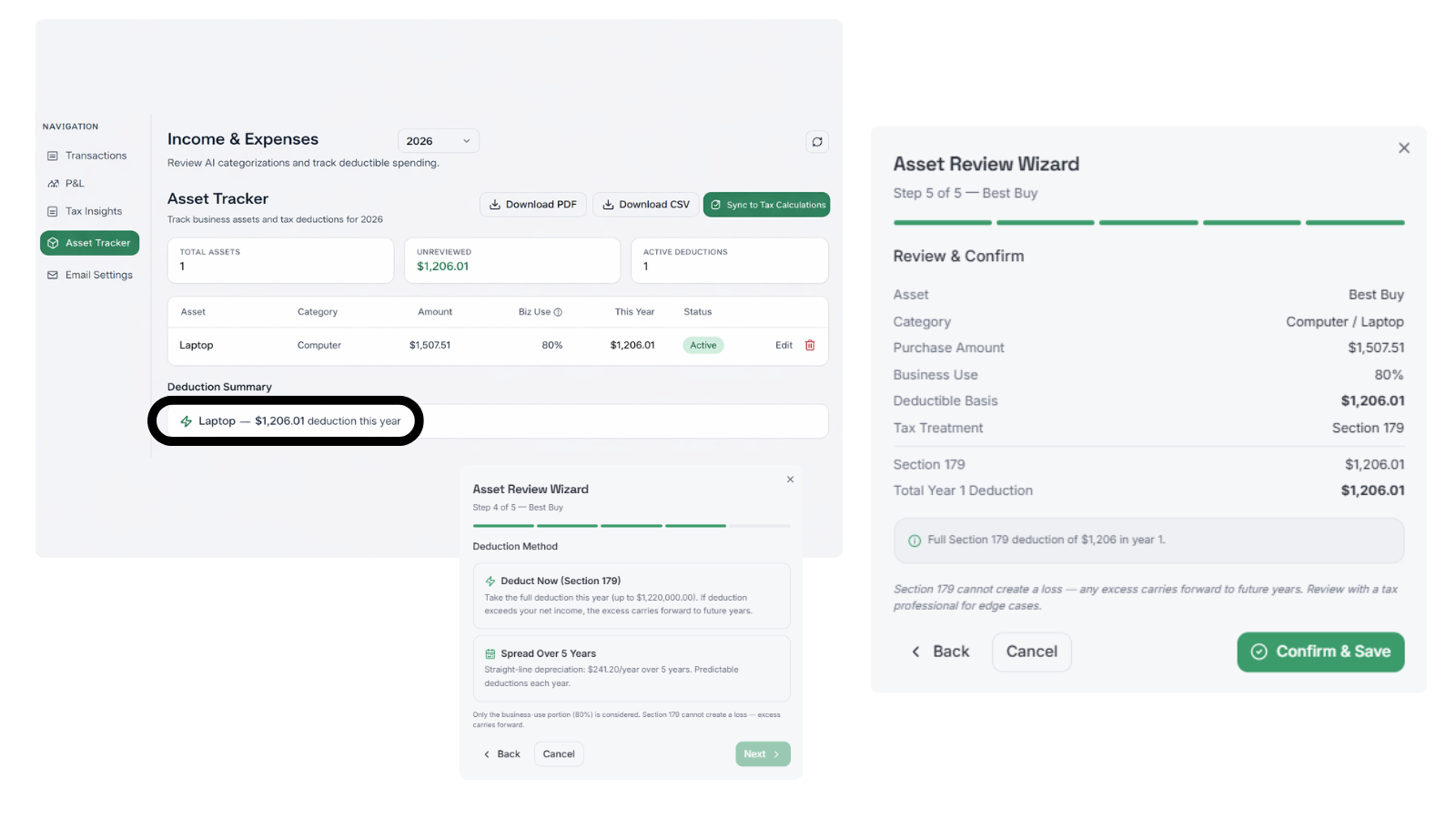
Our SnapTax platform includes a built-in Section 179 wizard that takes the guesswork out of depreciation. When you log a new piece of equipment, we walk you through the business-use percentage and automatically apply the correct IRS schedule to your quarterly tax estimates.
We designed the Asset & Depreciation Tracker to store your receipts and documentation in one place, so you're always audit-ready. Your P&L and tax liability update in real-time as you add gear, giving you total clarity on what you owe.
Depreciation isn't complicated. It's just unfamiliar. Most freelancers who start tracking assets properly save significant money in their very first year. You don't need an accountant to do this right. You just need the right tool.
Try the SnapTax Builder plan free for 30 days, or get started with our Starter plan which is free for your first 30 days.
Frequently Asked Questions
What equipment can freelancers depreciate under Section 179?
You can use the Section 179 provision to deduct computers, laptops, cameras, phones, office furniture, and off-the-shelf software. The key requirement is that the equipment must be used for your business more than 50% of the time.
Can I deduct a laptop I also use personally using asset depreciation tax deductions freelancers?
Yes, you can claim asset depreciation tax deductions freelancers on a laptop with mixed use. You simply deduct the percentage of the cost that matches your business use. For example, if you use it 80% for work, you deduct 80% of the price.
What is the Section 179 limit for 2026?
The deduction limit for Section 179 in 2026 is $2,560,000. Most freelancers will never reach this cap, making it an extremely accessible way to claim asset depreciation tax deductions freelancers.
What records do I need to claim asset depreciation tax deductions freelancers?
To safely claim asset depreciation tax deductions freelancers, you need a receipt showing the price and date, a record of your business use percentage, and proof the item was ready for use before the end of the tax year.
Can I claim Section 179 if I had a loss this year?
Section 179 cannot exceed your net business profit. If you have a loss, you cannot use it this year, but you can carry the deduction forward to future years to help with asset depreciation tax deductions freelancers later.
Does SnapTax calculate asset depreciation tax deductions freelancers automatically?
Yes, we built an Asset & Depreciation Tracker into SnapTax specifically to handle asset depreciation tax deductions freelancers. It applies Section 179 and MACRS rules automatically to your tax plan.
