How to avoid IRS quarterly tax penalties for freelancers: The 2026 guide
Crystal Harrison · April 25, 2026 · 11 min read
How to avoid IRS quarterly tax penalties for freelancers: The 2026 guide
Most freelancers know they owe taxes in April. But after more than two decades in bookkeeping, I can tell you that almost nobody knows the IRS can penalize you for underpaying throughout the year, even if you pay your full balance by April 15. The underpayment penalty isn't a punishment for not filing your return. It's a penalty for not paying enough at the right times during the year. This is the tax bill that blindsided my clients more than any other.
If you're a freelancer or a 1099 worker, you're effectively your own employer. That means you're responsible for withholding your own taxes. If you wait until the end of the year to settle up, the IRS views that as a late payment of the taxes you owed as you earned your income. Fortunately, with a clear system, you can stay ahead of these fees.
What is the IRS underpayment penalty for freelancers?
The IRS underpayment penalty is a charge for not paying enough tax throughout the year. The United States tax system operates on a pay-as-you-go basis. This means you need to pay most of your tax as you receive income, rather than in one lump sum at the end of the tax year.
When you work a traditional W2 job, your employer handles this for you by taking a slice of every paycheck. When you're self-employed, that responsibility falls on you. If the total tax you owe exceeds the amount you paid through withholding and estimated payments by more than $1,000, you're likely to face this penalty.
The penalty isn't a flat fee. It's calculated like interest on the amount you underpaid for each day it remained unpaid. The IRS sets a penalty interest rate that varies quarterly, usually the federal short-term rate plus 3 percentage points. For 2026, we're looking at an effective annualized rate of approximately 8%. If you want to see where you stand right now, you can use our Free 1099 Tax Calculator to get an instant estimate of your liability.
The two ways you trigger the penalty to avoid IRS quarterly tax penalties freelancers
There are two distinct scenarios that lead to an underpayment penalty. Understanding these is the first step to staying in the clear.
1. Missing a quarterly tax deadline entirely
The IRS has four specific Quarterly Tax Deadlines each year. Missing one does not just mean you owe that quarter's payment later. It means the penalty starts accruing the very next day. For the 2026 tax year, the deadlines are:
April 15, 2026: For income earned Jan 1 to Mar 31
June 15, 2026: For income earned Apr 1 to May 31
September 15, 2026: For income earned Jun 1 to Aug 31
January 15, 2027: For income earned Sep 1 to Dec 31
If you miss the June deadline and do not pay until September, you have over 90 days of daily interest accruing on that specific underpayment. Even if your total annual payment is correct by the end of the year, those 90 days of late payment will still cost you.
2. Underpaying despite making on-time payments
This scenario surprises people most. You might make all four payments on time, but each one is too small. The IRS calculates whether each quarterly payment met the required threshold. If you owe $10,000 for the year but only paid $1,000 per quarter, you have underpaid by $1,500 every single quarter.
A common cause for this is forgetting about the Self Employment Tax Rate. As a freelancer, you pay 15.3% for Social Security and Medicare on top of your standard income tax. If you only save for income tax, you are almost guaranteed to underpay. We built SnapTax specifically to prevent this by showing you a full tax breakdown in real-time.
Safe harbor: The golden rule to avoid IRS quarterly tax penalties freelancers
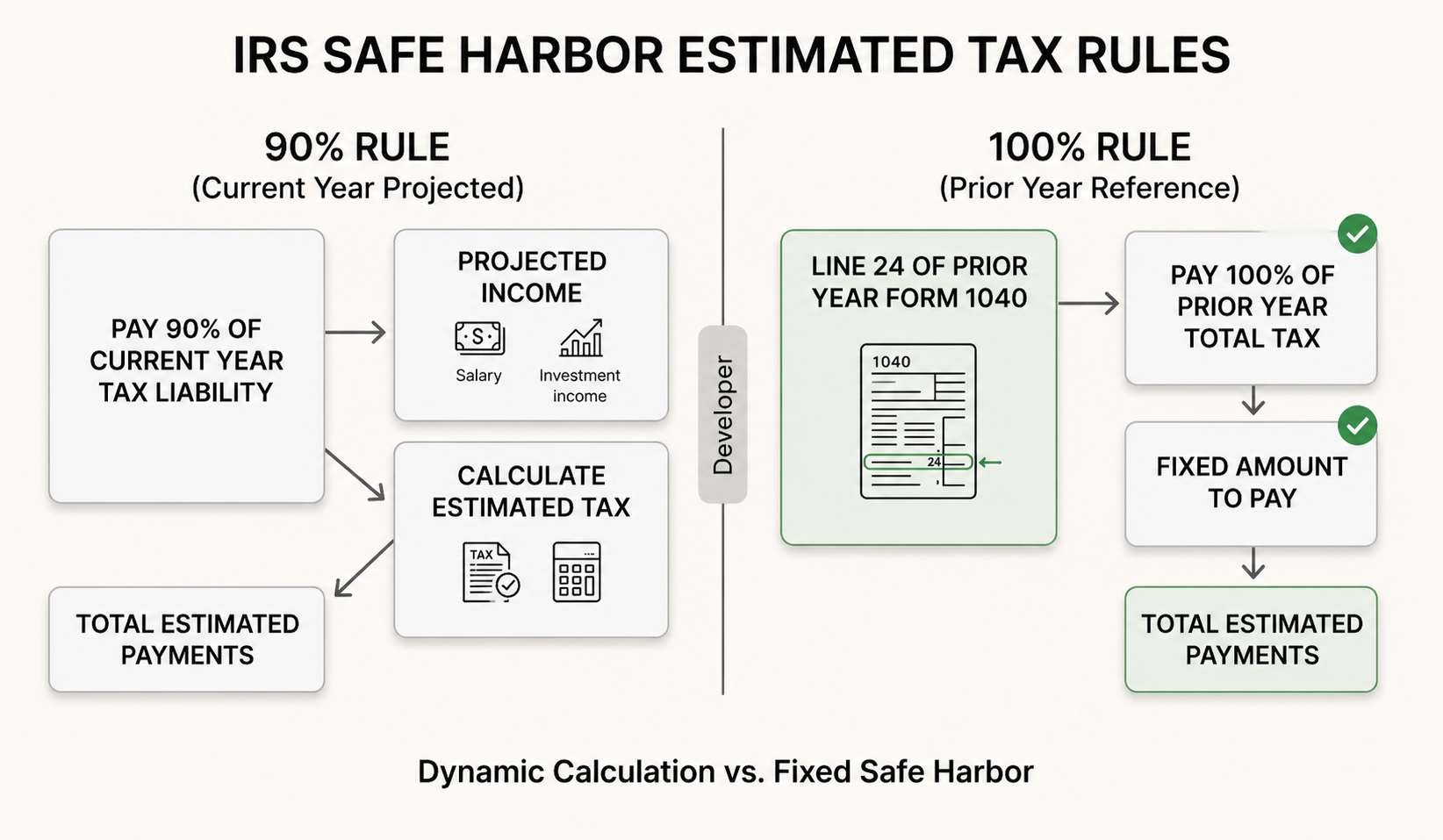
The IRS knows that predicting your income as a freelancer is difficult. Because of this, they provide two paths to avoid penalties entirely. You only need to meet one of these "Safe Harbor" thresholds to be protected.
Path 1: The 90% rule
This method requires you to pay at least 90% of your total tax liability for the current year. For example, if you end up owing $20,000 for 2026, you must have paid at least $18,000 across your four quarterly payments.
The challenge with this path is that you do not know the final number until the year ends. It works best for freelancers with very predictable, steady income. If your income fluctuates, you might find yourself scrambling in Q4 to make up the difference.
Path 2: The 100% rule (prior year liability)
This is the most reliable method for most freelancers. It requires you to pay 100% of the total tax you owed on your prior year tax return, regardless of how much you earn this year. You can find this number on Line 24 of your prior year Form 1040.
If your income doubles this year, you are still penalty-protected as long as you match last year's total tax. However, if your prior year adjusted gross income (AGI) exceeded $150,000 ($75,000 if married filing separately), the requirement jumps to 110% of your prior year liability.
In our Quarterly Taxes for Freelancers guide, we go deeper into why the 100% rule is the preferred "set it and forget it" strategy. It provides certainty in an uncertain business.
Strategy | Requirement | Best For |
|---|---|---|
90% Rule | Pay 90% of current year tax | Steady income, predictable profits |
100% Rule | Pay 100% of prior year tax | Fluctuating income, rapid growth |
110% Rule | Pay 110% of prior year tax | High earners (AGI > $150,000) |
What to do if you have already missed a quarterly tax deadline
If you are reading this and realize you missed a deadline, do not panic. But also, do not wait. Because the penalty is calculated daily, paying today is significantly cheaper than waiting until the next deadline.
Pay the missed amount immediately
You do not have to wait for the next quarterly window to open. You can make a catch-up payment through IRS Direct Pay at any time. This is a free service that allows you to pay directly from your bank account without even creating an account. Simply select "Estimated Tax" as your reason for payment.
Request a penalty waiver
In some cases, the IRS will waive the underpayment penalty. You can request this by filing Form 2210 with your tax return. Common reasons for a waiver include:
First-time penalty situations with a clean prior history
Casualty, disaster, or other unusual circumstances
Retirement or disability during the current or prior year
I have seen the IRS waive this penalty more often than people expect, but you have to be proactive and ask for it. You must attach a written explanation to Form 2210 explaining why the underpayment occurred.
Special scenarios to avoid IRS quarterly tax penalties freelancers
Tax law has several edge cases that frequently catch freelancers off guard.
The W2 + 1099 overlap
Many side hustlers assume their employer withholding covers everything. It rarely does. While your W2 withholding covers your salary, it does not account for your 1099 net profit. However, you can use this to your advantage. If you increase your W2 withholding, that extra tax paid counts as being paid "evenly" throughout the year, even if you make the change in December. This is a powerful shortcut to avoid making quarterly payments. You can read more about this in our 1099 vs W2 taxes breakdown.
Income spikes mid-year
If you have a slow Q1 but land a massive contract in Q2, your Q1 payment might have been low. To avoid a penalty for those early months, you can use the "Annualized Income Installment Method." This allows you to calculate your payments based on what you actually earned in each specific quarter rather than a flat yearly average. This requires more paperwork (Schedule AI of Form 2210), but it can save you from being penalized for a slow start to the year.
First year as a freelancer
If this is your first year in business and you did not have a tax liability last year, your prior year safe harbor is zero. However, this does not mean you can wait until April to pay. You must use the 90% of current year tax method to stay safe. This is arguably the hardest year to get right, which is why real-time tracking is so critical from day one.
A simple system to stay penalty-free with SnapTax
At SnapTax, we believe that tax planning should be simplified. You should not need a degree in accounting just to know what to save for the IRS. Our platform is built specifically for solo contractors who want clarity over complexity.
Real-time income tracking
Our features allow you to see your tax liability update the moment you log income or an expense. Instead of "vibes-based" estimation, you get a hard number based on current 2026 federal and state tax tables.
The safe harbor display
One of the most popular tools in our dashboard is the Safe Harbor Display. We pull your prior year tax data and show you exactly what your quarterly target is to remain penalty-protected. You can see your actual estimated liability side-by-side with your safe harbor amount, so you can decide exactly how much to send to the IRS.
It important to note though, that safe harbor payments doesn't mean reduced tax liability, it only means you will avoid an IRS penalty, you will still owe the difference between what you paid in and your actual tax liability, so consider the safe harbor rule your minimum you should pay. If you do real-time tracking of your income and expenses AND you know you are going to have a better year than the previous one, you should pay in more, SnapTax can help you know exactly how much to pay.
Unified side hustler support
If you have a day job and a business, our unified view allows you to add your W2 income and withholding. We calculate your total exposure across both streams, so you see a real "refund-vs-owe" picture rather than a one-sided estimate.
Ready to stop guessing? You can explore our pricing and start a free 30-day trial of our Starter plan today.
Plan | Price | Best For |
|---|---|---|
Starter | $4.99/mo (30-day free trial) | Basic planning and W2+1099 support |
Builder | $19.99/mo (30-day free trial) | AI expense management and P&L reports, Mobile receipts and Mileage tracker |
Optimizer | $39.99/mo (Coming soon) | Advanced deductions and capital gains |
The underpayment penalty is one of the most avoidable costs a freelancer faces. It does not require perfect prediction. It just requires a system that keeps you close enough to the pin. By using the safe harbor rules and staying current on your payments, you can keep more of your hard-earned money in your own pocket.
Frequently Asked Questions
What is the IRS underpayment penalty for freelancers and how is it calculated?
The penalty is essentially interest charged on the amount of tax you should have paid during the year but did not. It is calculated by taking the amount underpaid for each quarter and applying the federal short-term interest rate plus 3%. For 2026, this rate is approximately 8% annualized, and the penalty accrues daily from the date the payment was due until it is paid in full.
How can I avoid IRS quarterly tax penalties freelancers might face if their income changes?
The most reliable way to stay safe is the safe harbor rule. If you pay 100% of your prior year tax liability (110% if your income was over $150,000), the IRS will not charge you an underpayment penalty, even if you owe a large balance in April. Alternatively, you can aim to pay 90% of your current year tax through quarterly payments.
What are the specific deadlines to avoid IRS quarterly tax penalties freelancers need to know?
For the 2026 tax year, the quarterly payment deadlines are April 15, June 15, September 15, and January 15, 2027. If any of these dates fall on a weekend or holiday, the payment is due the next business day. Missing these dates triggers daily interest accrual on the unpaid amount.
Can I use W2 withholding to avoid IRS quarterly tax penalties freelancers usually have to pay?
Yes. The IRS treats W2 withholding as being paid evenly throughout the year. If you have a side hustle and a day job, you can increase your W2 withholding to cover your total tax liability. This can often satisfy the safe harbor requirements and allow you to skip making separate quarterly estimated payments entirely.
What should I do if I missed a payment and want to avoid IRS quarterly tax penalties freelancers often incur?
You should make a catch-up payment as soon as possible through IRS Direct Pay. Since the penalty accrues daily, paying now is better than waiting until the next deadline. You can also file Form 2210 with your tax return to request a penalty waiver if you have a reasonable cause, such as a natural disaster or a first-time mistake.
Does SnapTax show the safe harbor amount to avoid IRS quarterly tax penalties freelancers worry about?
Yes, SnapTax includes a dedicated Safe Harbor Display on your dashboard. It calculates your required payment based on your prior year tax liability and compares it to your actual estimated liability for the current year. This allows you to choose the payment amount that guarantees penalty protection.
