Common Freelancer Tax Mistakes That Trigger IRS Audits — and How to Stay Audit-Ready in 2026
Crystal Harrison · September 23, 2026 · 12 min read
Common Freelancer Tax Mistakes That Trigger IRS Audits - and How to Stay Audit-Ready in 2026
The IRS uses automated matching to verify freelancer returns. Here are the common documentation risks that lead to audit notices in 2026 - and how to address them.
September 23, 2026 · 11 min read

TL;DR
The IRS uses automated matching to compare income reported on your return against 1099s filed by clients and payment platforms. Most audit risk for freelancers comes from income that doesn't reconcile to those forms, deductions that can't be substantiated, and personal costs mixed into business expenses. The fixes are practical: reconcile every income form to your books, document a business reason for expenses where the connection isn't obvious, and keep vehicle records at or near the time of each trip. If your records are organized throughout the year, an audit is an inconvenience - not a crisis. SnapTax is built to help freelancers keep receipts, transaction categories, mileage records, and business-purpose notes organized in one place - so that documentation is ready if questions arise.
The IRS uses information reported by clients, payment platforms, banks, and other third parties to verify tax returns. For freelancers, the biggest recordkeeping risks are unreported income, deductions that cannot be supported, and personal costs mixed into business expenses. A mismatch between income reported on your return and income reported to the IRS by a third party can lead to notices or further questions.
The good news: these risks are preventable. They fall into two categories. The first is reporting errors that create mismatches the IRS catches automatically. The second is documentation gaps that make defensible deductions indefensible when questions arise.
SnapTax is built around exactly this problem. Receipts, transaction categories, mileage records, and business-purpose notes live in one place. Audit readiness isn't a separate project - it's a byproduct of normal monthly bookkeeping.
What 1099 reporting errors create problems for freelancers?
Income that doesn't reconcile to your information returns is a significant documentation risk for freelancers. The IRS receives a copy of every 1099-NEC and 1099-K filed on your behalf and compares those figures against your Schedule C. A gap between what was reported to the IRS and what you reported can result in a notice or further inquiry.
Three facts to know:
The One Big Beautiful Bill Act raised the 1099-NEC reporting threshold from $600 to $2,000 for payments made in 2026. Clients paying you less than $2,000 are no longer required to file a 1099-NEC for that payment.
All income is still reportable regardless of whether a 1099 was issued. The threshold change affects the form, not your obligation to report the income.
Payment platforms including PayPal, Venmo, and Stripe issue 1099-Ks based on statutory reporting thresholds. Not every business transaction necessarily produces a form, and a 1099-K may reflect gross payments that include refunds, reimbursements, or amounts not belonging on Schedule C.
Reconcile every Form 1099 you receive to your books. Your total Schedule C gross receipts may not exactly match a single form because of refunds, payment-processor gross reporting, shared transactions, or other adjustments. Keep a written reconciliation for any difference. If you received income that didn't generate a form, that still goes on your return.
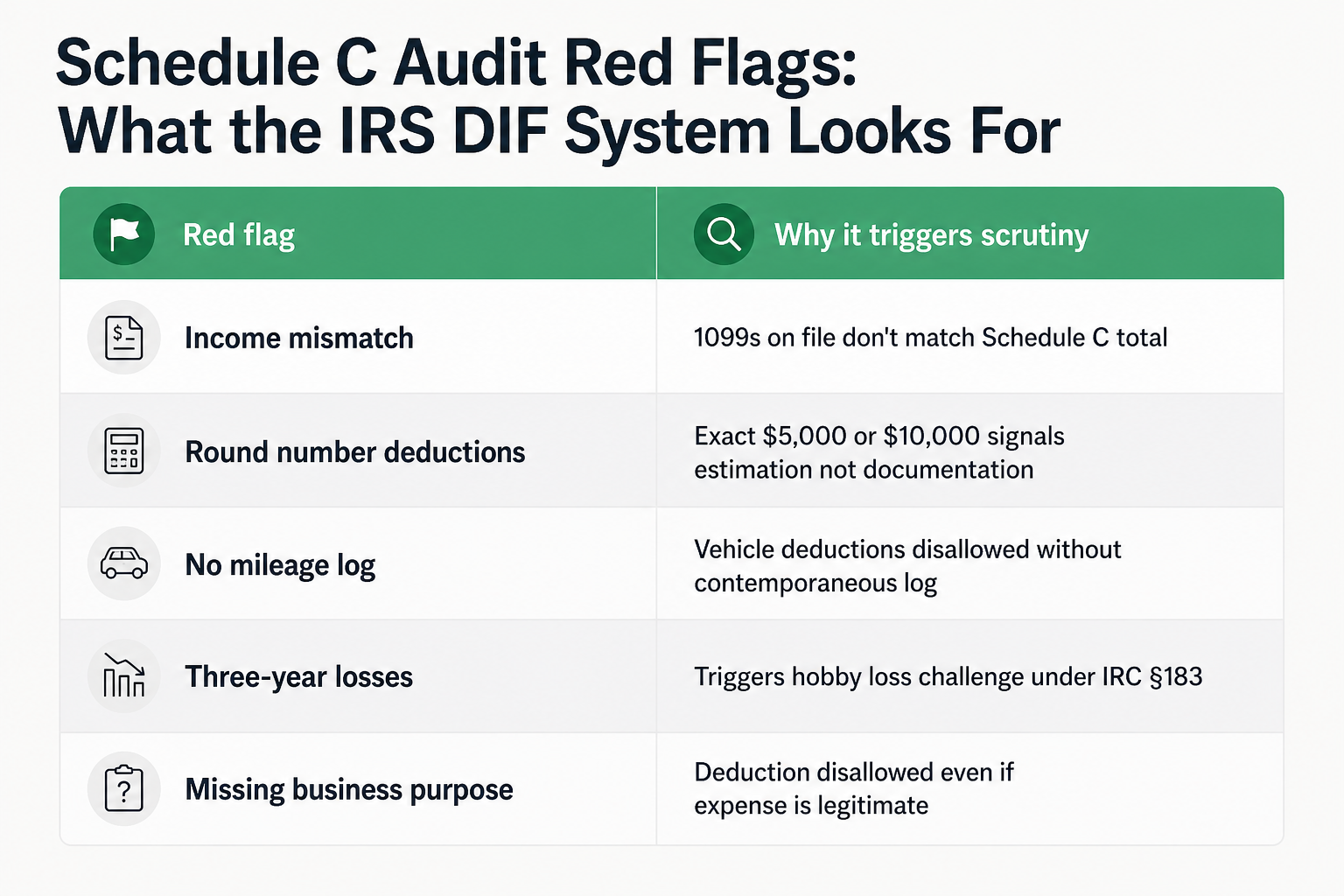
Which Schedule C deductions carry the most documentation risk?
Home office, vehicle, meals, and any deduction that is large or unusual relative to your reported business activity carry heightened documentation risk on Schedule C. Large, unsupported deductions can draw questions, especially when they don't fit the taxpayer's reported business activity.
Two patterns worth knowing:
Disproportionate ratios. A Schedule C showing $80,000 in income and $75,000 in deductions may raise questions. That ratio can be legitimate, but it needs records to support it.
Mixed-use expenses. Deductions for vehicles, phones, and home offices require documentation of the business-use percentage. A claim of 100% business use on a vehicle or phone is hard to support for most freelancers.
Home office and vehicle deductions are areas where documentation gaps create serious risk. IRS Publication 463 covers substantiation requirements for travel, vehicle use, meals, and gifts. For vehicle deductions, records need to be made at or near the time of each trip - not reconstructed from memory later.
What happens when a freelancer reports losses year after year?
An activity that reports losses year after year can raise questions about whether it is operated for profit. The IRS may examine whether the activity qualifies as a business or should be treated as a hobby under IRC §183.
Two things to understand about how this works:
The IRS generally presumes a profit motive if an activity earned a net profit in at least 3 of the last 5 tax years, including the current year. Failing that test does not automatically make the activity a hobby.
The IRS considers all facts and circumstances - including how the activity is run, whether records are kept, whether the owner has expertise in the field, and whether steps are being taken to improve profitability. For many individual taxpayers, hobby-related expenses are not currently deductible under federal rules, so proper business classification matters.
Keeping clean books, maintaining separate business accounts, and documenting client work and marketing efforts are all evidence of genuine profit intent - regardless of whether recent years were profitable.
What is missing business purpose and why is it a documentation problem?
Missing business purpose means an expense has a category but no explanation of why it was a business expense. For meals, travel, vehicle use, gifts, and mixed-use expenses, IRS Publication 463 requires records that show what the expense was for and how it related to your business. A written business-purpose note is especially important for any expense that isn't self-explanatory from the receipt alone.
The distinction matters in practice:
"Software" is a category. It tells you what you spent money on.
"Subscription to ChatGPT for drafting client deliverables" is a business purpose. It tells you why it was a business expense.
The second version is a best practice for any mixed-use or potentially ambiguous expense - not just software. Records made at or near the time of the expense are stronger than notes reconstructed later.
This is a documentation gap many freelancers don't notice until it becomes a problem. The expense was real. The receipt exists. But if the business reason wasn't captured close to the time of the expense, the documentation may be harder to defend.
What Schedule C entry errors create documentation risk for freelancers?
Common areas of documentation risk include entering personal expenses as business expenses, claiming a home office that doesn't meet the exclusive use requirement, and deducting a higher percentage of vehicle costs than business use supports.
Three specific problems to watch:
Personal expenses as business expenses. Mixing personal and business transactions is a significant documentation risk. The IRS Schedule C Instructions are explicit: only ordinary and necessary business expenses qualify. When bank records don't support claimed amounts, questions follow.
Home office without exclusive use. A home-office deduction generally requires a space used regularly and exclusively for business, plus a qualifying business-use test such as principal-place-of-business or administrative/management use. A dining table where you also eat doesn't qualify. A dedicated room with no personal use does.
Vehicle percentage higher than actual business use. Business use percentage needs to be supported by adequate records. For the standard mileage method or actual expenses on listed property, records made at or near the time of each trip are the standard. Inadequate documentation creates serious risk that a portion of the deduction will be questioned or reduced.
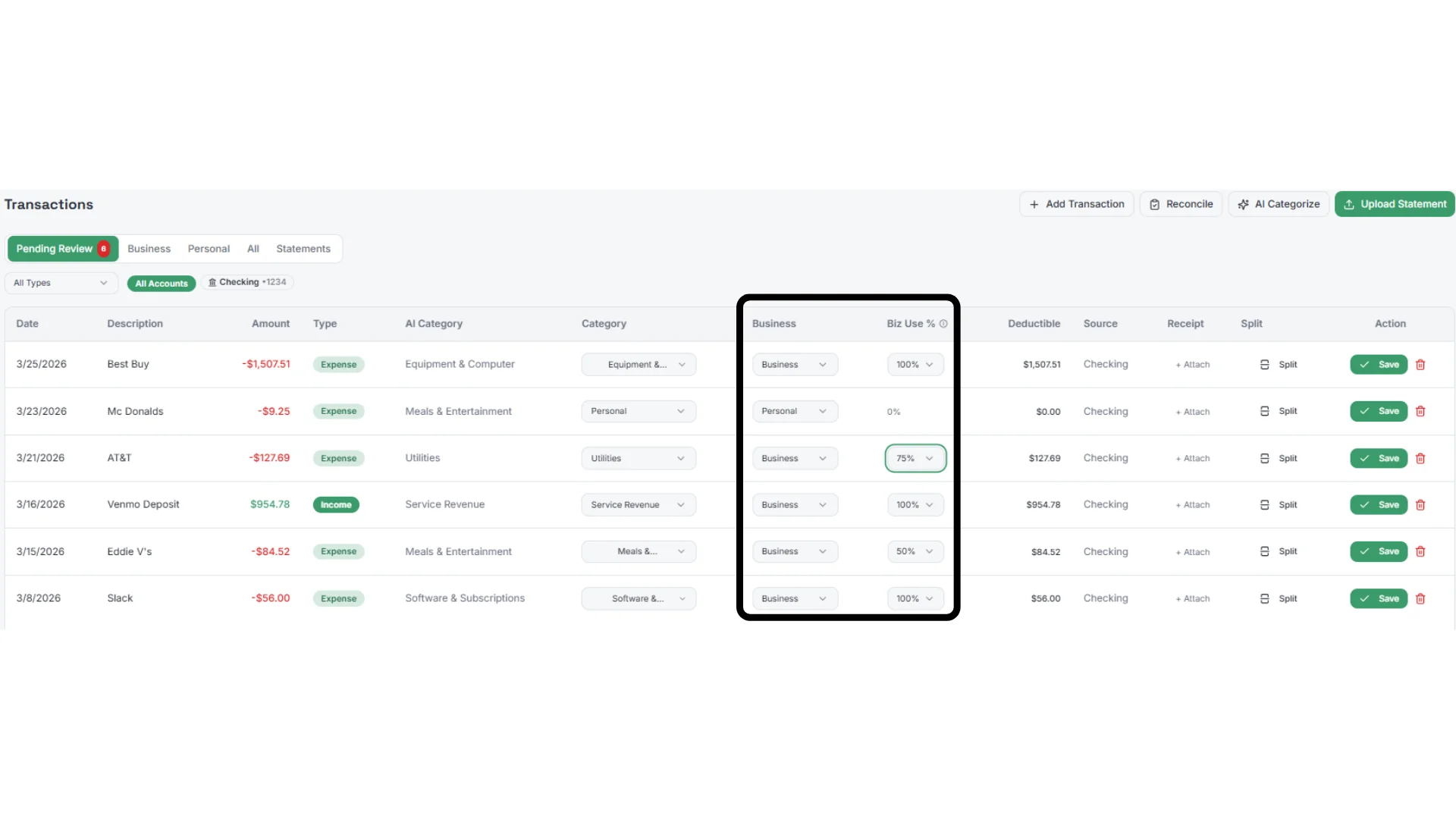
SnapTax's transaction view lets you separate personal and business on a per-transaction basis. When you log a transaction, you set the business use percentage - 75% for a phone used partly for personal calls, 50% for a client dinner with a personal component. That percentage flows directly into your deductible amount, so each transaction reflects the actual business portion rather than an estimate.
What does it mean to be audit-ready - and how do you get there?
Being audit-ready means you can support each deduction with adequate records - such as receipts, invoices, statements, mileage logs, contracts, and business-purpose notes where relevant - and link those records to the transaction. The IRS doesn't just want the deduction confirmed - it wants the chain of evidence.
Two facts about the audit window that change how you should think about this:
The IRS generally has three years after a return is filed - or its due date, if later - to assess additional tax. That window can be longer in certain situations, including substantial understatement of income.
Audit-ready documentation has to survive that full window - not just get you through tax season. A missing receipt can make a deduction harder to defend, especially if you do not have another reliable record showing what the expense was for.
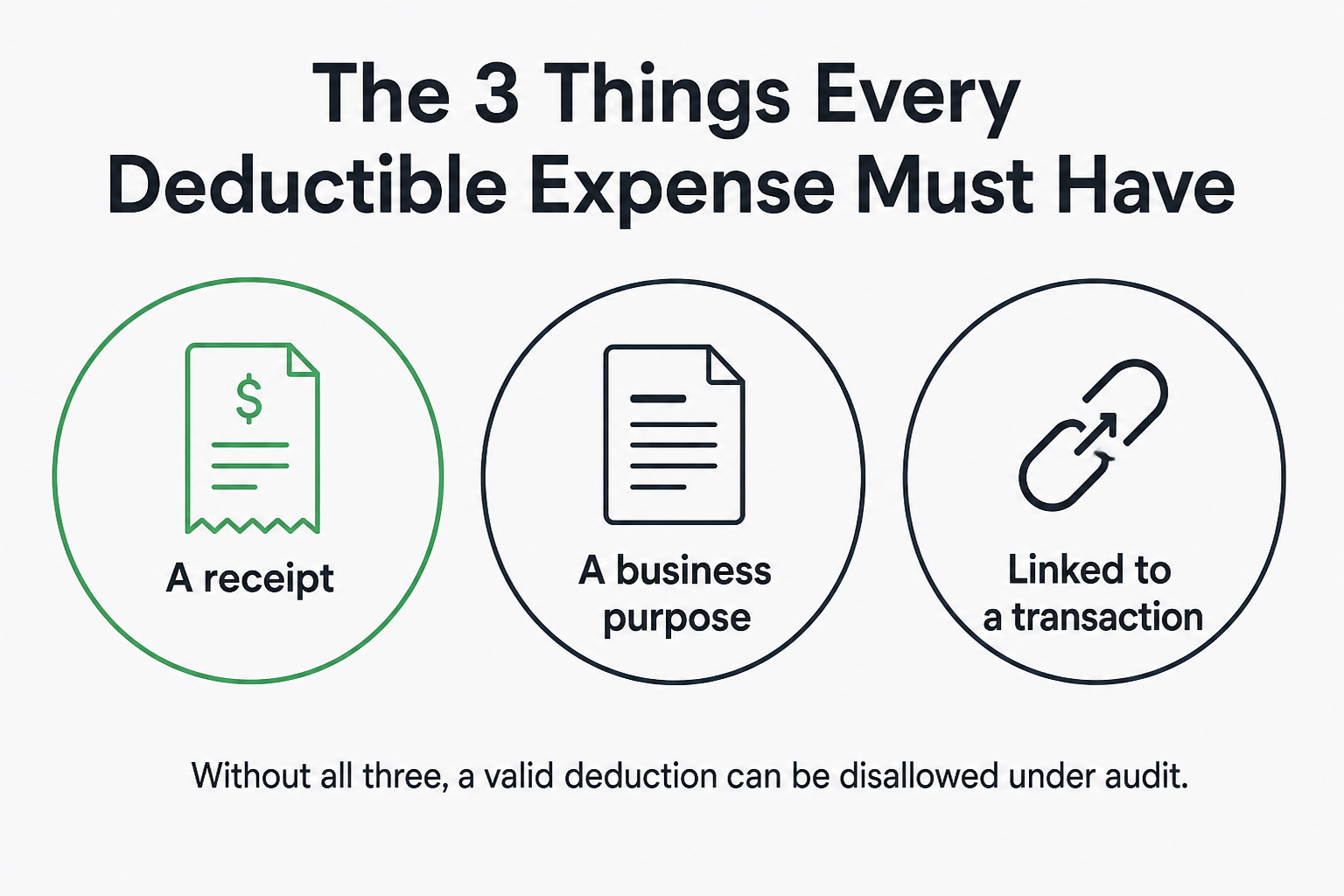
Most freelancers treat audit readiness as a filing-season project. They gather receipts in April, try to reconstruct business purposes from credit card statements, and hope it holds. That approach fails under the IRS's contemporaneous record standard.
The alternative is documentation that happens at the time of the expense - not reconstructed afterward. That's also just good bookkeeping.
SnapTax's audit export is designed to help you organize what an IRS examination might request. Receipts are linked to transactions. Business-purpose notes appear for each expense. Transactions are organized by Schedule C category. Personal transactions can be excluded. The scope of any actual audit depends on the facts, but having organized records ready before one starts puts you in a much better position.
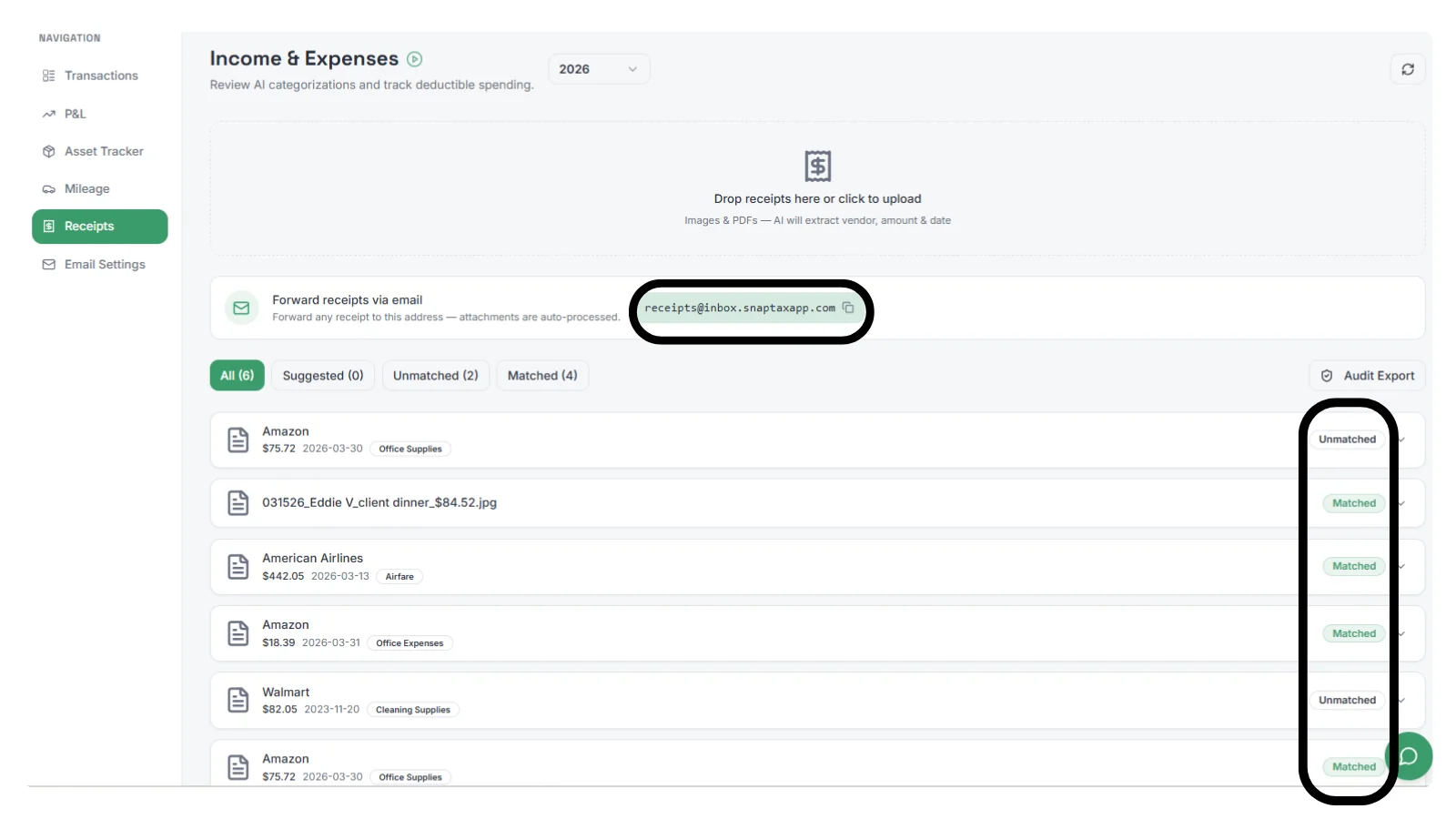
The receipt view above shows the Receipts tab in SnapTax: each uploaded receipt is matched to its transaction and tagged Matched or Unmatched. The Audit Export feature is designed to generate an organized package of linked transactions, receipts, categories, and business-purpose notes for CPA review or to help respond if questions arise. That's the documentation chain the IRS wants - receipt, transaction, category - assembled automatically as a byproduct of logging expenses monthly.
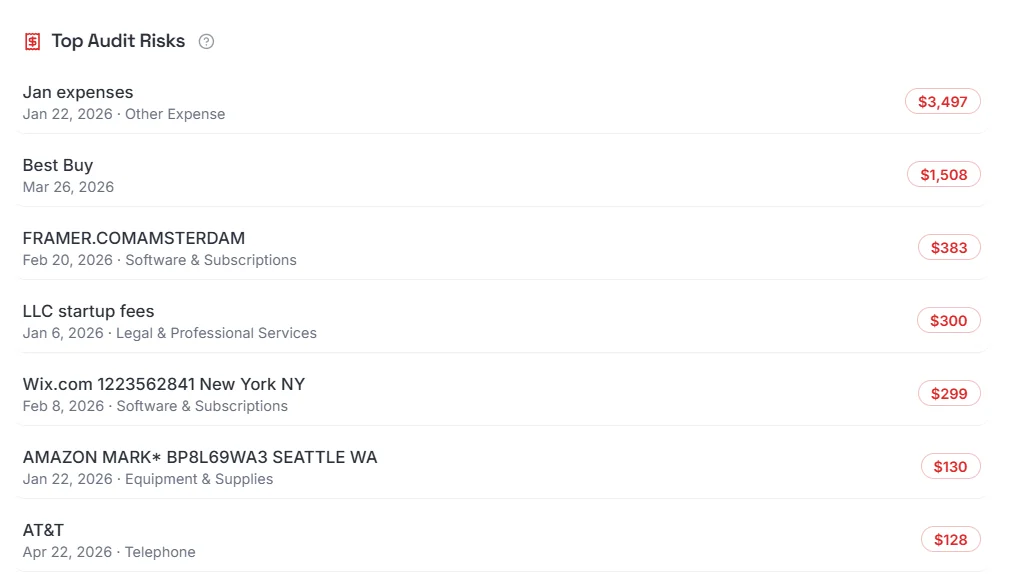
SnapTax also surfaces a Top Audit Risks list that flags transactions with documentation gaps - large expenses without receipts, vague categories, unmatched vendor charges. The panel above shows what that looks like in practice: each transaction is listed with the date, vendor, category, and amount, making it easier to identify and close gaps before year-end.
Audit risk for freelancers is largely a recordkeeping problem. Income that doesn't reconcile to information returns. Deductions that can't be substantiated. Business purpose that was never written down. These are fixable problems - and the fix is better documentation throughout the year, not a better accountant at filing time.
Audit readiness and good bookkeeping are the same habit. If your receipts are matched, your business purposes are documented, and your income reconciles to your 1099s, you're in a defensible position if questions arise.
Try SnapTax
SnapTax is built for freelancers, 1099 contractors, and gig workers who want receipts, transaction categories, mileage records, and business-purpose notes in one organized place throughout the year. The Builder plan ($19.99/mo) includes receipt management, business-purpose documentation, a GPS mileage tracker, business use percentage tracking, and the audit export feature. Complete records and accurate classifications remain the user's responsibility - but SnapTax makes keeping them organized a lot easier. Start your 30-day free trial at snaptaxapp.com.
Frequently Asked Questions
What are the most common freelancer tax mistakes that trigger IRS audits?
Common documentation risks include income that does not reconcile to the 1099s on file with the IRS, home office and vehicle claims without supporting records, and expenses logged without a clear business connection. The IRS uses automated matching systems to compare information returns against what you reported, so unreported or under-reported income is one of the clearest ways to draw attention. The IRS Self-Employed Individuals Tax Center covers filing requirements in detail.
How does the IRS select returns for audit?
The IRS uses automated matching and selection systems to identify returns that may need review. One system - the Discriminant Information Function (DIF)
scores returns against statistical norms for similar filers. The IRS also compares information returns (1099s, W-2s) against what you reported on your return. The specific selection criteria and procedures are not publicly disclosed, but the best defense is always the same: accurate income reporting and documentation that supports every deduction you claim.
Does the IRS require a mileage log for vehicle deductions?
For business vehicle deductions, you need adequate records made at or near the time of each trip, including date, destination, business purpose, and miles. If you use actual expenses instead of the standard mileage rate, you also need records of vehicle costs and total annual miles. Inadequate documentation creates serious risk - the IRS may disallow or reduce the deduction depending on the facts. SnapTax includes a GPS-tracked mileage tracker that records business trips and flows deductions into your Profit and Loss report.
What is the hobby loss rule and how does it affect freelancers?
An activity that reports losses year after year can raise questions about whether it is operated for profit. Under IRC §183, the IRS generally presumes a profit motive if an activity earned a profit in at least three of the last five tax years - but failing that test does not automatically make the activity a hobby. The IRS considers all facts and circumstances, including how the activity is run, whether records are kept, and whether the owner is taking steps to improve profitability. For many individual taxpayers, hobby-related expenses are not currently deductible under federal rules, so proper business classification matters. Keeping clean books and documenting client work are the best evidence of a genuine profit motive.
How long can the IRS audit a freelancer's tax return?
The IRS generally has three years after a return is filed - or its due date, if later - to assess additional tax. The period can be longer in certain situations, including substantial understatement of income. The IRS guidance on recordkeeping recommends keeping records for as long as they may be needed to support an item on your return. Property, depreciation, and basis records may need to be kept longer than the general audit period.
