Independent Contractor Accounting Guide: Everything 1099 Workers Need to Know
Crystal Harrison · November 11, 2026 · 19 min read
Independent Contractor Accounting Guide: Everything 1099 Workers Need to Know
This independent contractor accounting guide covers everything 1099 workers need to manage taxes, track expenses, and pay quarterly estimates correctly — built by a bookkeeper with more than two decades of experience.
November 12, 2026 · 15 min read
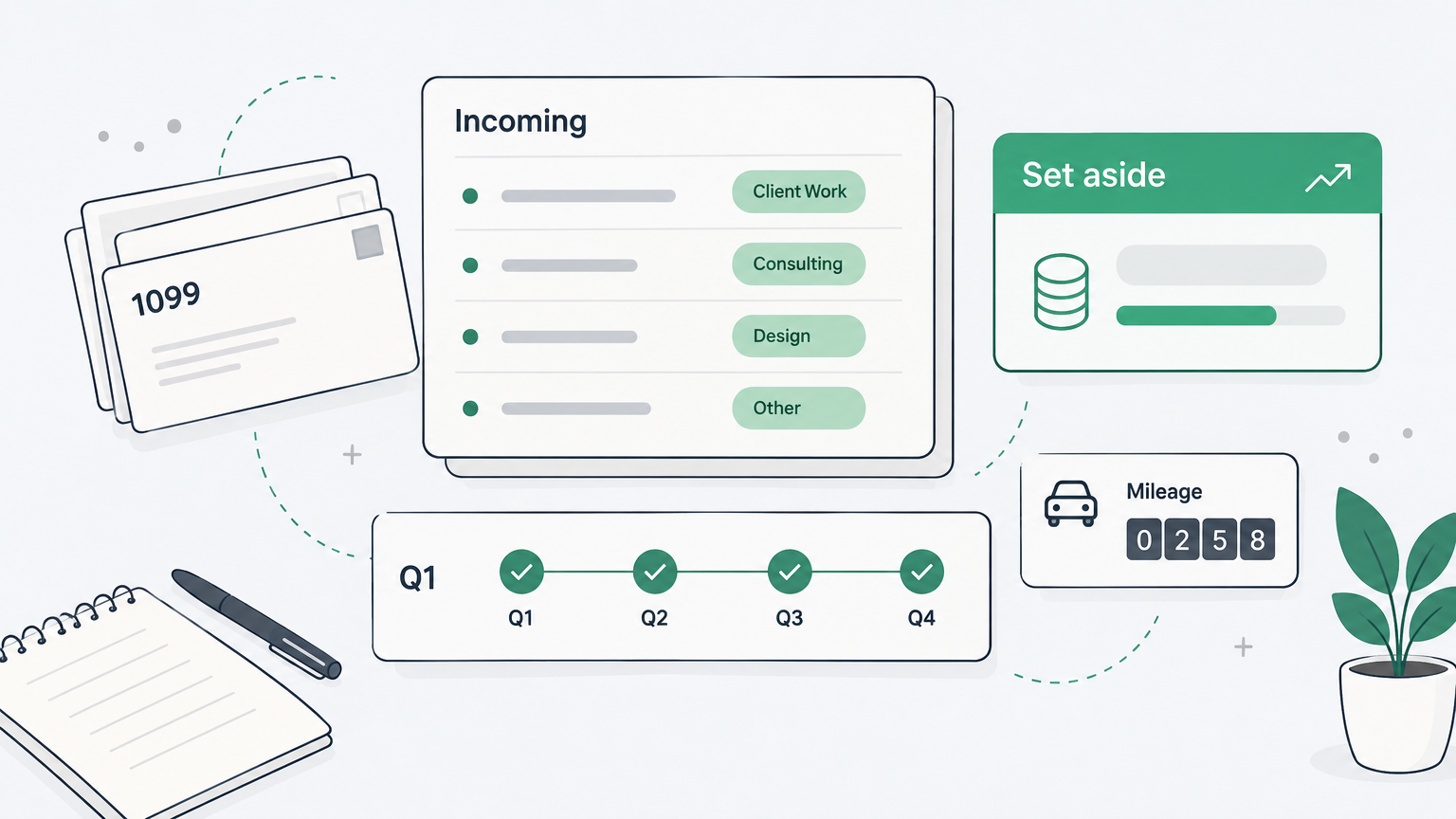
Quick Answer: What does independent contractor accounting involve?
Independent contractor accounting means tracking every dollar of business income and expense, setting money aside for taxes, and paying the IRS quarterly if you expect to owe at least $1,000 in federal tax for the year. Self-employment tax is generally 15.3% of 92.35% of your net profit, on top of income tax. Keep business money in its own account and save 25% to a third of each payment.
TL;DR
Accounting as an independent contractor comes down to four jobs: recording what you earn, recording what the business spends, knowing what you owe while there is still time to act on it, and paying the IRS on schedule. The IRS treats you as self-employed once you carry on a trade or business as a sole proprietor or an independent contractor, whether or not the work is full-time (IRS).
Business profit generally feeds into two calculations: income tax and self-employment tax. Under the regular method, self-employment tax generally starts with 92.35% of net business profit (IRS Topic no. 554). The regular combined rate is 15.3%, subject to the Social Security earnings limit and interaction with wages; Additional Medicare Tax can apply at higher incomes (IRS). Many contractors use an informal 25% to a third of every payment as a starting savings target, keep business money separate from personal money, and watch the four estimated-payment deadlines. A straightforward Schedule C is within reach of ordinary software, and a professional starts to earn their fee once the business gets more complex.
Related guide: Want the deduction table, quarterly deadlines and free tools on one page? Visit our Independent Contractor Accounting page.
What does accounting actually mean for an independent contractor?
Accounting for a 1099 worker is four jobs, not one: tracking what you earn, tracking what the business spends, knowing what you owe while there is still time to act on it, and paying the IRS on schedule. A typical sole proprietor does not need an audited financial statement just to file Schedule C, but does need complete records that support the return.
The IRS expects a self-employed person to file an annual return and pay estimated taxes quarterly, which means the tracking has to happen all year (IRS self-employed tax center).
"Net profit" is your business income minus your business expenses, and that single number drives both your income tax and your self-employment tax (IRS).
You land in this category if you carry on a trade or business as a sole proprietor or an independent contractor, or are otherwise in business for yourself, including part-time work and gig work (IRS).
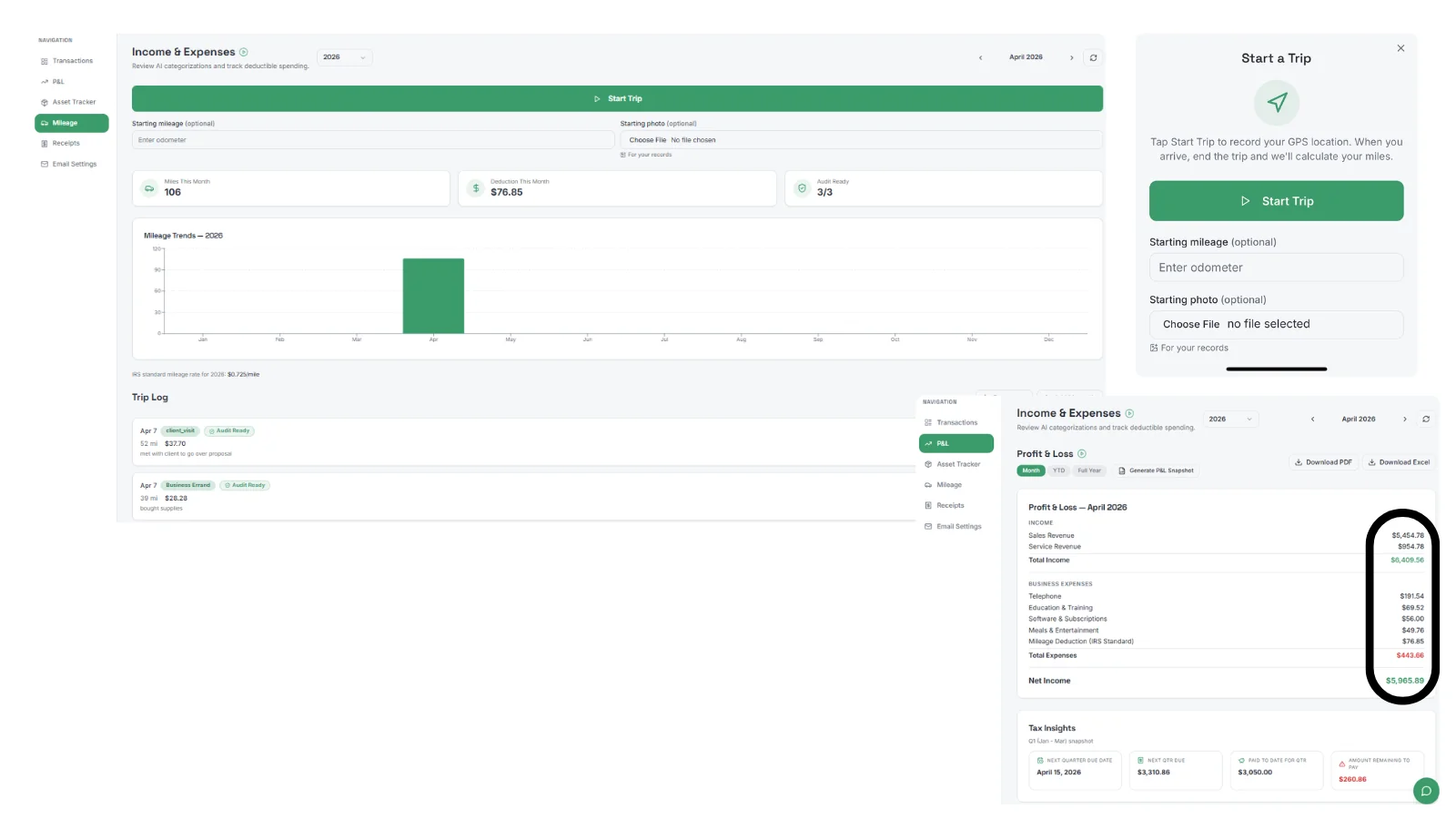
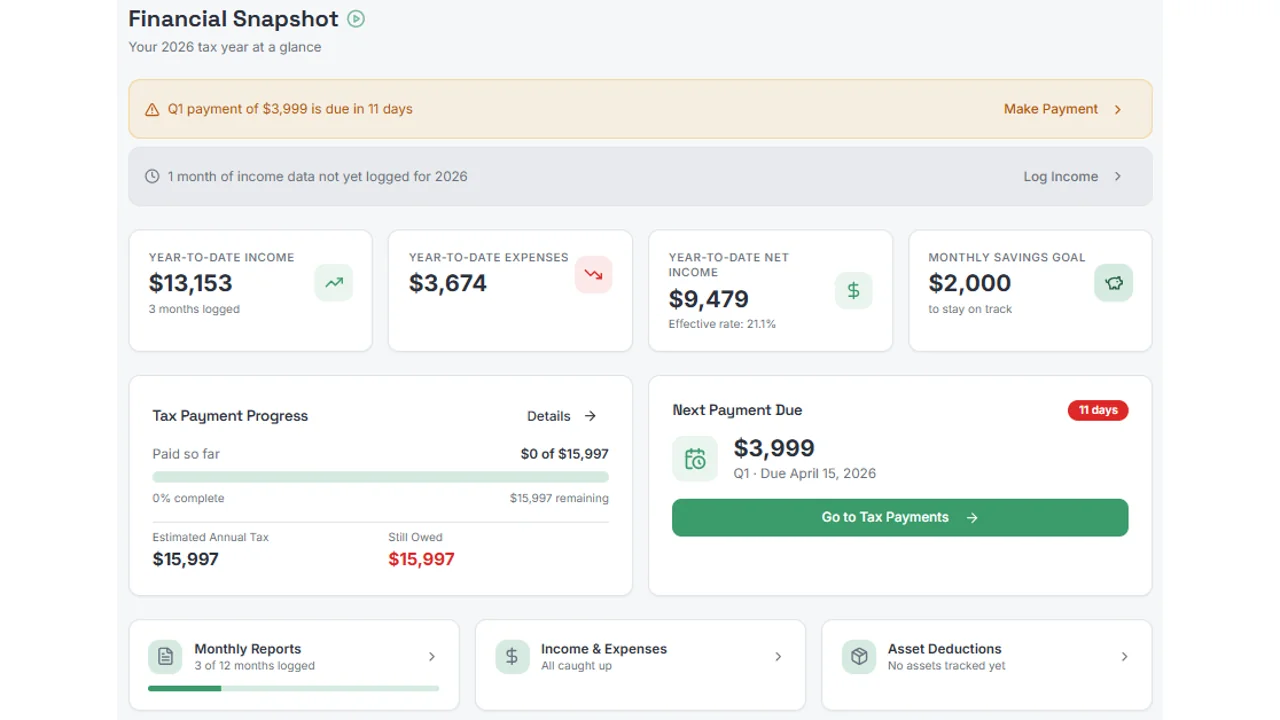
Most of the frustration contractors describe is not the bookkeeping itself. It is that nobody tells them the number until it is too late to do anything about it. That is the gap SnapTax was built to close: it estimates your federal income tax, self-employment tax, and state tax where supported, as income comes in, so the quarterly estimate moves with your actual year instead of being frozen in January.
Why is accounting different when you are a 1099 worker?
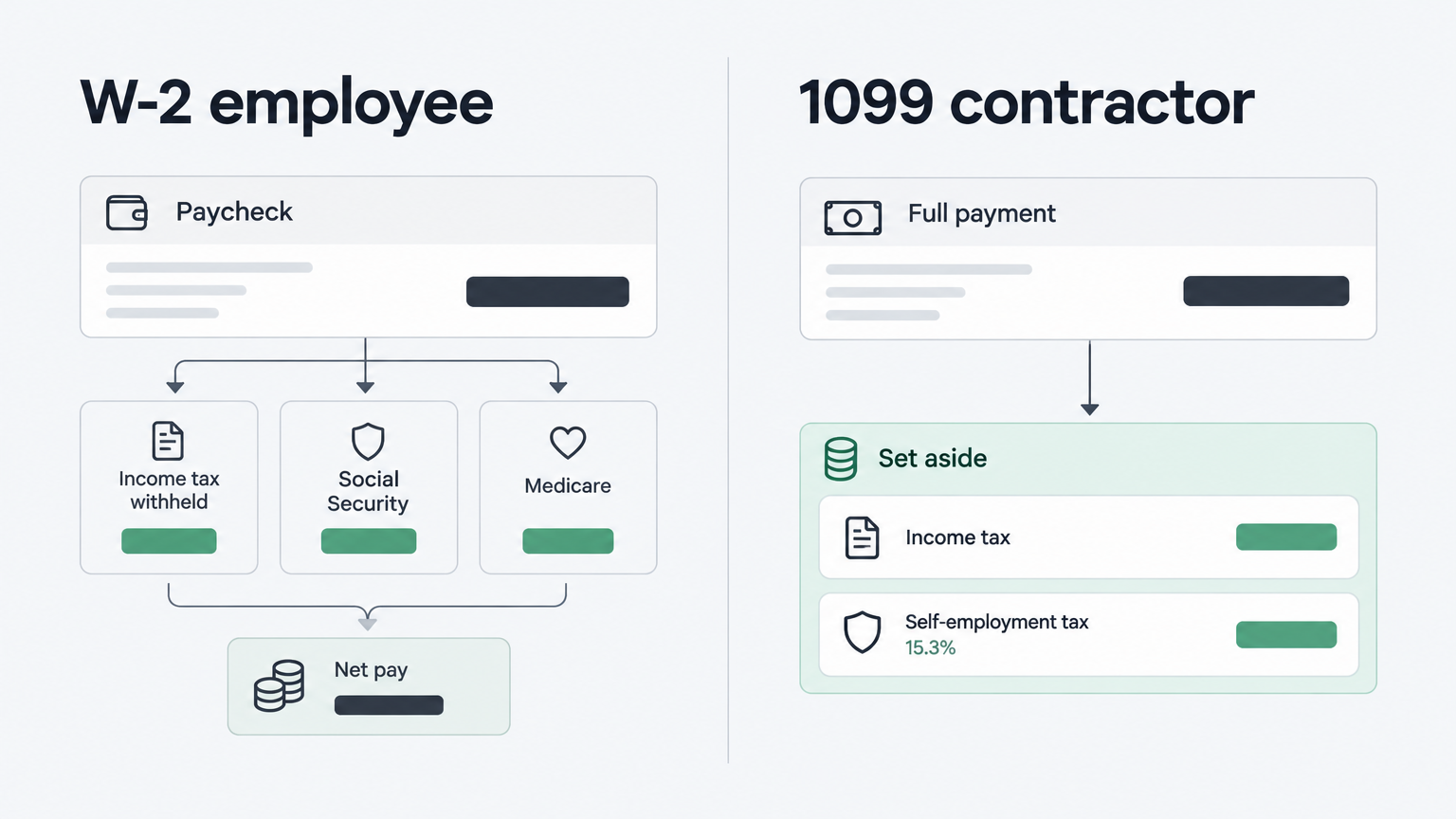
Unlike wages, independent-contractor payments generally arrive without income tax or Social Security and Medicare taxes withheld. Contractors therefore need to plan how those taxes will be paid. When a client pays you for contractor services, every tax a paycheck would have quietly removed is now yours to set aside and send in (IRS).
Employers must withhold and deposit income, Social Security and Medicare taxes from wages, and pay the matching employer share; for independent contractors, "generally you do not have to withhold or pay any taxes on payments" (IRS).
Your contractor earnings are reported by the payer in box 1 of Form 1099-NEC (IRS).
In place of that withholding, you pay self-employment tax, which the IRS describes as Social Security and Medicare tax for people who work for themselves (IRS).
Item | Employee (Form W-2) | Independent contractor (Form 1099-NEC) |
|---|---|---|
Income tax withholding | Withheld and deposited by the employer | Generally none |
Social Security and Medicare | Withheld from wages, plus a matching employer portion | Self-employment tax paid by the worker |
Unemployment tax | Paid by the employer on wages | Generally none |
Reporting form | Form 1099-NEC, box 1 |
How does the IRS decide whether you are a contractor or an employee?
It looks at how much control the payer has over your work, not at what the arrangement is called. You are an independent contractor when the payer "has the right to control or direct only the result of the work and not what will be done and how it will be done" (IRS).
The facts are weighed in three groups: behavioral control (what you do and how you do it), financial control (how you are paid, whether expenses are reimbursed, who provides the tools), and the type of relationship (contracts, benefits, whether the work continues) (IRS).
There is no fixed set of factors that decides the case, and what the parties call the relationship does not settle it (IRS).
If the answer matters and you cannot agree, either the business or the worker can file Form SS-8 and the IRS will rule, though it warns that a determination can take at least six months (IRS).
For a contractor, the practical point is simpler than the test: once you are self-employed, your profit is subject to self-employment tax, whatever a contract says (IRS).
What do you actually have to track?
Start with money in, money out, business-use allocations, and supporting documents. Depending on your business, you may also need records for assets and depreciation, inventory, workers, loans, or other tax obligations.
The highest-value habit behind all of this is keeping business money in its own account. It is not a filing rule, but it is what turns a pile of mixed transactions into a one-page answer, and it is the reason the IRS treats that account as the backbone of your books.
The IRS lets you choose any recordkeeping system that clearly shows your income and expenses, and says that for most small businesses the business checking account is the main source for entries in the business books (IRS recordkeeping).
Supporting documents include sales slips, paid bills, invoices, receipts, deposit slips, and canceled checks, and the IRS suggests organizing them by year and by type of income or expense (IRS).
Electronic accounting software is fine. The IRS (IRS) applies the same requirements to electronic records that apply to paper books and records.
What can a 1099 worker actually write off?
Ordinary and necessary business expenses are generally deductible, subject to specific eligibility rules, limits, and documentation requirements. Some purchases must be depreciated rather than deducted immediately.
The test is "ordinary and necessary": an ordinary expense is common and accepted in your field, and a necessary expense is helpful and appropriate, though the IRS notes it does not have to be indispensable (IRS Publication 334).
The categories 1099 workers deduct most often, all subject to that test (IRS Publication 334):
Business mileage, or the actual cost of running a car for business
A home office, if the space qualifies
Business phone and internet, at the business-use percentage
Software, subscriptions, and professional dues
Supplies, tools, and equipment
Business insurance, and accounting or bookkeeping fees
Business meals, at 50%
When a cost is partly business and partly personal, you separate out the personal part, and "the personal part is generally not deductible" (IRS Publication 334).
Personal, living, and family expenses are among the costs you usually cannot deduct (IRS Publication 334).
Property expected to last more than a year generally has to be depreciated rather than deducted in full up front, so the timing of a deduction depends on what you bought (IRS Publication 334).
Other deductions may be available outside Schedule C, including qualifying self-employed health insurance costs. Eligibility and limits apply.
For a car, you pick one of two methods, and you can figure both to see which gives the larger deduction (IRS Topic no. 510).
Standard mileage rate | Actual expense method | |
|---|---|---|
How the deduction is figured | A fixed rate per business mile | Your real costs, such as gas, oil, repairs, tires, insurance, registration, license, and depreciation or lease payments, split by business-use percentage |
What you need to track | Adequate records of business use, such as a log of business trips | Adequate records of business use plus receipts, split by business-use percentage |
Parking and tolls | Separately deductible | Separately deductible |
First-year rule | For a car you own, you must choose it in the first year the car is used in your business | You can move to it later if you started with the standard rate, subject to depreciation rules |
Main restriction | You must not operate five or more cars at once, or have claimed MACRS, Section 179, a special depreciation allowance, or actual expenses on a leased car | You must be able to divide costs between business and personal use |
The 2026 standard mileage rate for business driving is 72.5 cents per mile from January 1 through June 30, and 76 cents per mile from July 1 through December 31 (IRS standard mileage rates).
Both methods need adequate records of business use, not just a stack of receipts. If you switch from the standard mileage rate to actual expenses, the change is subject to depreciation rules, and for a leased car choosing the standard rate generally commits you to it for the entire lease period, including renewals (IRS Topic no. 510).
For a financed vehicle, loan principal is not an operating-expense deduction. Eligible purchase cost is recovered through depreciation, while business-use loan interest is handled separately (IRS Publication 334).
Home office costs qualify only if your use of the space is exclusive and regular and you meet an applicable business-use test, such as the space being your principal place of business, a place where you meet clients or customers, or a separate structure used in your business; in most cases you can use the simplified method of $5 per square foot up to 300 square feet (IRS Publication 334).
Which forms does a 1099 worker actually file?
A sole proprietor commonly reports business activity on Schedule C and calculates self-employment tax on Schedule SE as part of the individual return. Form 1040-ES provides worksheets and payment vouchers for estimated taxes; electronic payments generally do not require mailing a voucher.
Form | What it does |
|---|---|
Reports business income and expenses and produces your net profit or loss | |
Figures the Social Security and Medicare tax on your net earnings | |
Form 1040 with Schedule 1 | Your personal return, where net profit is included as income |
Worksheets and payment vouchers for figuring and paying quarterly estimated tax |
The IRS has you carry the net profit or loss from Schedule C line 31 to Schedule 1 (Form 1040), line 3, and to Schedule SE, line 2 (IRS Instructions for Schedule C).
A single-member LLC normally files the same way. Unless it has elected to be treated as a corporation, the IRS says to file Schedule C as if the LLC were not separate (IRS).
If you pay other contractors, the paper flow reverses and you may owe a Form 1099-NEC of your own, due January 31. For the 2026 forms that date falls on a Sunday, so the ordinary deadline is February 1, 2027, because a due date on a weekend or legal holiday moves to the next business day (IRS).
How much tax does a 1099 worker really owe?
Net business profit is a starting point for both calculations, but adjustments, deductions, household income, and wage-base rules affect the final amounts. The self-employment tax is the one that catches people out, because a paycheck would normally have hidden it inside the deductions you never see.
Under the regular method, self-employment tax generally starts with 92.35% of net business profit, then applies the rate (IRS Topic no. 554).
The self-employment tax rate is 15.3%, made up of 12.4% for Social Security and 2.9% for Medicare (IRS).
For 2026, only the first $184,500 of combined wages, tips, and net earnings is subject to the 12.4% Social Security part. The 2.9% Medicare part keeps applying above that, and an extra 0.9% Medicare tax applies over higher thresholds (IRS).
You can deduct the employer-equivalent portion, roughly half, of your self-employment tax when figuring adjusted gross income. The IRS points out that wage earners cannot deduct those taxes (IRS).
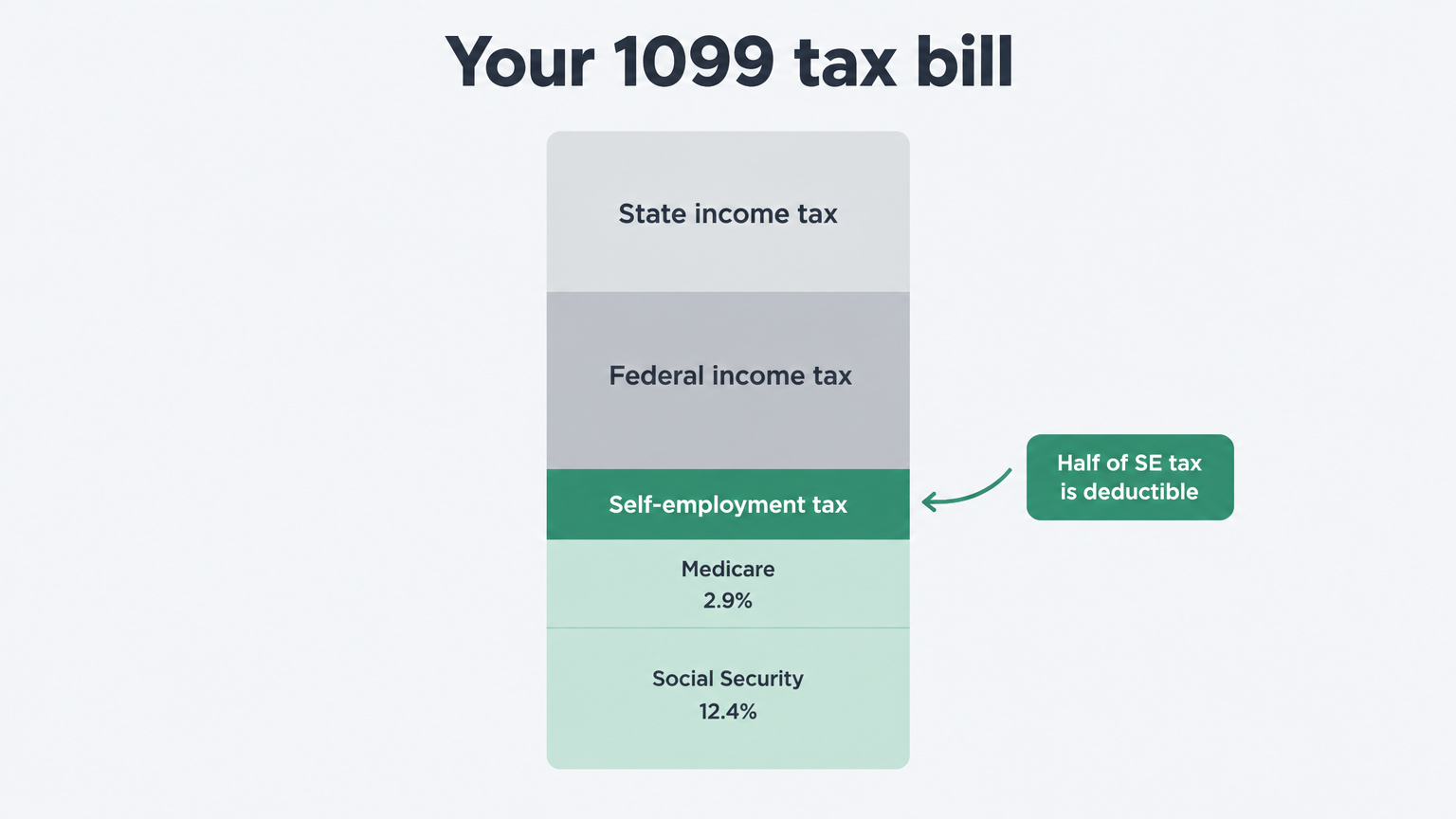
Simplified overview. Self-employment tax generally uses adjusted net earnings, and wage limits, deductions, and additional taxes can affect the calculation.
Self-employment tax generally applies when annual net earnings from self-employment reach $400, including for people already receiving Social Security or Medicare (IRS).
How much should you set aside from each payment?
A reserve percentage can be a useful starting habit, but no single percentage works for every contractor. Estimate tax using projected profit, household income, withholding, credits, state rules, and payments already made, then translate the remaining amount into a practical savings target.
"Rule of thumb as I said above is set aside 33% of all contractor income and pay it quarterly." - r/consulting, confused for taxes
"If you earn more then the year before, set aside 30% of the extra income for tax time." - r/tax, W4 for freelancers
Those figures are an informal starting heuristic, not a verified norm: people quote anywhere from roughly 25% to 33%, and the right share for you depends on your bracket, your state, and how much you have already paid (r/consulting, r/tax). The point is to keep the money out of reach before the deadline arrives, because the most common complaint in those same threads is not the tax itself but the shock of it.
When are quarterly estimated taxes due, and what happens if you miss one?
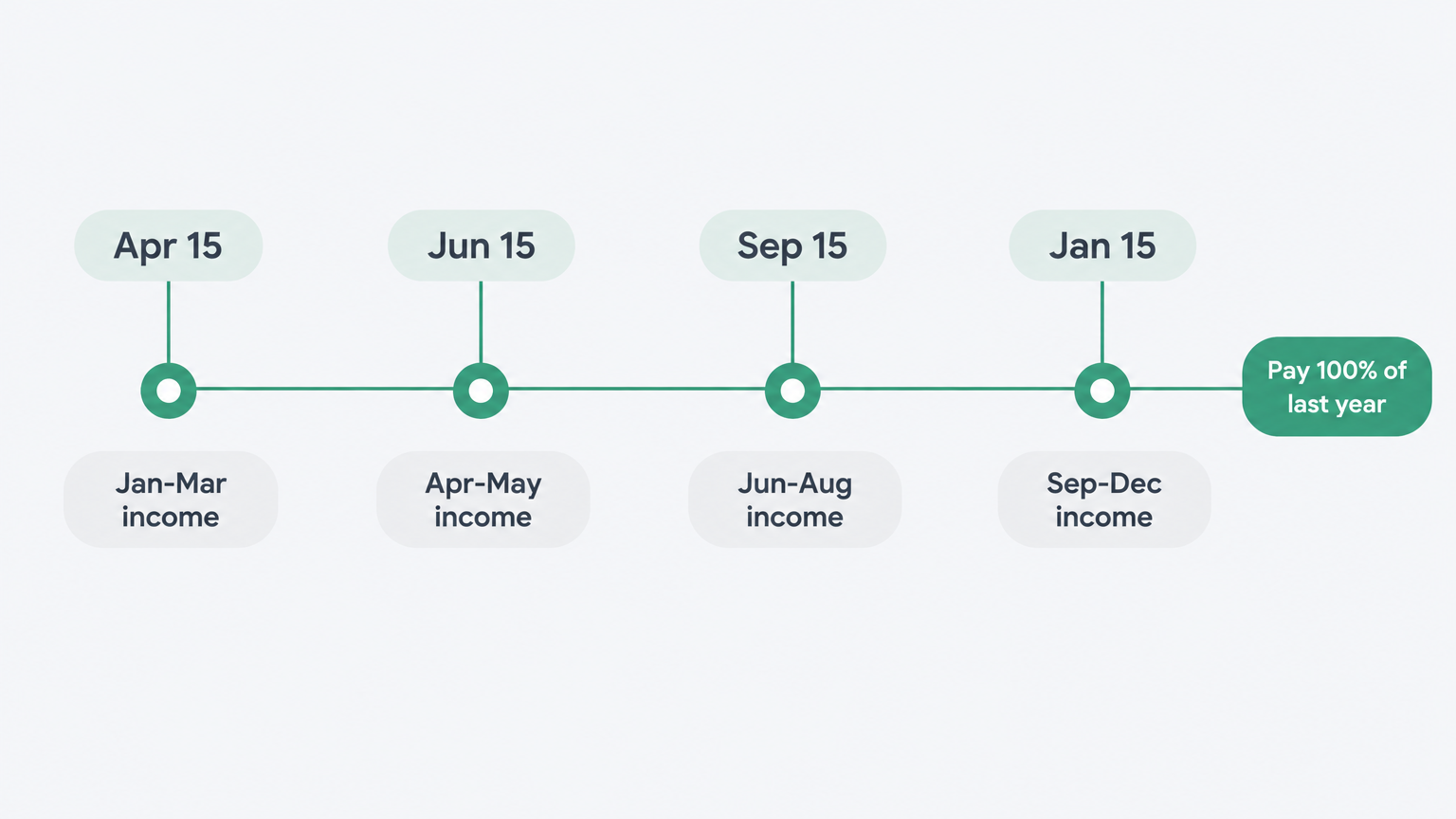
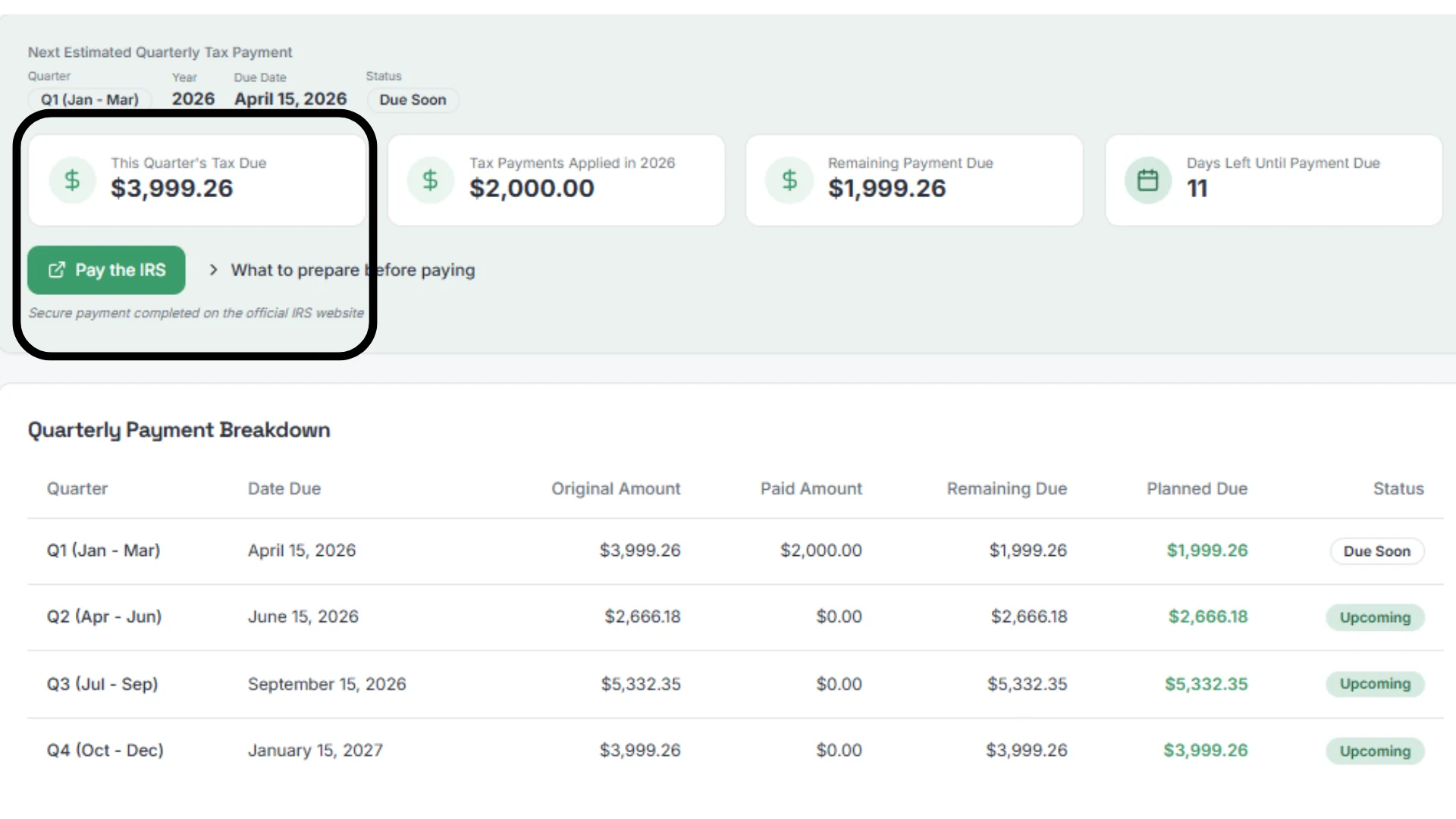
There are four dates, and each one covers a slice of income rather than a tidy calendar quarter. The IRS periods run January 1 to March 31, due April 15; April 1 to May 31, due June 15; June 1 to August 31, due September 15; and September 1 to December 31, due January 15 of the following year (IRS). If a due date falls on a Saturday, Sunday, or legal holiday, the payment is on time if you make it the next business day (IRS). If income is uneven, the annualized-income installment method may better match the required installments to when the income was earned, but it requires the applicable Form 2210 and Schedule AI calculations and records, so it is not the same as simply changing a forecast (IRS).
You generally have to make estimated payments once you expect to owe at least $1,000 in federal tax for the year after withholding and refundable credits, and those amounts will be less than the smaller of: 90% of your current-year tax; or 100% of your prior-year tax, increased to 110% when prior-year adjusted gross income exceeded $150,000, or $75,000 if married filing separately. The prior-year return must cover 12 months (IRS).
Required amounts must also be paid on time through withholding and/or estimated payments. Reaching the annual target late does not necessarily eliminate an underpayment penalty (IRS).
The penalty can land even if you are due a refund when you file, because each period is judged on its own due date (IRS).
Special rules and exceptions can apply, for example to farmers and fishers, certain household employers, certain higher-income taxpayers, and taxpayers whose prior-year return covered less than 12 months (IRS).
How long do you have to keep your records?
The IRS sets the clock by how long the return can still be questioned, and the default is three years.
What counts as a record is broader than a receipt. The IRS points to sales slips, paid bills, invoices, receipts, deposit slips, and canceled checks, and suggests organizing them by year and by type of income or expense (IRS). Electronic records are fine, and "all requirements that apply to hard copy books and records also apply to electronic records" (IRS).
"Keep records for 3 years if situations (4), (5), and (6) below do not apply to you" (IRS).
The window stretches to six years "if you do not report income that you should report, and it is more than 25% of the gross income shown on your return," and to seven years for a claim from worthless securities or a bad debt deduction (IRS).
It never closes if you do not file a return or you file a fraudulent one, and records for property generally run until the period of limitations expires for the year you dispose of it (IRS).
What accounting mistakes cost 1099 workers the most?
Common costly mistakes include missing required payments, losing supporting records, and waiting until filing season to resolve tax questions.
Missing required payments can lead to an underpayment penalty. Whether payments are required, and whether a penalty applies, depends on withholding, payment amounts and timing, safe-harbor rules, and applicable exceptions (IRS).
Losing the record trail creates another problem. One poster in r/Bookkeeping described the end state plainly: "I'm essentially the nightmare client you all complain about: terrible record keeping, shoebox method, behind on tax filings, all of it" (r/Bookkeeping).
Not knowing the vocabulary costs time and money too. A freelancer juggling several 1099s asked the community: "I've been told it might be in my interest to do quarterly taxes instead? I don't even know how to begin with this?" (TurboTax Community).
The pattern behind all three is that the work is small and steady, but the deadline is fixed. Federal income tax is "a pay-as-you-go tax," and you "must pay it as you earn or receive income during the year" (IRS Publication 334).
Do you need an accountant, or is software enough?
Software can handle much of the routine tracking for a straightforward sole proprietorship. Whether you also need professional help depends on your comfort level, record quality, tax situation, and business complexity. It helps to keep the three kinds of software distinct: bookkeeping tools that track income and expenses, planning tools that estimate what you owe, and filing software that produces the return.
You pick an accounting method, cash or accrual, when you file your first return that includes a Schedule C, and changing it later generally needs IRS approval (IRS Publication 334).
Tracking it in software is allowed. The IRS says you may choose any recordkeeping system that clearly shows your income and expenses, and that for most small businesses the business checking account is the main source for entries in the business books (IRS).
Bring in a professional when the picture stops being simple: more than one business, employees, inventory, an S corporation election, a large asset purchase, or a home-office or vehicle split you are unsure about. Publication 334 (IRS Publication 334) covers the extra forms these add, such as Form 4562 for depreciation and Form 8829 for a home office.
This is the gap SnapTax sits in. It is built for a solo contractor, not for an accounting department, and it keeps the monthly routine short: upload a bank statement, review the suggested categories, and check the updated tax projection. The estimate covers federal income tax, self-employment tax, and state tax where supported, so the number moves with your actual year. See SnapTax for how that works.
What free tools can help with independent contractor accounting?
SnapTax has free tools for the questions 1099 workers ask most. You'll find all of them, plus a deduction table and a deadline overview, on our Independent Contractor Accounting page.
1099 Quarterly Tax Estimator: enter your income and expenses to estimate your next quarterly payment, and get optional deadline reminders by email.
1099 Deduction Checklist: a free printable PDF of 47 write-offs, organized by category.
Tax Deadline Calendar: quarterly deadlines, 1099 dates and extension dates you can add to your calendar in one click.
"Am I Overpaying My Quarterly Taxes?" Quiz: seven questions, a personal score, and your top ways to lower your tax bill.
Freelancer Taxpayer Type Assessment: find out which type of 1099 taxpayer you are and get a tip sheet for your situation.
Home Office Deduction Calculator: compare the simplified and regular methods side by side.
Most tools ask for your name and email so we can send you your results. We won't spam you and you can unsubscribe any time!
Try SnapTax
SnapTax is a tax-planning app built by a bookkeeper with more than two decades of experience keeping books for freelancers and independent contractors.
The free plan is a permanent option, not a trial: it gives you a basic quarterly-tax estimate at no cost. Paid plans start at $4.99 per month, and each paid plan includes a 30-day trial; a credit card is required to start a trial. There is no contract, so you can cancel any time (SnapTax). SnapTax provides tax estimates and planning tools; it does not file your tax return.
If you have spent years guessing your quarterly taxes and dreading April, start free at snaptaxapp.com.
Frequently Asked Questions
Do independent contractors have to pay quarterly taxes?
Not always. You generally need federal estimated payments if you expect to owe at least $1,000 after withholding and refundable credits, and those amounts will not meet the applicable current-year or prior-year payment benchmark. Sufficient withholding can eliminate the need for separate estimated payments. When payments are required, timing matters.
What forms does a 1099 worker file?
A sole proprietor generally reports business income and expenses on Schedule C with the individual Form 1040 return and uses Schedule SE when required to calculate self-employment tax. Form 1040-ES provides estimated-tax worksheets and payment vouchers; paying electronically generally does not require mailing a voucher. Other forms may apply to deductions, credits, or particular business activities.
How much should I set aside for taxes as a 1099 worker?
There is no universal percentage. Base your savings target on projected business profit, household income, federal and applicable state taxes, withholding, credits, and payments already made. A percentage of incoming payments can be a convenient savings habit, but check it against an updated tax projection.
How long should I keep records as an independent contractor?
The default is three years. The window stretches to six years if you underreport income by more than 25%, to seven years for a claim from worthless securities or a bad debt deduction, and never closes if you do not file a return or file a fraudulent one.
Do I need an accountant if I am an independent contractor?
Not necessarily. Software can help with routine bookkeeping, planning, and (when using a separate filing product) return preparation. Professional help can be useful when records need cleanup, the business becomes more complex, or you are uncertain about a tax position. SnapTax provides bookkeeping and planning tools; SnapTax exports to TurboTax for filings, but it does not file the actual returns.
What is the self-employment tax rate for 2026?
The regular combined rate is 15.3%: 12.4% for Social Security and 2.9% for Medicare. Under the regular method, the calculation generally starts with 92.35% of net business profit. For 2026, the Social Security portion is limited by the $184,500 combined covered-earnings ceiling, including applicable wages. Additional Medicare Tax can apply at higher incomes.
