Q4 Estimated Tax Payment for Freelancers: What to Pay by January 15
Crystal Harrison · November 26, 2026 · 11 min read
Last updated:
Q4 Estimated Tax Payment for Freelancers: What to Pay by January 15
The Q4 estimated tax payment for freelancers is due January 15. Here's how to calculate what you owe from your actual 2026 income, and how to avoid an underpayment penalty.
November 26, 2026 · 9 min read
By the SnapTax Team · 9 min read
Quick Answer: When is the Q4 estimated tax payment due for freelancers?
The Q4 estimated tax payment for freelancers is due January 15, 2027, generally covering income earned from September 1 through December 31, 2026. You generally need to make it if you expect to owe at least $1,000 for 2026 after withholding and refundable credits, and those amounts fall short of the safe-harbor target. Base the amount on your projected full-year 2026 profit at your estimated rate, minus what you have already paid.
TL;DR
The Q4 deadline is January 15, 2027, for income earned September 1 through December 31, 2026. It is the last installment of the 2026 tax year.
You are required to pay if you expect to owe $1,000 or more in tax after withholding and credits, and your withholding and credits fall short of 90% of this year's tax or 100% of last year's.
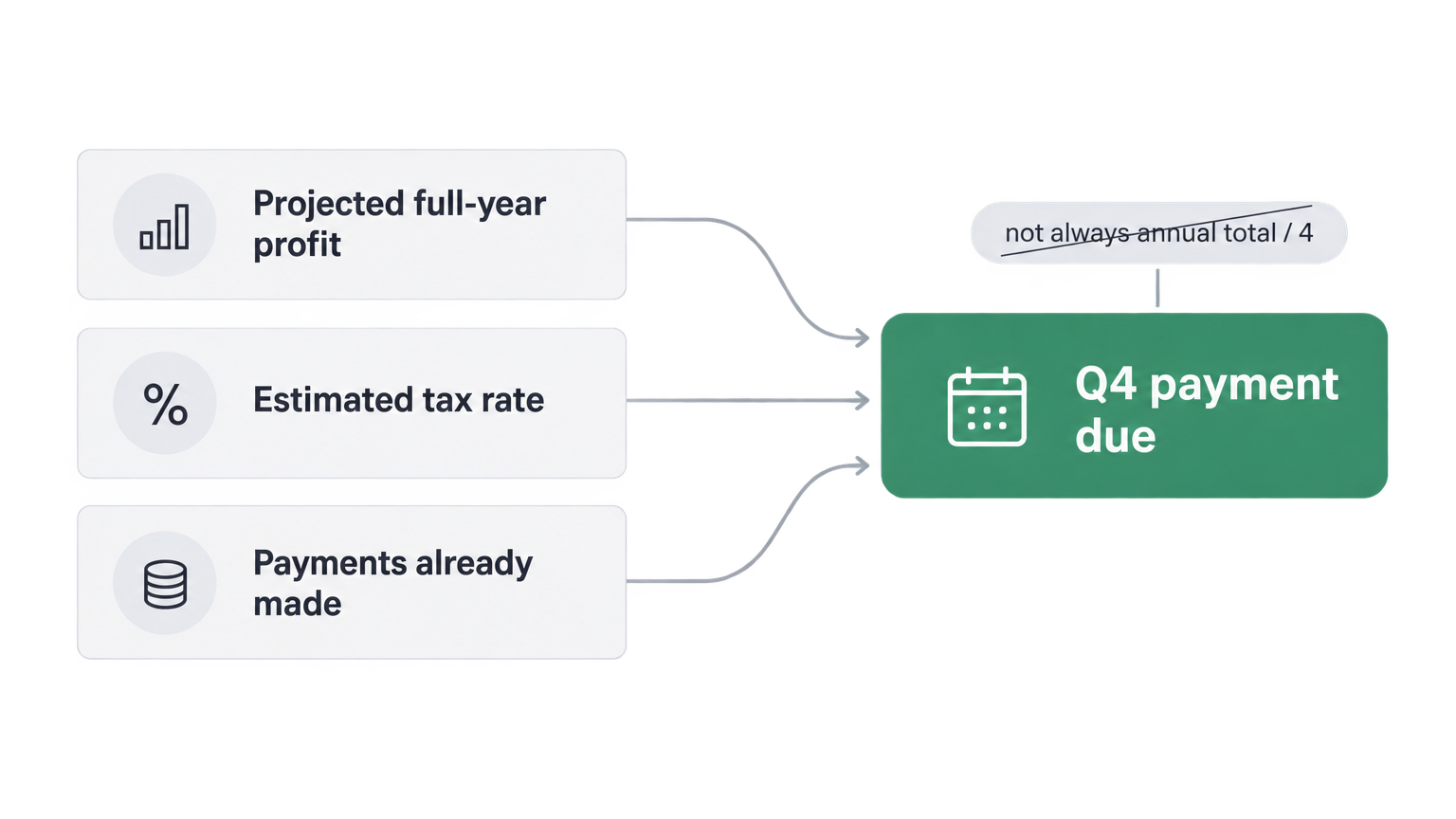
The Q4 amount is not automatically your annual total divided by four. It is your projected full-year profit at your estimated rate, minus what you have already paid.
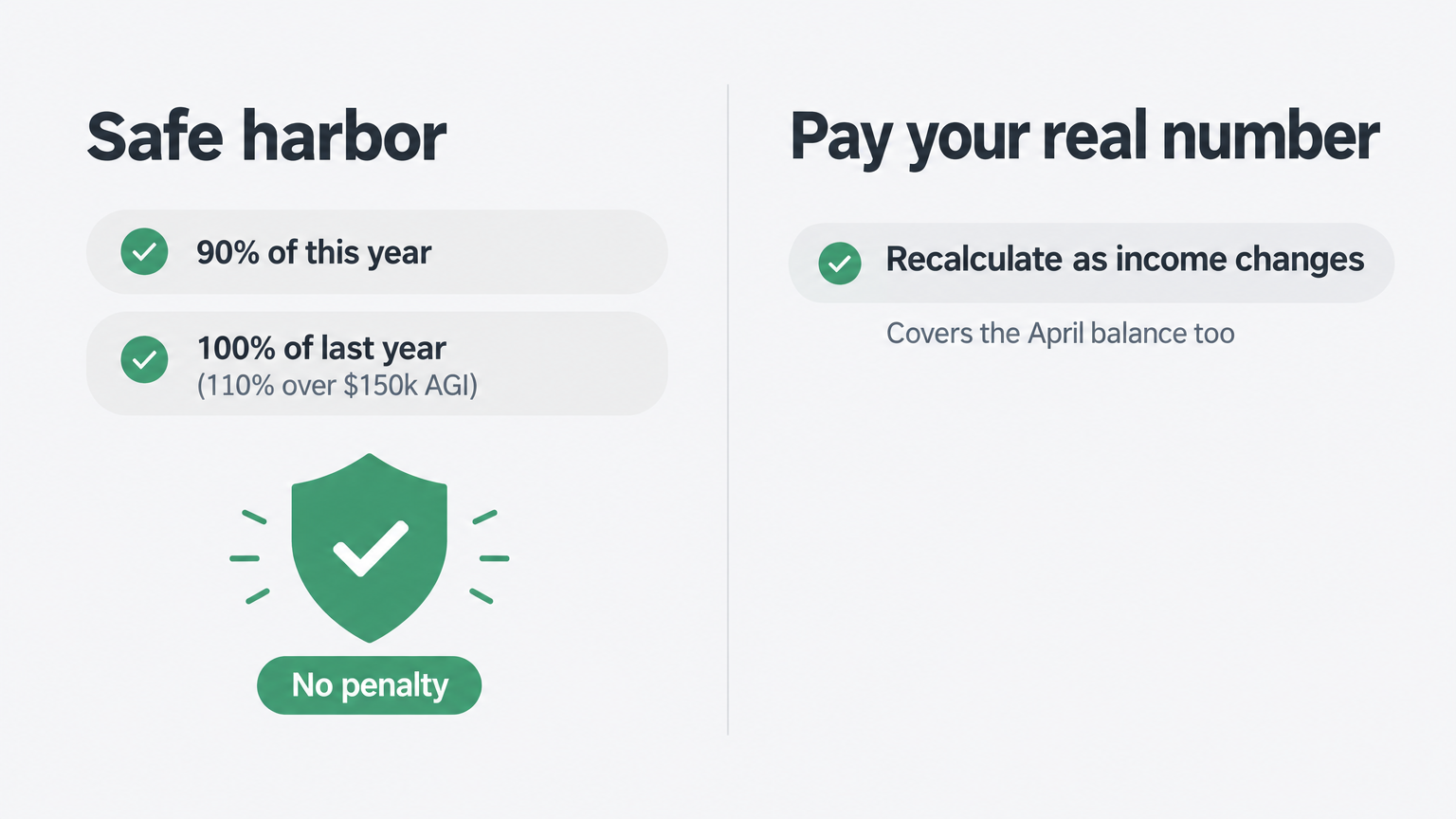
Safe harbor (90% of this year, or 100%/110% of last year) protects you from the underpayment penalty, but it does not cover the balance if your income grew.
The penalty is figured per payment period and can apply even if you are owed a refund, so a large January payment does not wipe out an earlier-quarter shortfall.
When is the Q4 estimated tax payment due in 2027?
The Q4 estimated tax payment for the 2026 tax year is due January 15, 2027. That installment generally covers income earned from September 1 through December 31, 2026, according to the 2026 due-date table in IRS Publication 505. January 15, 2027 is a Friday, so no weekend adjustment applies this year; when a due date falls on a Saturday, Sunday or legal holiday, the IRS moves it to the next business day, per Publication 505.
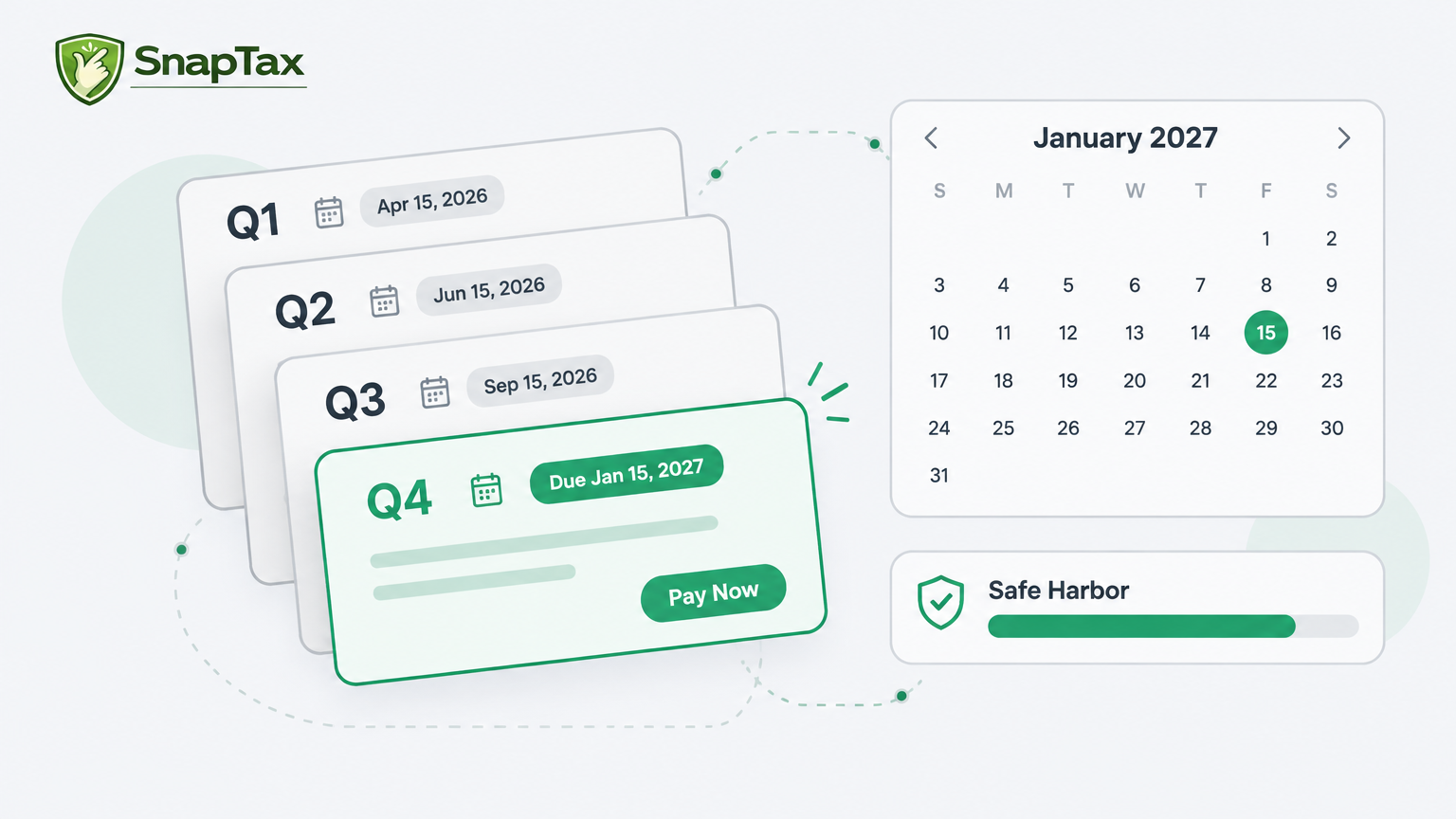
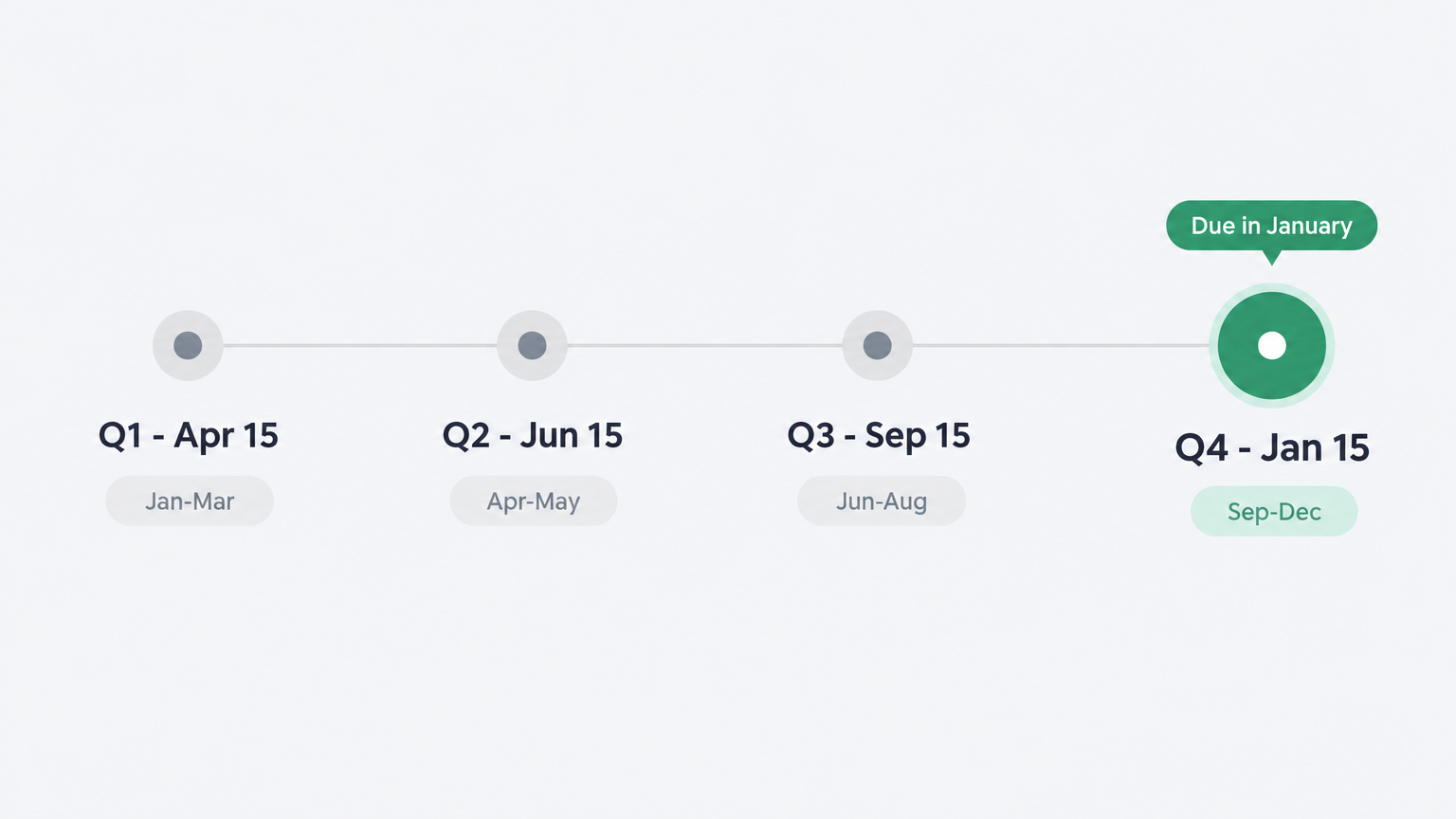
Q4 is the odd one out. It is the only 2026 installment due in the following calendar year, which is exactly why it catches freelancers off guard after the holidays. Here is the full 2026 schedule:
Quarter | Income period | Payment due |
|---|---|---|
Q1 | January 1 - March 31, 2026 | April 15, 2026 |
Q2 | April 1 - May 31, 2026 | June 15, 2026 |
Q3 | June 1 - August 31, 2026 | September 15, 2026 |
Q4 | September 1 - December 31, 2026 | January 15, 2027 |
Notice that the second period covers only two months and the fourth covers four. That is how the IRS structures its payment periods, not a mistake, per Publication 505. SnapTax keeps all four dates, with a countdown to the next one, on its quarterly tax deadlines page.
This article covers federal estimated tax. Many states have their own estimated-payment rules and due dates, so check your state's schedule.
You can pay online, by phone or from the IRS app, or mail a payment with a Form 1040-ES voucher, per the IRS estimated taxes page. If you mail it, the U.S. postmark date is your payment date (Publication 505).
Who has to make a Q4 estimated tax payment?
You have to make a Q4 payment if you expect to owe at least $1,000 in tax for 2026 after subtracting your withholding and refundable credits, and your withholding and credits come in under the smaller of two targets. Both tests come from Publication 505 and the IRS estimated tax FAQ:
You expect to owe $1,000 or more in tax for 2026 after subtracting your withholding and refundable credits, and
Your withholding and refundable credits are less than the smaller of:
90% of the tax you will show on your 2026 return, or
100% of the tax you showed on your 2025 return.
If your 2025 adjusted gross income was more than $150,000 ($75,000 if you file married filing separately), swap 110% for the 100% figure, per Publication 505.
Freelancers and 1099 contractors are the classic case because nothing is withheld from their pay. A W-2 employee can usually sidestep estimated tax by asking their employer to withhold more using a new Form W-4, but when you work for yourself there is no paycheck to withhold from.
For a quick read on your own situation, this is how the rule sorts out, per Publication 505:
If this matches you | Estimated tax required? |
|---|---|
Self-employed or 1099 with no withholding, expecting to owe $1,000 or more after credits | Generally yes |
W-2 employee whose withholding already covers the target | Usually no |
No tax liability for 2025, a U.S. citizen or resident all year, and a prior year that covered 12 months | No |
The last row is a full exemption. It applies when your 2025 total tax was zero (or you did not have to file a return), you were a U.S. citizen or resident for the whole year, and your 2025 tax year covered 12 months, per Publication 505. That "no tax liability" test looks at total tax, not just what you owed at filing, so a year where withholding covered everything still counts.
How do you work out the Q4 estimated tax payment?
You work out the Q4 payment from your projected 2026 tax minus what you have already paid through withholding and earlier installments, figured from your real numbers rather than a flat quarter of your annual total. The IRS approach starts by estimating your adjusted gross income, taxable income, deductions and credits for the year, then adding self-employment tax and other taxes and subtracting your credit amounts, per Publication 505.
Form 1040-ES's basic method does divide the annual figure by four, but the IRS intends it for income that stays roughly level through the year (Publication 505). Most freelancers' income is not. When income, deductions or credits change, Publication 505 tells you to refigure your estimated tax and pay the unpaid balance by the next due date, using its amended worksheet.
So instead of a fixed split, three moving inputs set the Q4 number:
Your projected full-year net profit for 2026: revenue minus deductible business expenses.
Your estimated tax rate, based on your filing status and projected annual income. This covers income tax and self-employment tax, which is 15.3% of net earnings (SnapTax's self-employment tax guide).
The payments already made: withholding plus the first three installments.
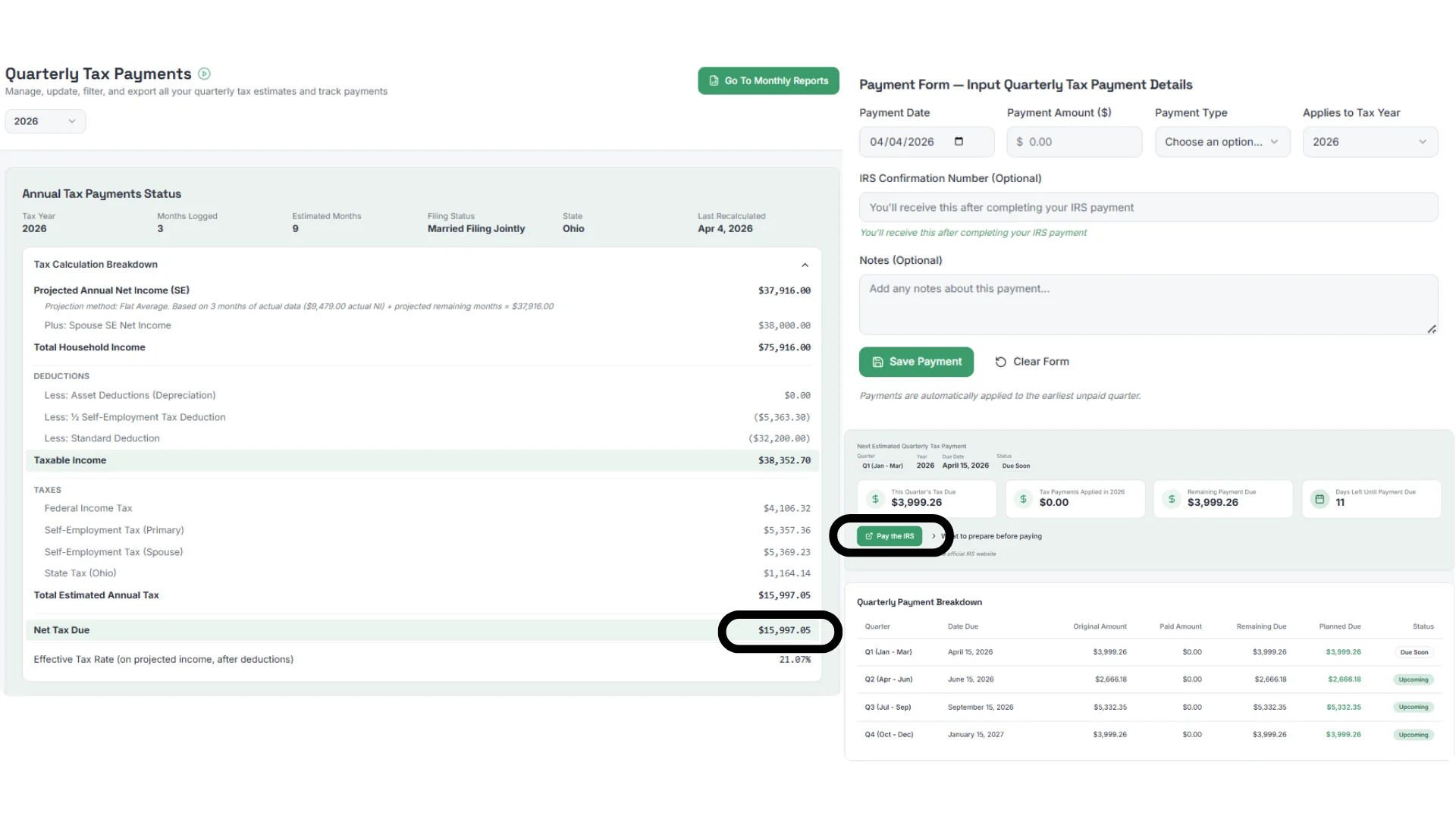
Subtract the third from the product of the first two and you have your Q4 balance. Here is one illustrative calculation (the numbers are examples only, not a rule). Project $80,000 of net profit. Self-employment tax is figured on 92.35% of net profit, about $73,880 (Publication 505), and income tax is added on top. If that puts your total 2026 tax near $19,000 and you have already paid $13,000, your Q4 payment is about $6,000. That number moves every time a new invoice lands or a deduction gets logged, which is why an estimate set in January goes stale long before Q4. SnapTax runs the same logic with Flat, Growth or Seasonal projection methods and recalculates the estimate as your income changes (see SnapTax pricing).
What is safe harbor, and how do you use it for Q4?
A safe harbor is a payment target that keeps you out of the underpayment penalty even if you end up owing more when you file. If you pay at least 90% of your 2026 tax, or 100% of your 2025 tax, whichever is smaller, you are protected, per Publication 505. If your 2025 adjusted gross income was over $150,000 ($75,000 married filing separately), the prior-year figure rises to 110%.
The catch most people miss: safe harbor protects you from the penalty, not from a bill. If you simply repeat last year's number and your income grew, you avoid the penalty but still owe the difference in April. And you cannot repair an earlier quarter with a big January payment, because the penalty is figured separately for each installment (Form 2210 instructions).
One shortcut applies to Q4 alone. If you file your 2026 return by February 1, 2027 and pay the entire balance due with it, you do not have to make the January 15 payment. Early filing treats the fourth installment as paid on time, but any penalty for earlier missed installments can still apply (2026 Form 1040-ES instructions).
What happens if you miss January 15 or underpay?
If you do not pay enough by a period's due date, the IRS charges a penalty on the amount you underpaid, and it can apply even if you are due a refund when you file, per the IRS estimated tax FAQ. The IRS figures the penalty for each installment period at an interest rate that is set quarterly.
A few practical moves, each grounded in IRS guidance:
Pay what you can as soon as you can. The amount the interest runs on shrinks with every payment you make (Publication 505).
If your income arrived unevenly, the annualized income installment method (Schedule AI) can size each installment to what you had actually earned by then. You must file Form 2210 to use it.
In certain situations, such as a casualty or disaster, or retiring at age 62 or older or becoming disabled, you can request a waiver (IRS estimated taxes page).
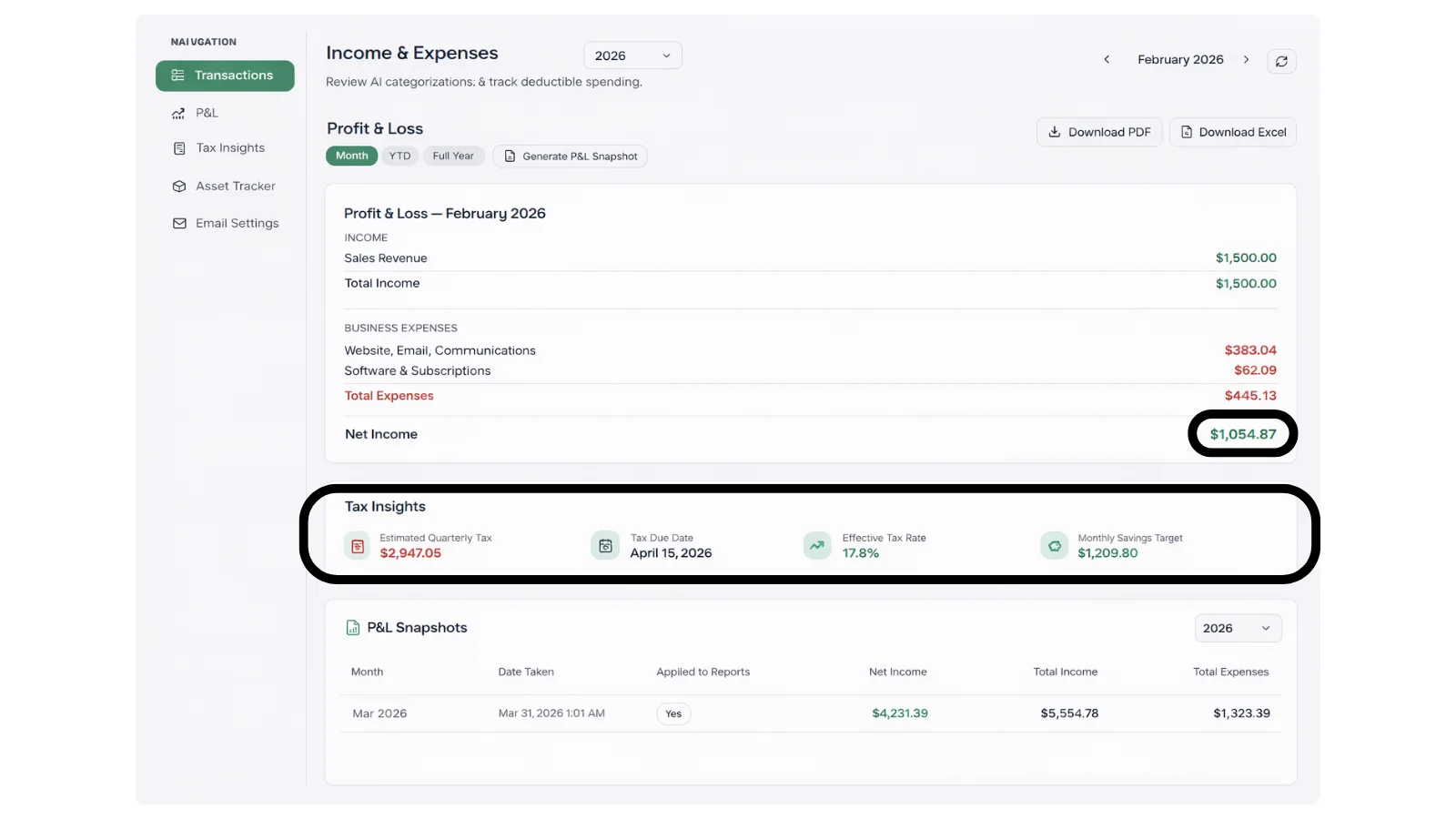
Keeping the remaining quarters current is the part that stops a one-off miss from becoming a pattern. SnapTax shows the current quarter's estimate, its due date, your effective rate and the monthly amount to set aside, so a correction is visible before the next deadline rather than at filing time.
The mistake to avoid is assuming a strong Q4 payment will cover a weak Q2. It will not, because each period is scored on its own (Form 2210 instructions). If you have already missed an earlier quarter, get the remaining ones right rather than trying to erase the past one.
SnapTax for your Q4 estimated payment
SnapTax recalculates your estimated tax as you add income, per SnapTax's real-time quarterly tax tracking, so the Q4 figure reflects the year you actually had rather than a January guess. It works the number from your income, deductible expenses, filing status and federal and state rates, minus the payments you have already logged, and it tracks your safe harbor position.
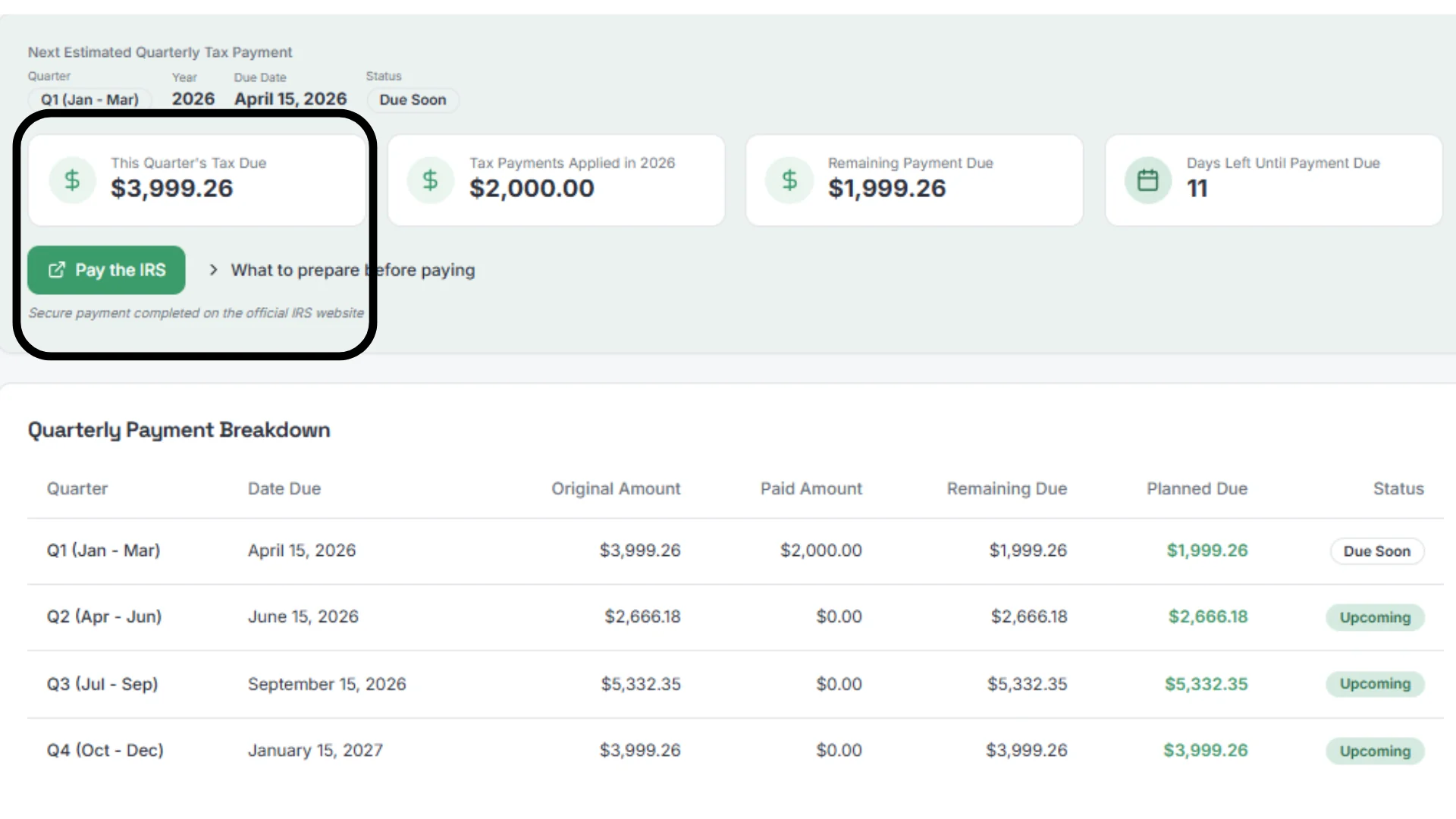
Payments you log are applied to the earliest unpaid quarter, and the free plan gives you quarterly tax estimates for all four quarters at no cost. Paid plans start at $4.99/mo for Starter and $19.99/mo for Builder, each with a 30-day trial, and you can cancel anytime (SnapTax pricing). SnapTax provides tax estimates and planning tools; it does not file your tax return.
Not sure of your number yet? The free 1099 tax calculator gives you a quarterly estimate in seconds.
Frequently Asked Questions
When is the Q4 estimated tax payment due for freelancers?
The Q4 estimated tax payment for freelancers is due January 15, 2027, and it generally covers income earned from September 1 through December 31, 2026. For the 2026 tax year the full schedule is April 15, June 15, September 15, and January 15, 2027. See the IRS due-date table in Publication 505.
How much should a freelancer pay for the Q4 estimated tax installment?
There is no standard Q4 figure. It is your projected 2026 tax minus the withholding and earlier installments you have already paid, worked out from your projected full-year profit and estimated tax rate. SnapTax recalculates the estimate as you add income, so you are not guessing from a January number.
Can I skip the January 15 estimated tax payment?
Yes, in one case. If you file your 2026 return by February 1, 2027 and pay the entire balance due with it, you do not have to make the January 15 payment, because early filing treats the fourth installment as paid on time. Any penalty for earlier missed installments can still apply. The rule is in the 2026 Form 1040-ES instructions.
Do freelancers have to pay quarterly taxes if they expect to owe less than $1,000?
Generally no. You have to make estimated payments only if you expect to owe at least $1,000 in tax for the year after subtracting your withholding and refundable credits. The exact tests are set out in the IRS estimated tax FAQ.
What is the safe harbor for Q4 estimated taxes?
Safe harbor means paying at least 90% of this year's tax or 100% of last year's tax, whichever is smaller, which protects you from the underpayment penalty. If your prior-year adjusted gross income was over $150,000 ($75,000 if married filing separately), the prior-year figure rises to 110%. The rules are in Publication 505.
What happens if I miss the January 15 estimated tax deadline?
The IRS charges a penalty on the amount you underpaid, for each installment period, and it can apply even if you are due a refund when you file. Pay what you can right away, and if your income arrived unevenly you can use the annualized income installment method on Form 2210.
