Roth Conversion Planning for Freelancers: Should You Convert Before RMDs?
Crystal Harrison · September 24, 2026 · 17 min read
Roth Conversion Planning for Freelancers: Should You Convert Before RMDs?
Freelancers have a Roth conversion window every slow year - not just in retirement. Here's how to decide whether to convert before RMDs start, and how much.
September 21, 2026 · 11 min read
TL;DR
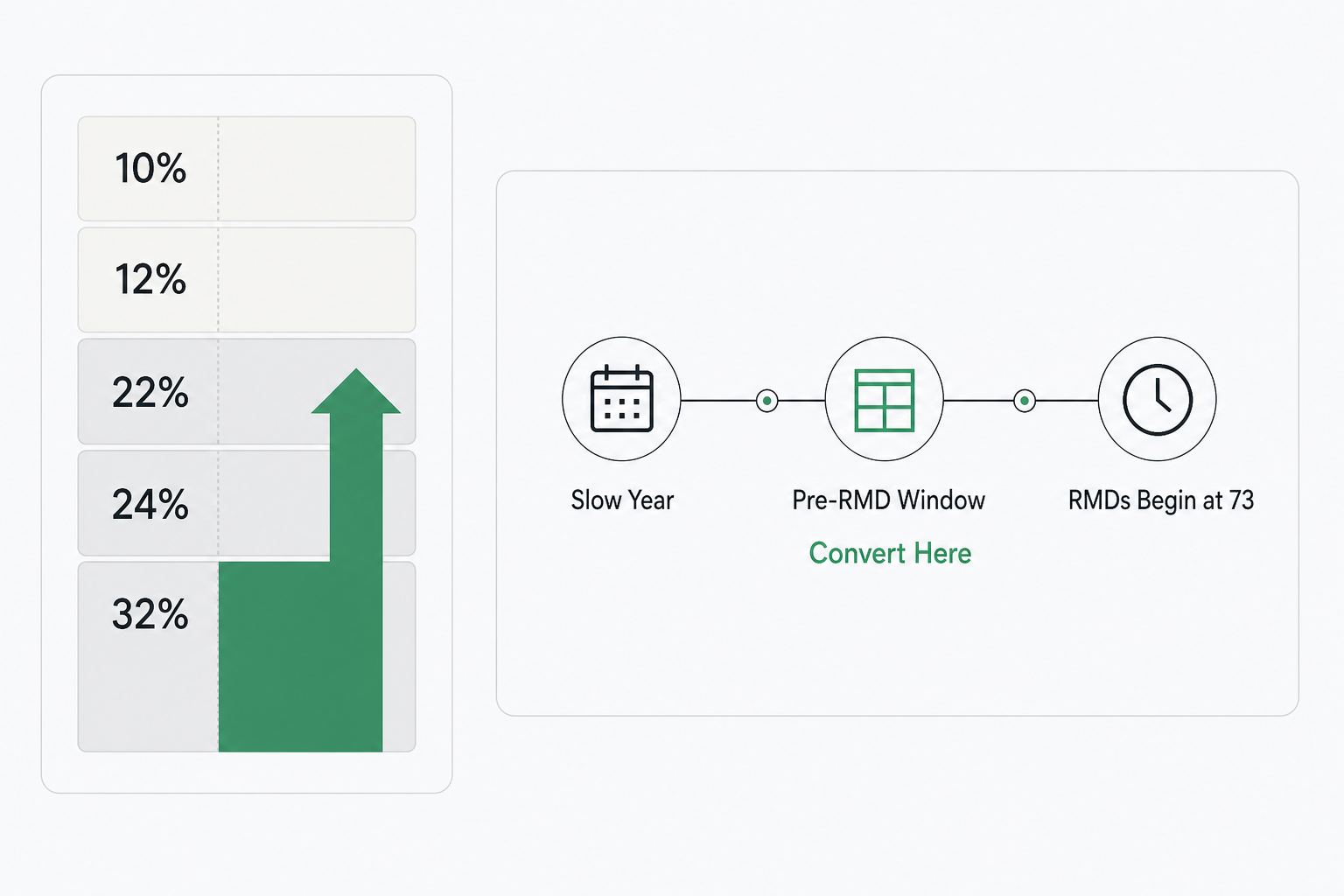
Roth conversion planning for freelancers is different from W-2 workers in one important way: variable income creates a natural conversion window every slow year, not just in retirement. A slow-income year can create room to consider a Roth conversion at a lower current tax rate. Whether it makes sense depends on your expected future tax rate, cash available to pay the tax, Medicare or ACA thresholds, state tax, and the rest of your return. The key facts for 2026: RMDs begin at age 73 (born 1951-1959, with a potential edge case for 1959 - see below) or 75 (born 1960+), Roth IRAs have no RMDs during the owner's lifetime, and the RMD must be satisfied before any conversion in the same year. The OBBBA made TCJA tax brackets permanent, so the urgency has shifted from "rates will go up" to "my future RMD bracket will be higher than my slow-year bracket right now." SnapTax Optimizer is designed to model a conversion scenario using the information you enter and show its potential effect on projected annual tax, taxable income, and projected remaining estimated-tax payments.
W-2 employees have one Roth conversion window: the years between retirement and RMDs. Freelancers have a new window every slow year. Any year income drops significantly is a natural conversion opportunity that W-2 workers never get.
The question isn't whether Roth conversions are right for every freelancer - they aren't. The question is whether they make sense for your situation: how much to convert, in which year, and how to see the bracket impact before you act.
SnapTax Optimizer's planned Roth Conversion Planner is designed to model a conversion scenario using the information you enter and show its potential effect on projected annual tax, taxable income, and projected remaining estimated-tax payments - before you transfer a dollar.
What makes Roth conversion planning different for freelancers vs W-2 employees?
Freelance income can be more variable than salary income, which may create more frequent low-income conversion opportunities. But W-2 employees can also have lower-income years or other planning windows.
A freelancer's income swings with client volume, project cycles, and market conditions. A slow year naturally drops their bracket - and that's one type of conversion window.
A freelancer earning $90,000 most years who has a $55,000 year is briefly in the 22% bracket instead of the 24%.
That gap is real conversion room at a known, lower rate.
Freelancers may encounter this window more frequently than salaried workers, though it isn't guaranteed.
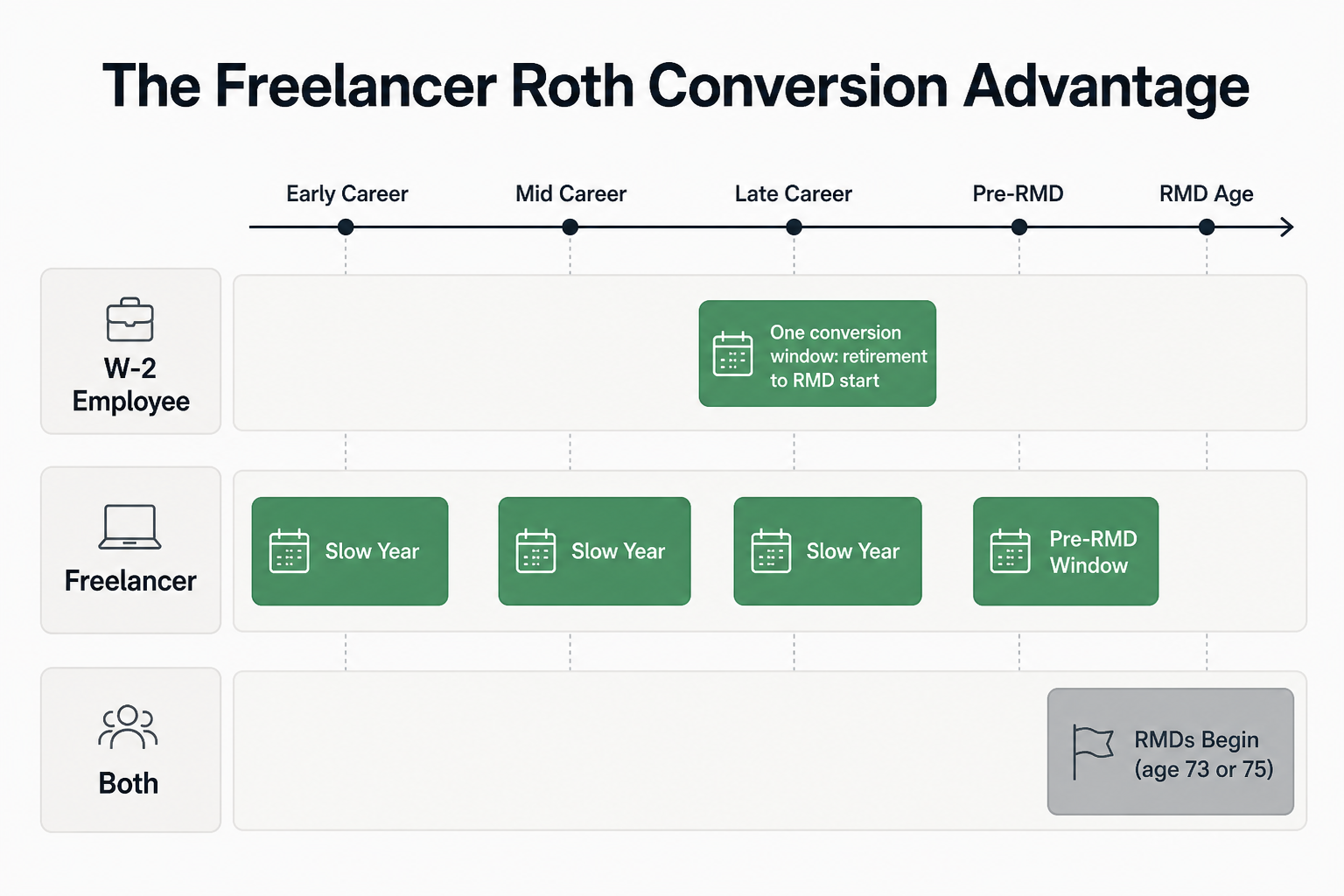
The One Big Beautiful Bill Act (OBBBA) made the TCJA tax brackets permanent in 2026. The "convert before rates go up" urgency has changed. The argument for converting before RMDs start remains fully intact - because your personal bracket when RMDs arrive may be higher than your slow years today.
What is the RMD problem that makes pre-conversion worth considering?
Pre-tax retirement balances trigger mandatory taxable withdrawals starting at age 73 or 75. Roth accounts have no such requirement during the owner's lifetime.
The IRS requires minimum distributions from traditional IRAs, SEP-IRAs, and pre-tax Solo 401(k) balances once you reach a certain age:
If you were born between 1951 and 1958, RMDs begin at age 73.
If you were born in 1959, your RMD start age may be 73 or 75 - the SECURE 2.0 legislation contains an ambiguity for this birth year. Consult a tax professional or check the most current IRS guidance before relying on either age.
If you were born in 1960 or later, RMDs begin at age 75, per SECURE 2.0.
Roth IRAs have no RMDs during the original owner's lifetime. Only inherited Roth IRAs carry RMDs for beneficiaries.
RMDs are calculated using the IRS Uniform Lifetime Table. The amount increases each year as your remaining life expectancy shortens. A $600,000 IRA balance at age 75 produces roughly a $24,400 RMD in year one ($600,000 ÷ 24.6, using the IRS Uniform Lifetime Table distribution period for age 75) - and that number grows as the distribution period shortens each year.
The problem compounds when RMDs stack on top of other income. Social Security payments, freelance income that continues part-time, and capital gains can push a retiree into a higher bracket than expected. IRMAA surcharges add further pressure: Medicare Part B and D premiums increase in steps once modified adjusted gross income exceeds certain thresholds (currently published annually by CMS and SSA). A large pre-tax balance that generates forced distributions can quietly push a retiree across one of those thresholds, triggering meaningfully higher Medicare costs. Check the current year's IRMAA thresholds directly from Medicare.gov or your SSA notice, as the figures adjust annually for inflation.
When is the optimal Roth conversion window for a freelancer?
The optimal window is any year when Schedule C net income is significantly lower than your typical earning years. The goal is to convert before the balance grows large enough to create forced RMDs in a higher bracket later.
Fourthought's analysis of the pre-RMD window identifies three specific scenarios where the conversion math works best:
Slow revenue year. A project gap, a lost contract, or a deliberate sabbatical can drop net income by $20,000 to $40,000. That shift alone may move you one full bracket down. That's room to convert without a meaningful rate penalty.
Year of large deductions. A maxed-out SEP-IRA contribution (up to $72,000 in 2026) paired with the QBI deduction (up to 20% of qualified business income under §199A) and a home office deduction using the actual method can dramatically reduce taxable income. Important caveat: a deductible SEP-IRA contribution can reduce taxable income and may reduce qualified business income for purposes of the Section 199A calculation. It does not reduce self-employment tax. Model the contribution and QBI together rather than assuming deductions compound independently.
Year before RMDs begin. The final years before your RMD start age are the last chance to reduce your pre-tax balance without mandatory distributions competing for space. Every dollar converted in those years is a dollar that won't generate a forced, potentially higher-bracket distribution later.
The pre-RMD years are often especially attractive because the full distribution amount can be considered for conversion. After RMDs begin, you must take the RMD first, but you may still convert additional eligible amounts if doing so fits your plan.
How much should a freelancer convert in any given year?
A common approach is to convert enough to fill part or all of a chosen tax bracket. But do not use bracket thresholds alone - check Medicare IRMAA, ACA premium-tax-credit rules, capital-gain rate thresholds, state tax, credits, cash available to pay the tax, and your expected future tax rate before deciding on an amount.
The bracket-fill strategy starts here: estimate your taxable income before any conversion and compare it to the 2026 bracket thresholds.
2026 federal income tax brackets for single filers (Tax Foundation):
Tax Rate | Taxable Income |
|---|---|
10% | $0 to $12,400 |
12% | $12,401 to $50,400 |
22% | $50,401 to $105,700 |
24% | $105,701 to $201,775 |
32% | $201,776 to $256,225 |
35% | $256,226 to $640,600 |
37% | $640,601 or more |
2026 federal income tax brackets for married filing jointly (Tax Foundation):
Tax Rate | Taxable Income |
|---|---|
10% | $0 to $24,800 |
12% | $24,801 to $100,800 |
22% | $100,801 to $211,400 |
24% | $211,401 to $403,550 |
32% | $403,551 to $512,450 |
35% | $512,451 to $768,700 |
37% | $768,701 or more |
The bracket-fill calculation follows this structure: estimate adjusted gross income first by including business income and other income, then subtract allowable adjustments such as the deductible part of self-employment tax, eligible retirement contributions, and self-employed health insurance. Next subtract the standard or itemized deduction. Then calculate the QBI deduction if eligible, since its limit depends on taxable income before the QBI deduction and net capital gain. Finally, add the proposed Roth conversion amount and compare the resulting taxable income with the bracket thresholds above. That comparison shows your current bracket and how much room remains before the next rate kicks in.
One critical rule that most freelancers miss: If you are already subject to RMDs in a given year, you must satisfy the full RMD before converting anything. Per IRS guidance and confirmed by multiple financial planning sources, RMD dollars are not eligible for rollover or conversion. The RMD comes out as a taxable distribution first - only the remaining balance can be converted.
How does a Roth conversion affect quarterly estimated taxes for freelancers?
The converted amount is added to ordinary income in the year of conversion. That increases your quarterly tax liability and must be reflected in estimated payments.
The IRS treats Roth conversion income the same as any other ordinary income. It counts toward your total taxable income for the year, raises your effective tax rate, and increases what you owe by each quarterly deadline.
Here is the piece most freelancers miss: a $30,000 conversion completed in August adds to your total income recognized in that year. Whether you need to adjust a specific quarterly payment depends on which safe harbor method you are using. Under the annualized income installment method, you report income as it is actually earned each quarter - so a mid-year conversion would affect the relevant installment. Under the prior-year safe harbor (paying 100% or 110% of last year's tax, depending on income), your penalty exposure may be limited even without adjusting. If you made your Q1 and Q2 estimates based only on Schedule C income and are not relying on a safe harbor, converting mid-year without revisiting your estimates can result in an underpayment penalty. Consult Form 2210 or a tax professional to determine which method applies to your situation.
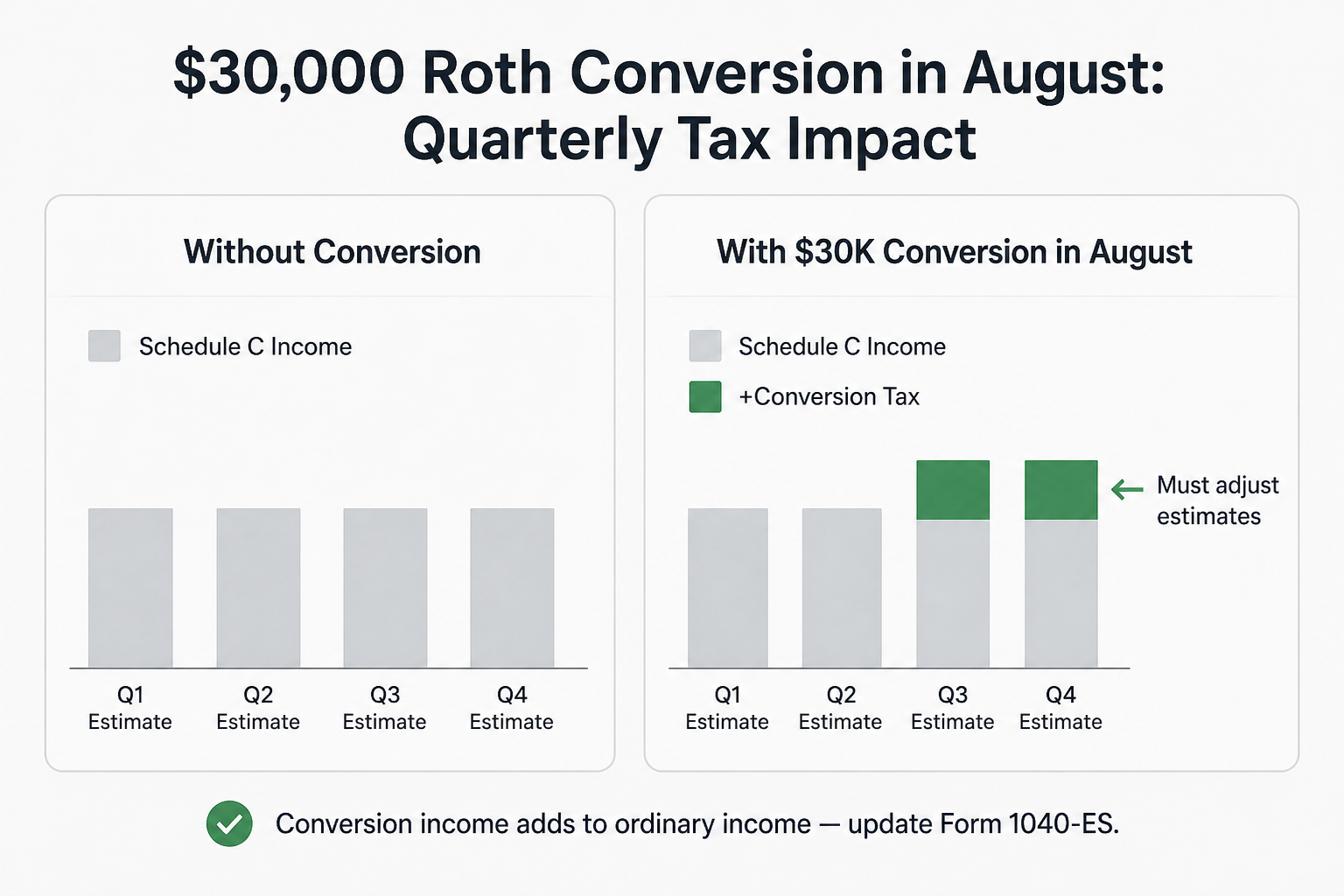
The practical fix is to model the conversion before you execute it - not after. Add the conversion amount to your year-to-date Schedule C income, recalculate your total taxable income, and determine whether your estimated payments need to be adjusted using Form 1040-ES and Form 2210 (underpayment of estimated tax). The specific deadlines and methods that minimize penalty exposure depend on which safe harbor approach you use.
On paying the tax bill: most financial planners recommend paying the tax from non-retirement funds if you can, so the full converted amount moves into the Roth and compounds tax-free. If you elect to have taxes withheld from the conversion amount instead, that withheld portion is still counted as a taxable distribution in the current year - it just goes to the IRS rather than to the Roth account. And if you are under 59½, withholding from the conversion may also trigger the 10% early distribution penalty on that withheld portion. Either approach is technically permitted; the math generally favors paying from outside funds when available.
SEP-IRA vs Solo 401(k) - which is better for Roth conversion planning?
Solo 401(k) offers more flexibility. Under SECURE 2.0 Section 604, employer profit-sharing contributions to a Solo 401(k) can now be designated as Roth at contribution time - but this requires your plan document to support it and your Solo 401(k) provider to have implemented the feature. Not all providers have updated their plans. Verify with your provider before assuming this option is available. When it is, designating employer contributions as Roth at contribution time reduces the pre-tax balance that would otherwise require conversion later.
Feature | SEP-IRA | Solo 401(k) |
|---|---|---|
2026 contribution limit | Up to $72,000 (25% of W-2 or ~20% of net SE income) | Up to $72,000 combined (employee deferral up to the annual IRS limit + employer profit-sharing; verify current deferral limits at IRS.gov) |
Roth employer contributions | Roth SEP contributions may be permitted under SECURE 2.0 Section 601 for certain plan types - confirm with your IRA custodian, as availability varies | Allowed under SECURE 2.0 Section 604 (effective 2024), subject to your plan document and provider support |
Direct Roth contributions at contribution time | Potentially available depending on custodian; historically all contributions were pre-tax | Yes - employee deferrals and employer profit-sharing can both be designated Roth if your plan document and provider support it; if permitted, Roth employer contributions are generally included in taxable income when contributed |
Conversion mechanics | Must convert through Roth IRA; pro-rata rule applies to all IRAs | May allow in-plan Roth conversion or Roth contribution features, depending on the plan document and provider; pro-rata rule limited to plan assets only |
RMD treatment | Pre-tax balances subject to RMDs at 73 or 75 | Pre-tax balances subject to RMDs; Roth Solo 401(k) exempt from lifetime RMDs post-2024 under SECURE 2.0 |
Age 50+ catch-up | Not available | Age-50-plus catch-up contributions may be available; SECURE 2.0 includes a special higher catch-up for certain ages - verify the current IRS limit and any age-based special catch-up amount at IRS.gov |
Administration complexity | Minimal - no annual IRS filing required | Moderate - Form 5500-EZ required when plan assets exceed $250,000 |
The SEP-IRA is simpler to set up and administer. It is the right choice for freelancers who want to minimize paperwork.
But if your goal is Roth conversion planning, the Solo 401(k) offers meaningful advantages. The ability to designate employer profit-sharing as Roth at contribution time (where the plan supports it) means you can build a Roth balance without ever needing to convert. The pro-rata rule is also more favorable: when you convert a SEP-IRA or traditional IRA, the IRS aggregates all your traditional IRA, SEP-IRA, and SIMPLE IRA balances to calculate the taxable portion - so even if you only convert one account, the pre-tax money in all your IRAs factors into the tax calculation. A Solo 401(k) in-plan Roth conversion is isolated to plan assets only and does not aggregate with your IRA accounts. That distinction can significantly reduce the tax cost of converting if you hold multiple pre-tax IRA accounts.
One important deadline consideration: a Solo 401(k) plan generally must be established by December 31 of the tax year - but the exact deadline depends on your business structure and when you adopted the plan. Rules in this area have evolved under SECURE 2.0, and some employer structures may have different timelines. Verify the current setup deadline with your plan provider or a tax professional before assuming December 31 applies in your situation. A SEP-IRA can be opened as late as your tax filing deadline including extensions, which makes it easier to decide after the tax year closes.
Should every freelancer convert before RMDs?
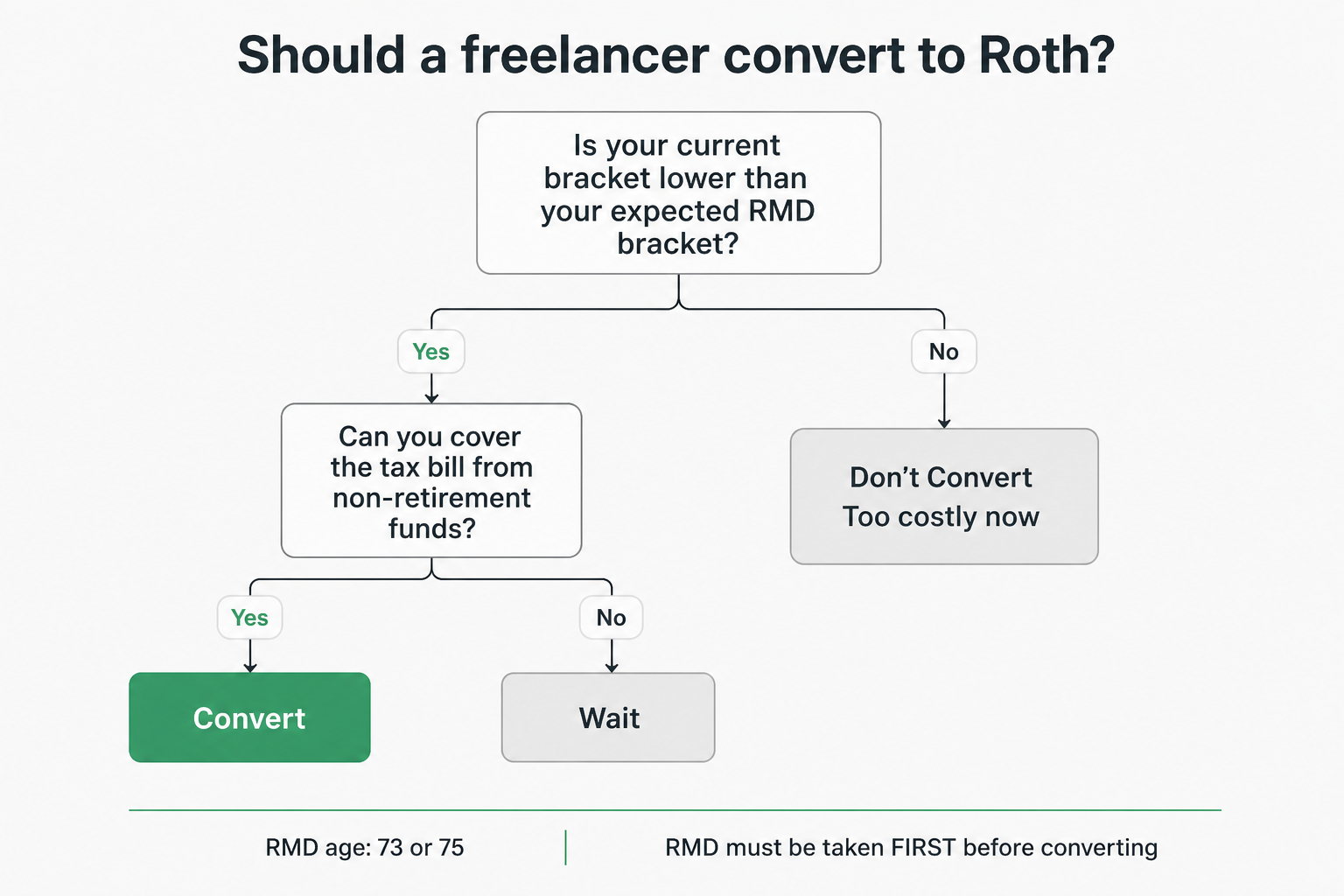
No. Conversion makes sense when your current tax rate is lower than your expected rate when RMDs force distributions. It does not make sense in every situation.
Advice from fee-only financial planners points to a clear decision framework:
Convert when:
Your current bracket plus the conversion amount stays below your projected RMD bracket.
You can pay the tax from non-retirement assets.
Your pre-tax balance is large enough that RMDs will meaningfully affect your bracket at 73 or 75.
You are in a slow year with reduced Schedule C income.
Do not convert when:
Your current year income is already at or near your peak earning level.
You need the cash to cover quarterly estimated taxes or business expenses.
Your pre-tax account balance is small enough that RMDs will not create a meaningful tax problem.
The conversion would push your MAGI above the IRMAA threshold ($109,000 single or $218,000 joint for 2026) and trigger Medicare surcharges that outweigh the Roth benefit.
The simple test is this: if (current bracket) + (conversion amount) produces a tax rate lower than your expected RMD bracket, converting makes financial sense over a long enough time horizon. If the two rates are close - or if your RMD balance will be modest regardless - the conversion may not justify the current-year tax cost.
Age matters too. A freelancer at 45 with a $200,000 SEP-IRA has decades of compounding before RMDs arrive. Converting $20,000 in a slow year now at 22% may look very different from paying 24% or 32% on growing RMDs starting at 73. A freelancer at 65 with a $1.2 million pre-tax balance is facing a more urgent decision with a shorter window.
How do you model a Roth conversion before you act?
Model the conversion against your actual year-to-date Schedule C income, confirmed deductions, and current bracket before transferring any money.
The calculation is not complicated, but the inputs matter. You need your current-year net profit from Schedule C, your confirmed deductions (standard or itemized, QBI, SEP-IRA contribution if already made), and the 2026 bracket table. Add the proposed conversion amount to your taxable income and compare the result to the bracket thresholds. Then calculate the additional quarterly estimated tax that would result from the conversion.
SnapTax Optimizer's planned Roth Conversion Planner is designed to do exactly this. Enter the conversion amount, and see its potential effect on projected annual tax, taxable income, and projected remaining estimated-tax payments - so you can evaluate the cost before you convert, not after you file.
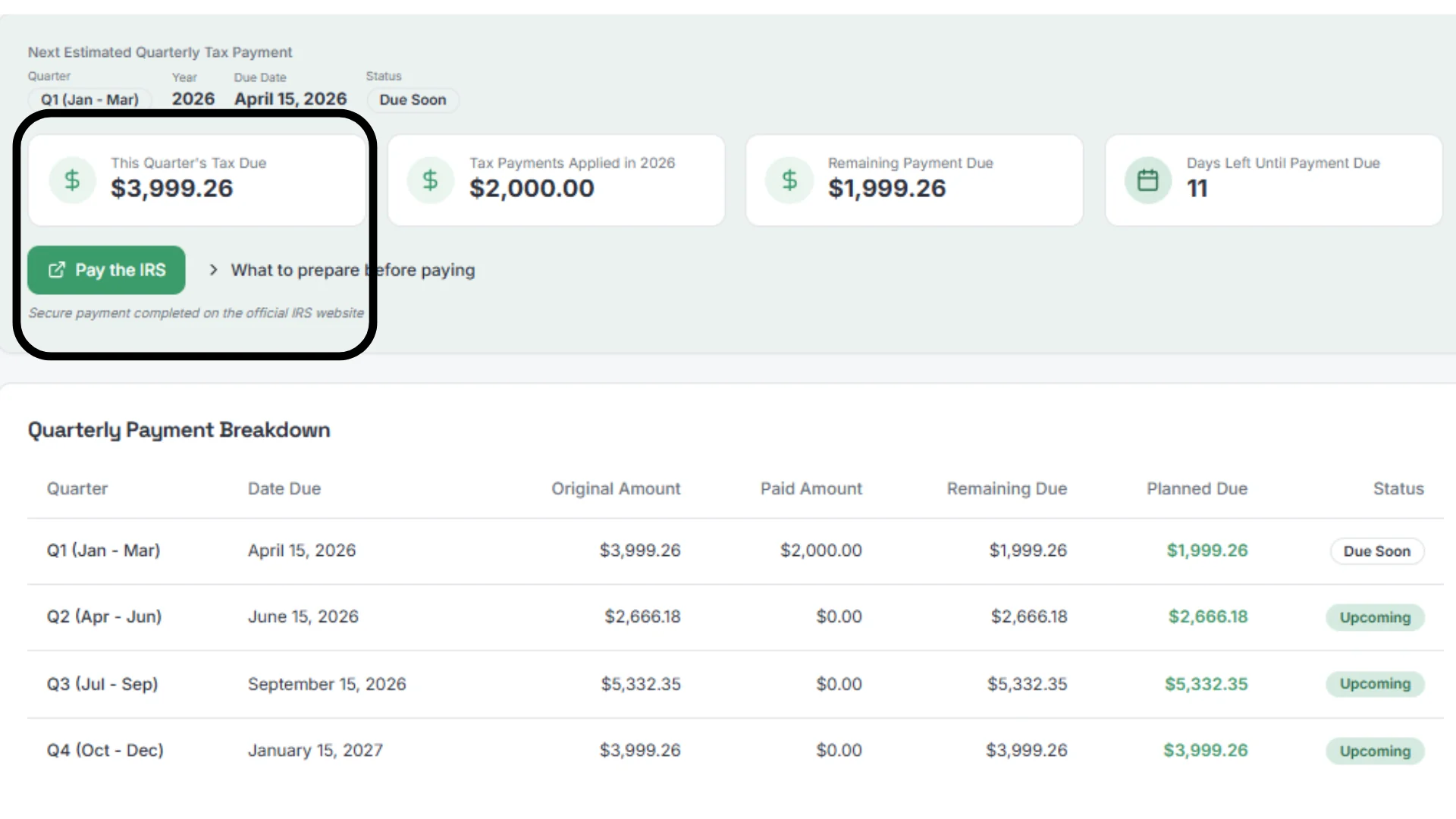
This is the single most important step in the process. The bracket-fill strategy only works if you know where you actually stand in the year. A conversion that seemed to fit in the 22% bracket can spill into 24% if you underestimated Q4 income. Modeling it live - against real year-to-date numbers rather than projections - is what separates a strategic conversion from an expensive mistake.
Roth conversion planning for freelancers rewards variable income rather than penalizing it. Every slow year is an opportunity. The key is modeling the impact before you act - so the conversion improves your long-term tax picture without creating a surprise at the next quarterly deadline.
This article is for informational purposes only and does not constitute tax or financial advice. Consult a qualified tax professional before making Roth conversion decisions.
Try SnapTax Optimizer
SnapTax Optimizer is being built specifically for freelancers who want to model retirement planning decisions before acting on them. The planned Retirement Tax Planner is designed to model a conversion scenario using the information you enter and show its potential effect on projected annual tax, taxable income, and projected remaining estimated-tax payments. Planned features include Roth conversion scenario modeling, an RMD calculator using the IRS Uniform Lifetime Table, and SEP-IRA and Solo 401(k) scenario comparisons.
Join the waitlist at snaptaxapp.com/optimizer
Frequently Asked Questions
Can freelancers do Roth conversions even if they still have self-employment income?
Yes. There is no income limit on Roth conversions. A freelancer earning $150,000 from Schedule C can convert just as freely as someone in retirement. The conversion amount is simply added to ordinary income for the year. Roth conversion rules in 2026 have no income ceiling and no cap on the amount converted - the only constraint is the resulting tax bill.
What happens if you don't take your RMD before doing a Roth conversion?
The IRS does not allow RMD dollars to be rolled over or converted. If you try to convert before satisfying your RMD for the year, the RMD amount will be treated as an ineligible rollover. You must take the full RMD first, then convert any additional amount. Failing to do so correctly can trigger penalties. Once RMDs begin, the ordering matters every single year.
What is the best year for a freelancer to do a Roth conversion?
The best year is one where your Schedule C net income is significantly below your typical earnings - putting you in a lower tax bracket than usual. The bracket-fill strategy works by converting just enough to reach the top of your current bracket without crossing into the next one. Years with large deductions (a big SEP-IRA contribution, QBI deduction, home office) compound the opportunity further. SnapTax Optimizer is designed to model a conversion scenario and show its potential effect on projected annual tax and taxable income before you transfer any money.
How does a Roth conversion affect quarterly estimated tax payments for freelancers?
A conversion increases taxable income for the year and may affect projected remaining estimated-tax payments. Whether a taxpayer needs to change a specific payment depends on safe-harbor rules, withholding, prior payments, and whether they use the annualized-income installment method. The IRS provides guidance on estimated tax requirements through Form 1040-ES. Review Form 1040-ES and Form 2210 or consult a tax professional to determine the right approach for your situation.
Is a SEP-IRA or Solo 401(k) better for Roth conversion planning?
For Roth conversion planning specifically, a Solo 401(k) is more flexible. Under SECURE 2.0 Section 604, employer profit-sharing contributions to a Solo 401(k) can now be designated as Roth at contribution time - reducing the pre-tax balance that would otherwise need to be converted later. SEP-IRA contributions are always pre-tax and subject to the pro-rata rule when converted. Solo 401(k) also isolates the pro-rata calculation to plan assets only, which is a meaningful advantage.
