Should Freelancers Itemize or Take the Standard Deduction in 2026?
Crystal Harrison · September 8, 2026 · 15 min read
Should Freelancers Itemize or Take the Standard Deduction in 2026?
With the SALT cap jumping from $10,000 to $40,400 under OBBBA, the standard vs. itemized deduction math changed significantly for many freelancers in 2026. Here's how to decide.
September 8, 2026 · 14 min read
TL;DR
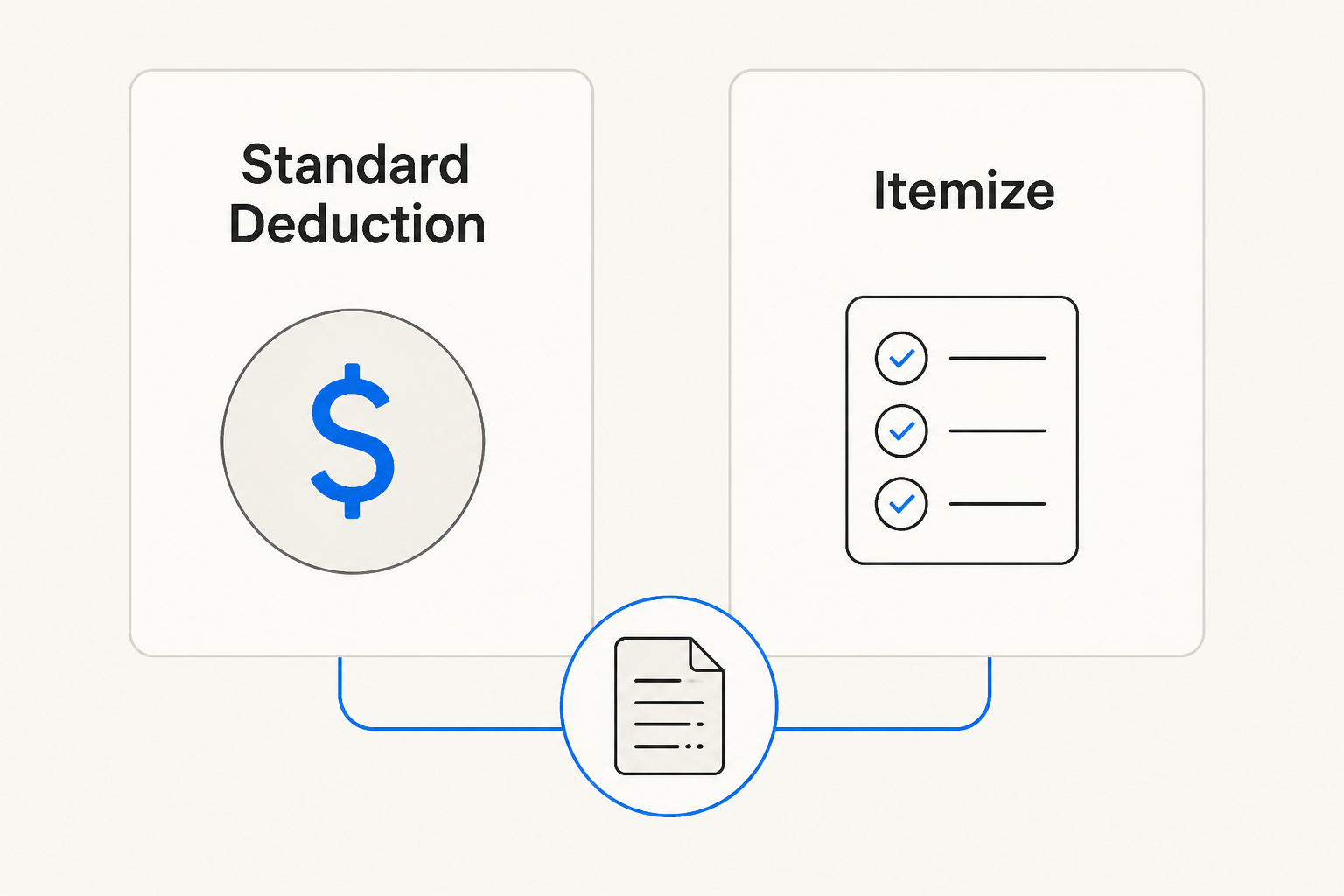
Taking the standard deduction does not prevent a self-employed taxpayer from claiming otherwise allowable business expenses. Eligible Schedule C expenses - such as business software, supplies, advertising, qualified home-office expenses, and business vehicle expenses - are evaluated under their own tax rules regardless of which personal deduction you take. The standard-versus-itemized decision is about personal deductions only: eligible mortgage interest, state and local taxes (up to the applicable cap), charitable contributions, and qualifying unreimbursed medical expenses. In 2026, the SALT cap is generally $40,400 for Single, MFJ, and HOH filers, and $20,200 for MFS filers - up from $10,000 under TCJA - which means some homeowners and high-tax-state residents should re-run the comparison this year. SnapTax Optimizer's Standard vs. Itemized wizard models both options using the information in your account and updates your projected quarterly tax estimate using the information recorded in your account.
A common source of confusion is treating the standard-versus-itemized decision as if it determines whether business expenses are deductible. It doesn't. The standard-versus-itemized decision concerns personal deductions claimed on Schedule A. It does not prevent a self-employed taxpayer from claiming otherwise allowable business expenses on Schedule C.
That distinction matters because the 2026 standard deduction - $16,100 for single filers, $32,200 for married filing jointly - is a threshold for your personal itemized deductions only. Schedule C expenses must still meet their own ordinary-and-necessary, business-use, substantiation, and limitation rules. The QBI deduction is available whether you itemize or take the standard deduction, though its final amount can be limited by taxable income and other rules.
The reason to revisit this in 2026 specifically: OBBBA made significant changes to itemized deductions. The SALT cap rose substantially. A new charitable contribution floor applies to itemizers. Freelancers who've automatically taken the standard deduction since 2018 should run the numbers again - particularly if they own a home in a high-tax state.
SnapTax Optimizer's Standard vs. Itemized wizard models both options against your actual figures - mortgage interest, SALT, charitable giving, and medical expenses - and shows you which produces the larger deduction before you file. The result updates your Tax Center so your quarterly estimate reflects the decision, not just your April return.
What is a common misconception about the standard deduction?
The most common misunderstanding is that taking the standard deduction means losing your business deductions - it doesn't, because the standard-versus-itemized decision concerns personal deductions on Schedule A and does not prevent a self-employed taxpayer from claiming otherwise allowable business expenses on Schedule C.
The standard-versus-itemized decision concerns personal deductions claimed on Schedule A. It does not prevent a self-employed taxpayer from claiming otherwise allowable business expenses on Schedule C - such as eligible software, supplies, advertising, qualified home-office expenses, and business vehicle expenses. Those business deductions must still meet their own rules, including business purpose, substantiation, allocation, and any applicable limitations. The QBI deduction is also available whether you itemize or take the standard deduction - but its final amount depends on qualified business income, taxable income, and other applicable limitations, so the itemize-vs-standard choice can indirectly affect it in some situations. The itemize-vs-standard decision only directly affects personal deductions: mortgage interest, state and local taxes, charitable contributions, and qualifying unreimbursed medical expenses above 7.5% of AGI.
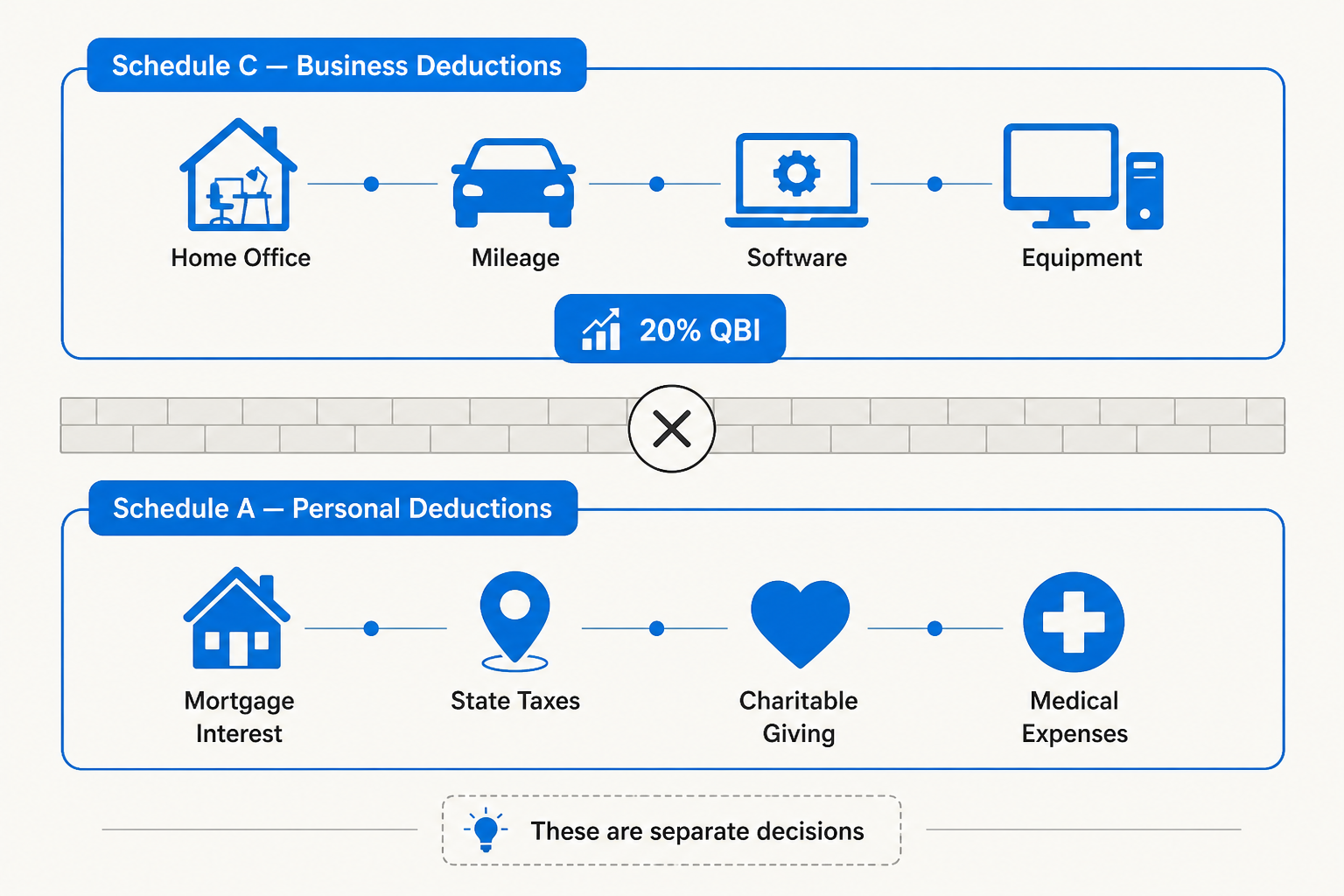
This separation is the foundation of everything that follows. Once you understand that your Schedule C deductions are entirely off the table in this decision, the question becomes much simpler: do my personal expenses exceed the standard deduction amount for my filing status?
What is the 2026 standard deduction for freelancers?
The 2026 standard deduction is $16,100 for single filers, $32,200 for married filing jointly and qualifying surviving spouses, $24,150 for head of household, and $16,100 for married filing separately.
The IRS also allows an additional standard deduction for taxpayers who are age 65 or older or legally blind - $2,050 for single filers and $1,650 per qualifying person for MFJ. OurTaxPartner's 2026 standard deduction guide covers those additional amounts and phase-out rules. OBBBA introduced separate deductions for qualifying tips, qualified overtime pay, and a $6,000 deduction for eligible seniors - these are specific deductions with their own eligibility rules, not a universal add-on to the standard deduction for all filers. Verify specific OBBBA deduction eligibility with IRS.gov before filing.
Here are the 2026 standard deduction amounts by filing status:
Filing status | 2026 standard deduction |
|---|---|
Single | $16,100 |
Married filing jointly | $32,200 |
Qualifying surviving spouse | $32,200 |
Head of household | $24,150 |
Married filing separately | $16,100 |
How did OBBBA change the itemize-vs-standard decision for freelancers in 2026?
OBBBA made the itemize-vs-standard decision worth revisiting in 2026, primarily because the SALT deduction cap rose substantially - which may cause some homeowners and residents of higher-tax jurisdictions to reconsider whether itemizing produces a larger deduction than the standard amount.
For 2026, the state-and-local-tax deduction cap is generally $40,400 for taxpayers filing Single, Married Filing Jointly, or Head of Household, and $20,200 for Married Filing Separately. The cap begins to phase down for taxpayers with modified adjusted gross income above $505,000 in 2026. The reduction is generally 30% of the amount above that threshold, but the cap does not fall below $10,000 for most filers or $5,000 for Married Filing Separately. This is up from the $10,000 cap that generally applied from 2018 through 2024. The higher cap began in 2025 at $40,000 and is $40,400 for 2026. A taxpayer with $30,000 of otherwise deductible state and local income and property taxes may be able to deduct the full amount in 2026 if their filing status and modified adjusted gross income allow it - the result depends on the SALT limitation, the phaseout rules, and whether the taxpayer itemizes. For taxpayers who itemize, OBBBA introduced a 0.5% of AGI floor for charitable contributions. In practical terms, only the portion of total qualifying charitable contributions above 0.5% of AGI is generally deductible on Schedule A, subject to the usual contribution limits and documentation rules.
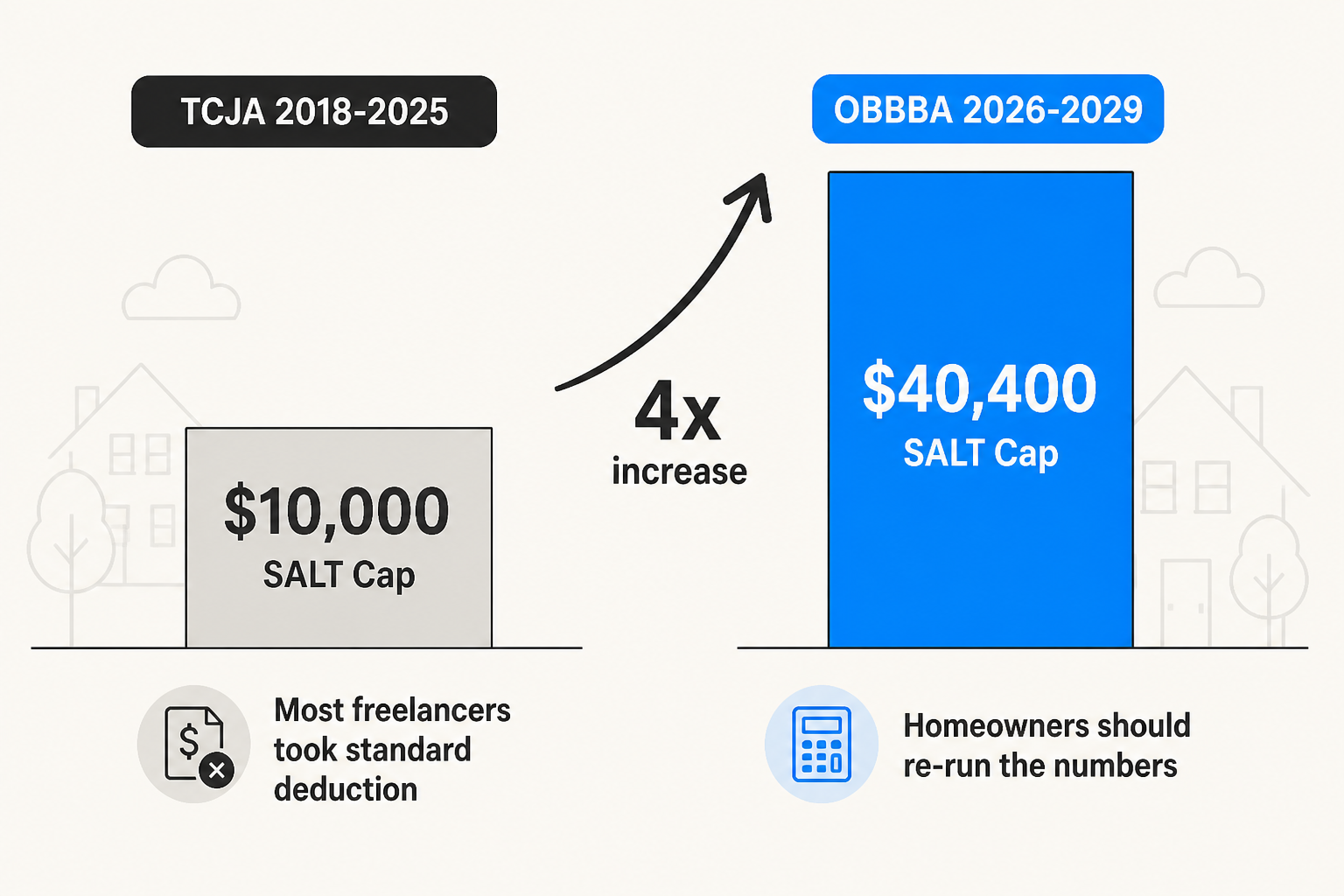
The higher SALT limit is scheduled to apply through 2029. It reverts to $10,000 in 2030 unless Congress extends it - making this a meaningful planning window for affected filers.
When should a freelancer itemize deductions in 2026?
A freelancer should itemize in 2026 when the total of their mortgage interest, SALT (up to $40,400), qualifying charitable contributions, and medical expenses above 7.5% of AGI exceeds the standard deduction for their filing status.
Approximately 85–90% of individual filers claim the standard deduction rather than itemizing - but the higher SALT cap means that percentage may shift meaningfully for homeowners in high-tax states in 2026. A freelancer who owns a home with significant mortgage interest, pays $25,000 in state taxes, and makes charitable contributions may have itemized deductions totaling $45,000–$60,000 - well above the $32,200 MFJ standard deduction. High-tax states where freelancers should specifically re-run the comparison in 2026 include California, New York, New Jersey, Illinois, Massachusetts, Oregon, and Connecticut.
Itemize if you have:
Mortgage interest payments on a primary or secondary residence
Eligible state and local income or sales taxes, plus eligible real-property taxes, that may produce a larger Schedule A deduction under the applicable 2026 SALT limit
Charitable contributions that, after applying the 0.5% of AGI floor for itemizers and any other applicable limits, add meaningful value to your Schedule A total
Unreimbursed qualifying medical expenses exceeding 7.5% of your AGI
Any combination of the above that totals more than your standard deduction
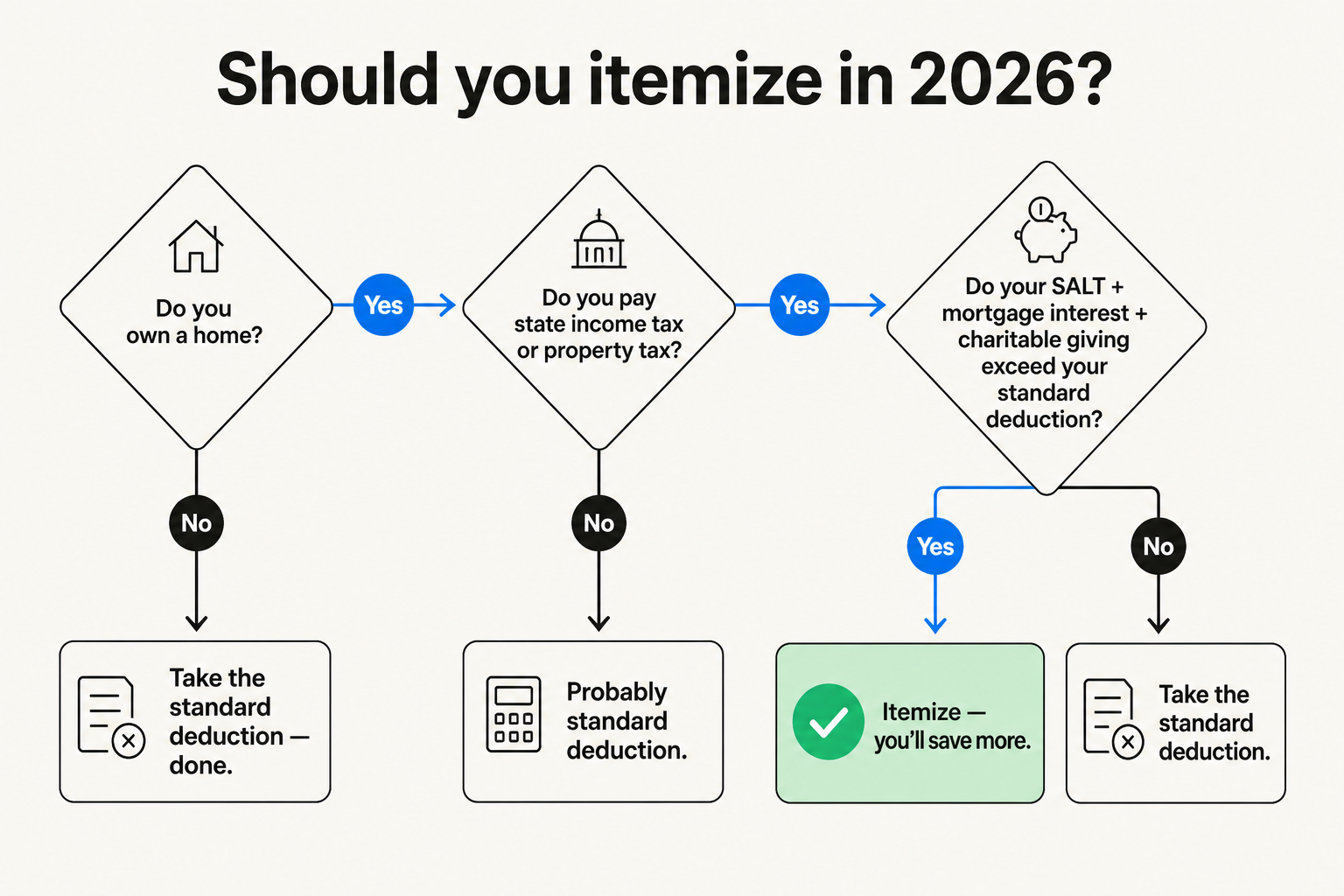
If you are a homeowner in a higher-tax state such as California, New York, or New Jersey and have defaulted to the standard deduction since 2018, the higher SALT cap makes it especially worthwhile to rerun the comparison. Whether itemizing produces a larger deduction still depends on mortgage interest, actual taxes paid, filing status, the MAGI phaseout, and other deductions.
When should a freelancer take the standard deduction in 2026?
A freelancer should take the standard deduction when their personal itemized expenses don't exceed the threshold - which applies to most freelancers who rent, live in low-tax states, and don't have large mortgage interest payments.
Renters have no mortgage interest to deduct and often have lower state income tax exposure. For a single renter paying $8,000 in state income taxes with modest charitable giving, itemized deductions are unlikely to exceed $16,100. Experian's freelancer tax guide confirms this pattern. Taking the standard deduction does not eliminate any Schedule C business deductions - business expenses reduce taxable income before the standard deduction is applied. For freelancers in states with no income tax (Texas, Florida, Washington, Nevada, Wyoming) and no significant mortgage, the SALT cap increase is largely irrelevant - state income taxes are zero or near zero, leaving only property tax and charitable giving to push toward itemization.
Take the standard deduction if you:
Rent rather than own (no mortgage interest)
Live in a state with no or low state income tax
Have modest charitable contributions (under $1,500)
Have no significant medical expenses above 7.5% of AGI
Want simplicity and minimal Schedule A recordkeeping
For many freelancers - particularly renters and those in low-tax states - the standard deduction will still be the larger amount. The OBBBA changes made it worth double-checking, not a reason to assume you should suddenly itemize.
Does the home office deduction affect the itemize-vs-standard decision?
No - the home office deduction is a Schedule C business expense and has no effect on the itemize-vs-standard decision, but homeowners who itemize can claim a separate mortgage interest deduction on Schedule A at the same time.
The home office deduction is claimed on Schedule C (simplified method, Line 30) or via Form 8829 (actual method) - it is a business deduction completely separate from Schedule A. IRS Publication 587 is the definitive source on this. For an eligible self-employed taxpayer using the actual-expense home-office method, mortgage interest allocable to business use may be included in the Form 8829 calculation, subject to the form's ordering and limitation rules. The IRS Form 8829 instructions govern how that allocation works. If the taxpayer itemizes, the remaining eligible personal-use share of mortgage interest may generally be claimed on Schedule A. This is an allocation of one expense between business and personal use - not a double deduction.
This is a coordinated allocation, not a double deduction. The mortgage interest is split between Schedule C and Schedule A based on the business-use percentage - you're deducting different portions of the same expense on two forms. For homeowners using the actual method, this means you don't have to choose between your home office deduction and itemizing.
How does the itemize-vs-standard decision affect a freelancer's quarterly tax estimate?
The itemize-vs-standard decision can affect your projected federal income tax - which means it can affect your quarterly estimated tax payments every time you model it during the year, not just when you file.
The standard-vs-itemized choice can affect federal income tax and therefore total projected tax liability. It generally does not reduce self-employment tax, which is calculated from net self-employment earnings. A $10,000 difference in deductions can reduce federal income tax by roughly $1,200 to $2,400 depending on your marginal income-tax bracket. The IRS expects quarterly estimated payments to reflect actual projected liability - choosing the wrong deduction method and underestimating federal income tax can lead to underpayment penalties, though taxpayers may often use a safe harbor to manage that exposure. Many taxpayers do not run the itemize-versus-standard comparison until they prepare their return. Reviewing it earlier can make projected income-tax estimates more useful during the year.
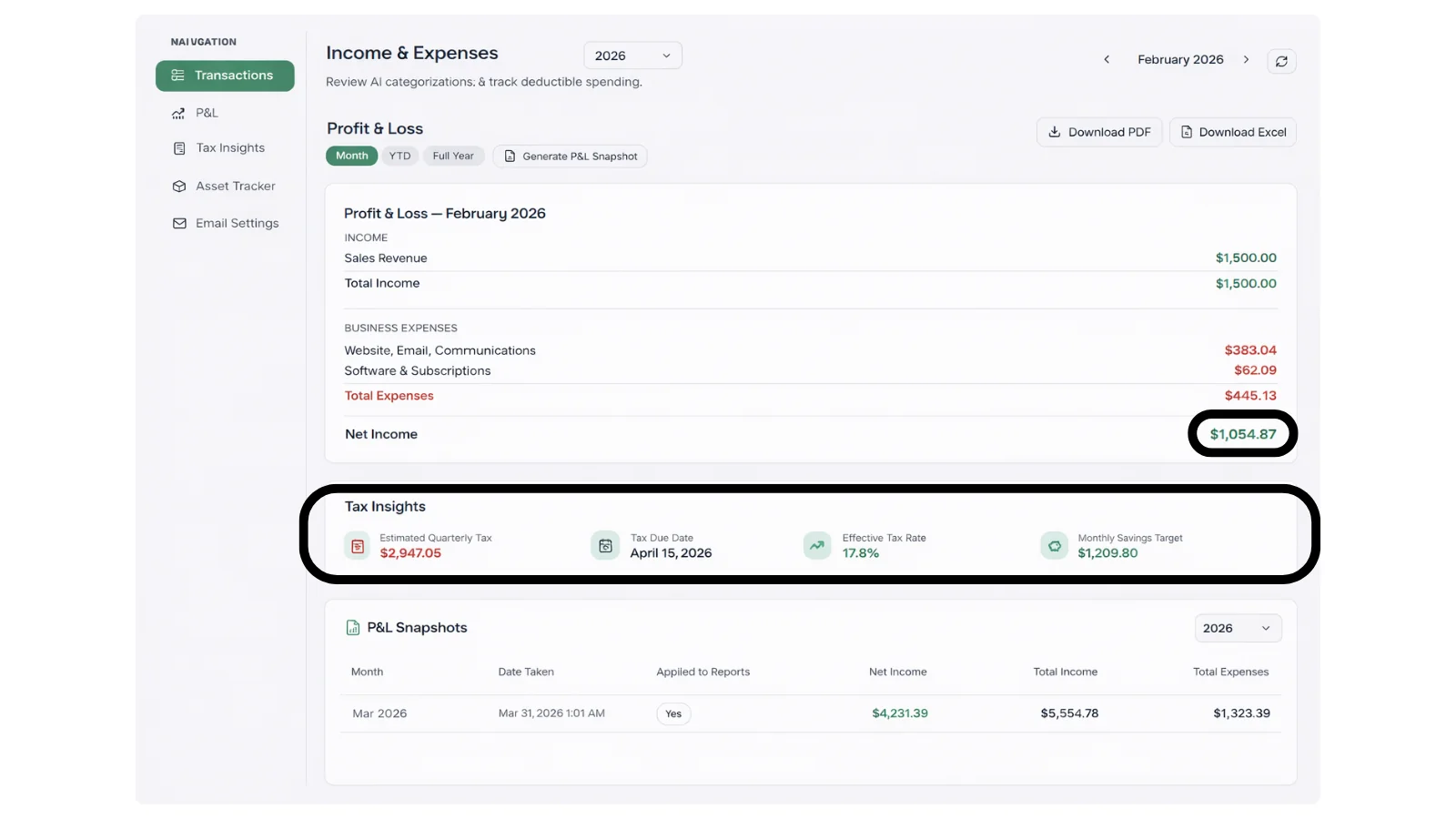
SnapTax Optimizer's Standard vs. Itemized wizard models both options using your actual mortgage interest, SALT payments, charitable contributions, and medical expenses. It shows the deduction amount under each method and confirms which is larger for your specific situation. The confirmed result writes directly into your Tax Center and updates your quarterly estimated tax payment immediately - so your remaining projected payments can reflect the deduction assumption you selected. Try SnapTax Optimizer free at snaptaxapp.com - no credit card required.
What records do freelancers need to itemize deductions in 2026?
Itemizing requires documentation for every personal deduction claimed - mortgage interest statements, property tax bills, state tax payment records, and charitable contribution receipts - all organized before you file.
Form 1098 from your mortgage lender reports mortgage interest paid during the year - this is the primary document for the largest itemized deduction most homeowners claim. State income tax payments are documented through W-2 withholding, estimated state tax payment receipts, and prior-year state tax refunds - all required to calculate the SALT deduction accurately, as Charitable contributions over $250 require a contemporaneous written acknowledgment from the organization - cash donations under $250 require a bank record or receipt. IRS Publication 526 is the governing source on charitable contribution documentation.
Records needed to itemize in 2026:
Form 1098 - mortgage interest statement from lender
Property tax bills - county or municipal property tax paid during the year
State and local income tax records - W-2 withholding, estimated tax payment receipts
Charitable contribution receipts - acknowledgment letters for donations $250+
Medical expense receipts - all unreimbursed qualifying medical costs totaling more than 7.5% of AGI
Investment interest expense documentation if applicable
Records of your state and local income tax vs. sales tax election - in some cases, deducting state sales taxes instead of income taxes produces a larger SALT deduction
The SALT cap change makes state income tax payment records especially valuable in 2026. If you're in a high-tax state and you've never tracked exact state tax payments, this is the year to start.
The should-freelancers-itemize-or-take-standard-deduction question is more worth asking in 2026 than it's been since 2018. The SALT cap increase from $10,000 to $40,400 changes the math for homeowners in high-tax states who've automatically taken the standard deduction for the past seven years.
The standard-versus-itemized choice directly affects personal deductions on Schedule A. Your otherwise allowable Schedule C business expenses - such as qualified home-office expenses, mileage, and software - are evaluated independently under their own tax rules. The QBI deduction is available whether you itemize or take the standard deduction, although its final amount can be affected by taxable income and other limitations.
Try SnapTax Optimizer
SnapTax Optimizer is built for freelancers and 1099 contractors navigating exactly this kind of decision. The Standard vs. Itemized wizard runs both calculations using your actual numbers and connects the confirmed result directly to your real-time quarterly estimated tax payment - so you're not making this decision in isolation in April. You're making it when it can actually change your Q2, Q3, and Q4 payments.
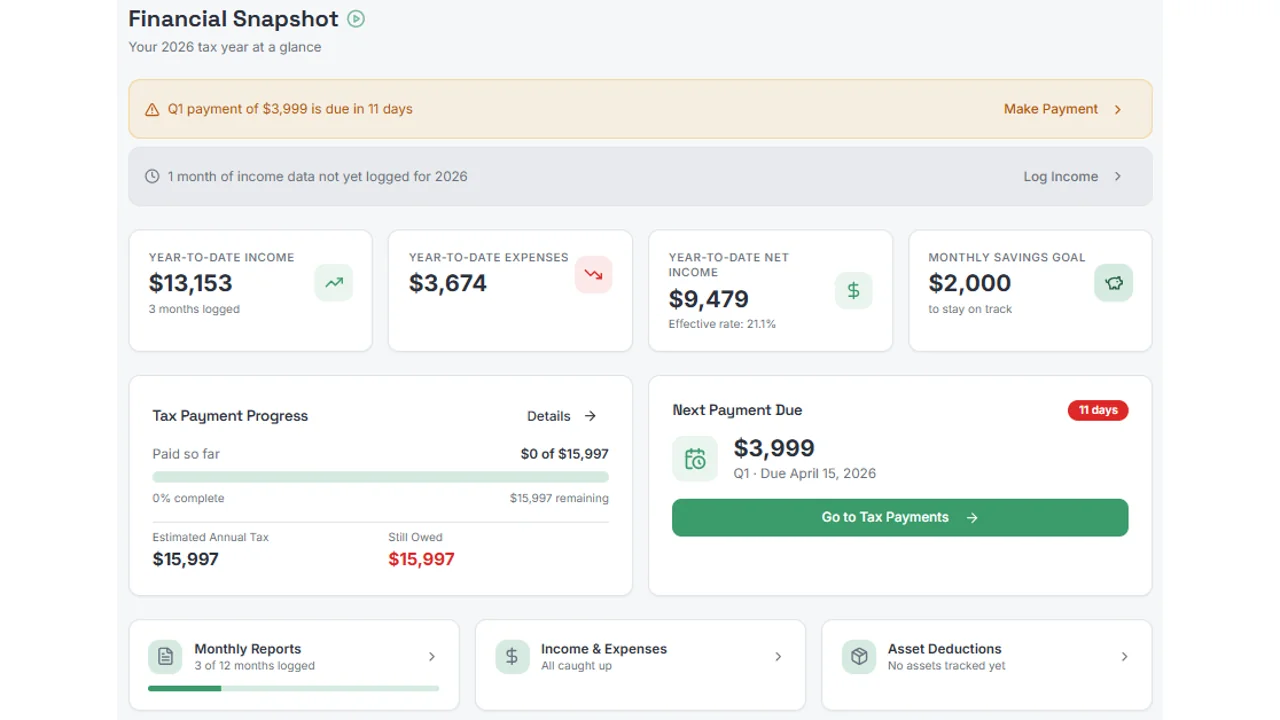
Start free at snaptaxapp.com - no credit card required.
Frequently Asked Questions
Can freelancers take the standard deduction and still deduct business expenses?
Yes. The standard-versus-itemized decision concerns personal deductions on Schedule A. It does not prevent a self-employed taxpayer from claiming otherwise allowable business expenses on Schedule C - such as eligible software, supplies, advertising, qualified home-office expenses, and business vehicle expenses. Those business deductions must still meet their own rules, including business purpose, substantiation, and any applicable limitations. The QBI deduction is also available whether you itemize or take the standard deduction, though its final amount depends on qualified business income, taxable income, and other applicable limitations.
What is the 2026 standard deduction for a single freelancer?
The 2026 standard deduction for a single filer is $16,100. Married filing jointly and qualifying surviving spouses get $32,200. Head of household is $24,150, and married filing separately is $16,100. Additional amounts may apply for taxpayers who are age 65 or older or legally blind, and OBBBA introduced separate deductions for qualifying tips, overtime, and senior taxpayers - verify with IRS.gov for specific eligibility rules.
How does the SALT cap change under OBBBA affect freelancers in 2026?
For 2026, the SALT deduction cap is generally $40,400 for Single, Married Filing Jointly, and Head of Household filers, and $20,200 for Married Filing Separately. The cap begins to phase down for taxpayers with MAGI above $505,000 in 2026, at a rate of roughly 30% of the excess, but does not fall below $10,000 for most filers or $5,000 for MFS. This is up from $10,000 under TCJA. The higher limit is scheduled to apply through 2029. Freelancers in high-tax states with eligible state and local taxes exceeding $10,000 should re-run the itemize vs. standard comparison this year.
Does the home office deduction count toward the standard deduction threshold?
No. The home office deduction is a Schedule C business expense and has zero effect on the itemize vs. standard decision. It lives entirely outside of Schedule A. If you use the actual method via Form 8829, you split the mortgage interest between Schedule C (business-use portion) and Schedule A (personal-use portion) - so a homeowner can claim deductions on both simultaneously.
How does the itemize vs. standard deduction choice affect quarterly estimated taxes?
The choice can affect projected federal income tax, which in turn affects quarterly estimated payments. A $10,000 difference in deductions can reduce federal income tax by roughly $1,200 to $2,400 depending on your marginal income-tax bracket. It generally does not reduce self-employment tax, which is calculated from net self-employment earnings. Estimated-tax rules are pay-as-you-go, but taxpayers may often use a safe harbor to manage underpayment-penalty exposure. SnapTax Optimizer's Standard vs. Itemized wizard models both options using the information in your account and updates your quarterly estimate accordingly.
