Tax Credits Freelancers Miss: Child Care, ODC, and EITC Explained for 2026
Crystal Harrison · September 10, 2026 · 21 min read
Family Tax Credits for Freelancers: CDCC, CTC, ODC, and EITC for 2026
Self-employed taxpayers can qualify for child care, ODC, CTC, and EITC credits without W-2 income or itemizing. Here's how each credit works, what income measures apply, and what records the IRS requires.
September 9, 2026 · 16 min read

TL;DR
Self-employed taxpayers can qualify for the Child and Dependent Care Credit (CDCC), the Credit for Other Dependents (ODC), and the Earned Income Tax Credit (EITC) without W-2 income or itemizing. For 2026, the maximum EITC is $8,231 for eligible taxpayers with three or more qualifying children; the CTC is up to $2,200 per qualifying child who is under age 17 at the end of the tax year; and the ODC is $500 per qualifying dependent who does not qualify for the CTC. Net Schedule C profit is an important input for EITC and CDCC eligibility - but each credit has its own rules. ODC and CTC depend primarily on qualifying-dependent rules and modified AGI phaseouts. Eligibility across all three can also depend on filing status, AGI, provider information, a dependent's taxpayer identification number, investment income, and other IRS requirements. SnapTax Optimizer's Family Credits wizard gathers information about your family situation and income to help screen for these credits, using your net Schedule C income. Credit amounts you attest to are incorporated into your quarterly tax estimate.
Tax credits can reduce tax liability dollar for dollar, while deductions generally reduce taxable income. A $4,000 credit reduces a tax bill by $4,000; a $4,000 deduction reduces taxable income, with the actual tax reduction depending on the marginal rate. Several credits available to self-employed taxpayers with dependents are sometimes assumed to require W-2 income, a specific employer benefit, or a simpler tax situation than a self-employed person has - but that assumption is not accurate for the credits covered here.
Three credits that may be relevant to self-employed taxpayers with dependents are the Child and Dependent Care Credit (CDCC), the Credit for Other Dependents (ODC), and the Earned Income Tax Credit (EITC). None of these credits requires W-2 income. Self-employment does not by itself prevent a taxpayer from qualifying for these credits. None of these credits requires itemizing - a taxpayer may claim them whether they take the standard deduction or itemize, provided they meet the credit's separate eligibility requirements.
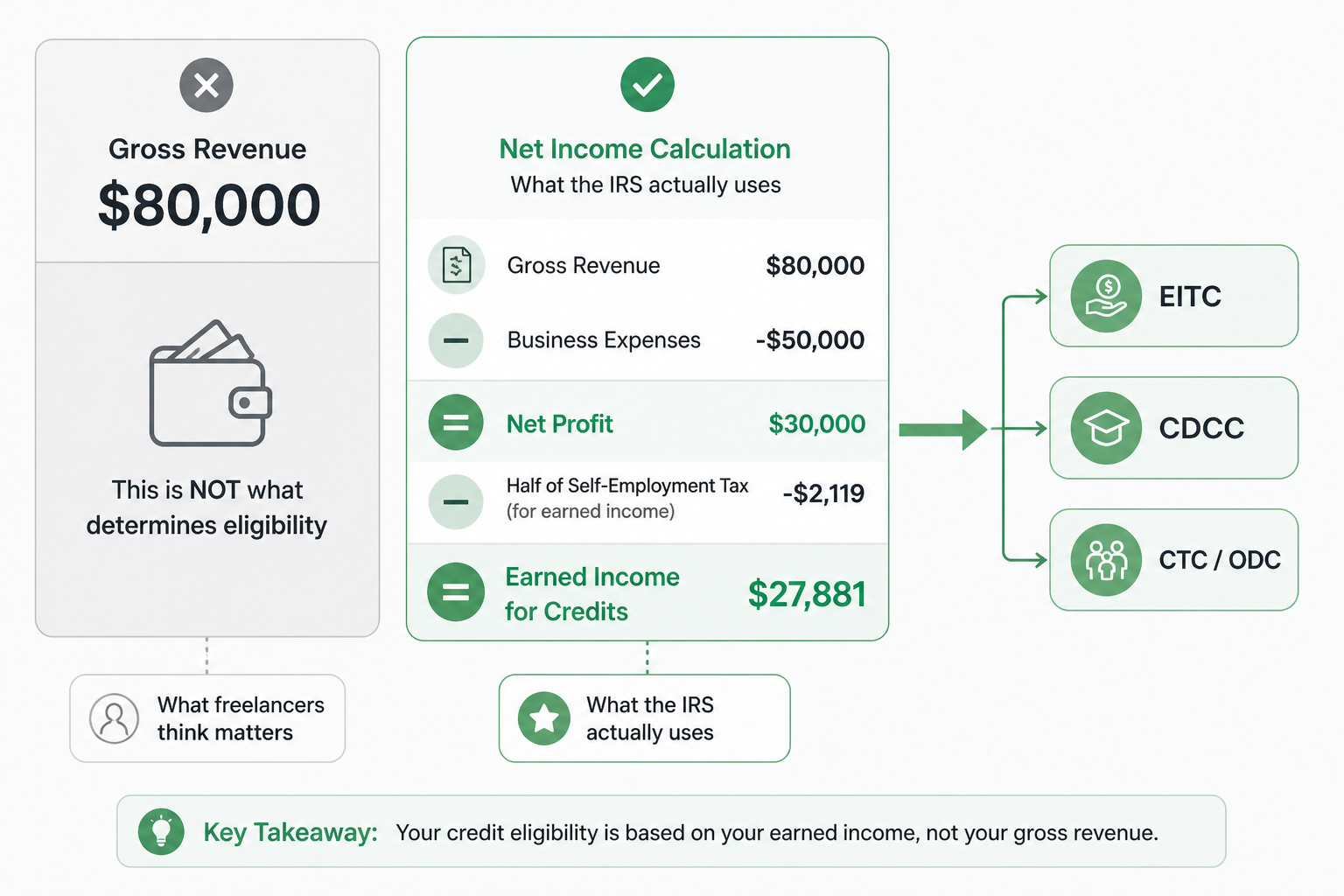
A key distinction for self-employed taxpayers is that gross business revenue is not the same as net earnings from self-employment - and net earnings, not gross revenue, is what the IRS uses for credits tied to earned income. A freelancer billing $80,000 with $50,000 in business expenses has $30,000 in net Schedule C profit - and that net profit, not the $80,000 gross, is the starting point for EITC and CDCC calculations. The ODC and CTC use different measures and depend primarily on dependent-eligibility rules and modified AGI phaseouts, not earned income alone.
SnapTax Optimizer's Family Credits wizard gathers information about your family situation and income to help screen for CDCC, ODC, and EITC eligibility - using your net Schedule C income, not gross revenue. Credit amounts you attest to are incorporated into your Tax Center to inform quarterly estimated-tax planning during the year, not just at filing.
Why do freelancers miss these tax credits more than W-2 workers do?
Self-employed taxpayers have no employer benefits enrollment process to flag these credits, and each credit has nuances that apply differently to self-employment income - which can make eligibility less obvious than it is for employees with W-2 income.
The IRS has reported that a significant share of eligible workers do not claim the EITC each year. Self-employed filers can face additional complexity because earned income for EITC purposes is based on net earnings from self-employment - not gross revenue - and the final credit amount depends on multiple factors that vary by situation.
Employees may encounter dependent-care benefits during employer enrollment, while self-employed taxpayers may not have an employer-provided prompt to consider either dependent-care benefits or the Child and Dependent Care Credit. These are separate tax mechanisms, and many employees have no DCFSA option regardless.
The good news: the IRS generally allows amended returns to claim missed credits within the later of three years after the return was filed or two years after the tax was paid. A freelancer who missed EITC or ODC in 2023 or 2024 may still be able to file Form 1040-X - the window is worth checking before it closes.
What is the Child and Dependent Care Credit and how does it work for freelancers?
The Child and Dependent Care Credit (CDCC) may give freelancers a credit based on a percentage of qualifying childcare expenses. Eligible expenses are generally limited to $3,000 for one qualifying person or $6,000 for two or more, reduced by any dependent-care benefits received (such as FSA amounts) and subject to earned-income limitations.
The CDCC may apply to qualifying care expenses that enable a taxpayer to work or look for work. Net earnings from self-employment can satisfy the earned-income requirement. On a joint return, both spouses generally must have earned income unless the student or incapacity exception applies, and the allowable expense amount may be limited by the lower-earning spouse's earned income. Qualifying expenses include care at licensed daycare centers, after-school programs, summer day camps, and in-home babysitters when the care enables work. The key phrase is "enables you to work" - the care has to be tied to your ability to work, not just convenient.
The credit percentage ranges from 20% to 35% of qualifying expenses depending on AGI - lower income earners receive the higher 35% rate. At the maximum expense limit of $6,000 for two or more children and the 35% rate, that's up to a $2,100 credit. At the 20% rate applied to higher incomes, it's $1,200. Actual credit amounts depend on earned income, dependent-care benefits received, and other rules.
One important distinction: the federal CDCC is generally nonrefundable - it can reduce income-tax liability, but it generally does not create a refund beyond that liability and does not offset self-employment tax. That distinguishes it from the EITC, which is fully refundable.
Qualifying childcare expenses for the CDCC:
Licensed daycare centers and preschool programs
After-school care programs
Summer day camps (not overnight camps)
In-home babysitters or nannies, when the care is work-related and the taxpayer can provide required provider information on Form 2441 or meets the applicable due-diligence exception. Household-employment tax and payroll-reporting rules may apply.
Care for a dependent who is physically or mentally incapable of self-care
What does NOT qualify:
Overnight summer camps
Kindergarten or higher-grade school tuition (though before- and after-school care programs for a child in kindergarten or above may qualify separately if the care enables work)
Care provided by a dependent you claim or your spouse
Expenses that cannot be substantiated, or payments for which the required provider information is unavailable and the taxpayer does not qualify for an applicable due-diligence exception
Provider identification matters: you generally must report each provider's name, address, and taxpayer identification number (EIN or SSN) on Form 2441. If a provider will not supply a TIN, retain evidence that you requested it - there is a due-diligence exception available in some circumstances, but you should review the Form 2441 instructions or consult a tax professional before assuming the expense still qualifies. Getting that information upfront is simpler than resolving the issue later.
How does the Dependent Care FSA interact with the CDCC for freelancers?
Self-employed freelancers without a payroll structure cannot use a Dependent Care FSA - but the OBBBA raised the DCFSA exclusion limit to $7,500 in 2026, which matters for freelancers who later form an S-Corp or payroll setup.
A Dependent Care FSA (DCFSA) is an employer-sponsored benefit that lets eligible employees set aside pre-tax dollars for qualifying childcare expenses. The One Big Beautiful Bill Act (OBBBA) raised the annual employer-plan exclusion limit from $5,000 to $7,500 ($3,750 for married filing separately) for 2026. Tax savings from a DCFSA depend on federal and state income-tax brackets, payroll-tax treatment, filing status, and whether the full amount can be excluded - the result varies significantly by situation.
Sole proprietors and single-member LLCs taxed as sole proprietors generally cannot access a DCFSA, because the benefit requires an employer-sponsored plan. Freelancers in this category may evaluate eligibility for the CDCC instead.
An S corporation may be able to establish a Section 129 Dependent Care Assistance Plan, but owner-employee eligibility for this benefit involves more-than-5%-owner rules, nondiscrimination requirements, and payroll and reporting obligations that can be complex. Forming an S corporation does not automatically make the benefit available tax-free to the owner. An S-corporation owner should get CPA or benefits counsel review before treating dependent-care benefits as excludable compensation.
What is the Credit for Other Dependents (ODC) and who qualifies?
The Credit for Other Dependents (ODC) is a $500 nonrefundable credit for each qualifying dependent who doesn't meet the requirements for the Child Tax Credit - including older children, college students, and dependent parents.
The ODC may be relevant where a dependent does not meet the Child Tax Credit requirements. At $500 per qualifying dependent, a taxpayer with two college-age children and one elderly parent who each meet the dependency tests could potentially claim $1,500 in ODC credits, subject to the AGI phaseout thresholds and all applicable rules.
The ODC is available for qualifying dependents who do not meet the Child Tax Credit requirements - including qualifying children aged 17 or older, and qualifying relatives such as elderly or disabled parents you support financially. It phases out at the same income thresholds as the CTC: $400,000 AGI for married filing jointly, $200,000 for all other filers. Whether a specific person qualifies depends on the applicable qualifying-child or qualifying-relative rules under IRS Publication 501.
Freelancers who provide more than half the financial support for an aging parent may be able to claim the ODC for that parent if the dependency requirements are met, including that the parent's gross income is below the applicable threshold (verify from IRS Publication 501 - approximately $5,050 for 2026, but confirm the exact current figure before filing).
Examples of dependents who may qualify for ODC (but not CTC) - dependency rules apply in each case:
A qualifying child who is age 17 or older
A full-time college student you claim as a dependent
A parent or other relative you provide more than half the support for, if other dependency requirements are met
A qualifying relative who lives with you and whose gross income is below the applicable threshold
Taxpayer identification numbers: For the Child Tax Credit and Additional Child Tax Credit, a qualifying child generally must have a valid SSN issued before the return due date. A dependent who does not qualify for the CTC because of the SSN requirement may still potentially qualify the taxpayer for the $500 ODC if the dependent has another acceptable taxpayer identification number (such as an ITIN or ATIN) and all other requirements are met. Consult IRS Publication 972 and the Form 1040 instructions for the applicable rules.
What is the Child Tax Credit in 2026 and how does it combine with ODC?
The Child Tax Credit is $2,200 per qualifying child who is under age 17 at the end of the tax year in 2026 - a portion of which may be refundable as the Additional Child Tax Credit - and it works alongside the ODC for families with both young children and older dependents.
For 2026, the CTC is $2,200 per qualifying child who is under age 17 at the end of the tax year. A portion of the CTC may be refundable through the Additional Child Tax Credit (ACTC) provisions under OBBBA; the ACTC calculation depends on earned income, the amount of CTC that exceeds tax liability, and other rules - it is not a simple percentage formula. For self-employed taxpayers, net earnings from self-employment generally contribute to the earned-income calculation. The final ACTC computation should be completed using Schedule 8812 and the applicable Form 1040 instructions, because earned income, CTC limits, phaseouts, and other requirements can affect the result.
A taxpayer with two children under age 17 at end of tax year and one college-age dependent could potentially claim $4,400 in CTC plus $500 in ODC - provided the college-age dependent qualifies for ODC but not the CTC. The CTC and ODC cannot both be claimed for the same dependent. CTC and ODC can apply together where a taxpayer has different dependents separately qualifying for each credit, subject to all eligibility requirements.
Child Tax Credit (CTC) | Credit for Other Dependents (ODC) | |
|---|---|---|
Amount | $2,200 per child | $500 per dependent |
Qualifying age | Under age 17 at end of tax year | Qualifying dependent who does not qualify for CTC; dependency and ID rules apply; CTC and ODC cannot both apply to the same dependent |
Refundable portion | Up to $1,700 (ACTC) | Not refundable |
Phase-out begins | $400,000 MFJ / $200,000 other | Same as CTC |
Examples | Child age 8, 12, 15 | Child age 17+, college student, dependent parent |
Note: The $2,200 CTC figure reflects OBBBA changes. Verify from IRS Rev. Proc. 2025-32 before filing.
One illustrative scenario: a freelance designer with two qualifying children under age 12 and a college-age stepchild who qualifies as a dependent (but not for the CTC) could potentially claim up to $4,400 in CTC and $500 in ODC - a combined potential credit amount of up to $4,900 before considering CDCC or EITC, subject to the CTC/ACTC refundable-credit rules, AGI phaseouts, and all dependency requirements. The ODC is nonrefundable. The CTC first reduces income-tax liability, and a qualifying portion may be refundable as the ACTC. The CTC and ODC cannot both apply to the same dependent.
What is the EITC and can freelancers qualify in 2026?
The Earned Income Tax Credit is a refundable federal credit for eligible taxpayers with earned income. Self-employment income can count as earned income, and the credit is fully refundable - meaning it can exceed income-tax liability. For 2026, the maximum EITC for an eligible taxpayer with three or more qualifying children is $8,231. The credit is not available if aggregate investment income exceeds $12,200.
The final EITC amount depends on filing status, earned income, AGI, the number of qualifying children, each child's eligibility, and investment income. A freelancer with $30,000 in net Schedule C profit and three qualifying children may be eligible for a substantial credit, but the exact amount requires running the full credit calculation - net profit alone does not determine eligibility or the credit amount.
For self-employed filers, earned income for EITC purposes is generally based on net earnings from self-employment. A freelancer with $60,000 in gross revenue and $28,000 in business expenses has approximately $32,000 in net Schedule C profit as a starting point. The EITC calculation then incorporates AGI, filing status, qualifying-child rules, and investment income to determine the actual credit amount - consult IRS Publication 596 or a tax professional for the complete calculation.
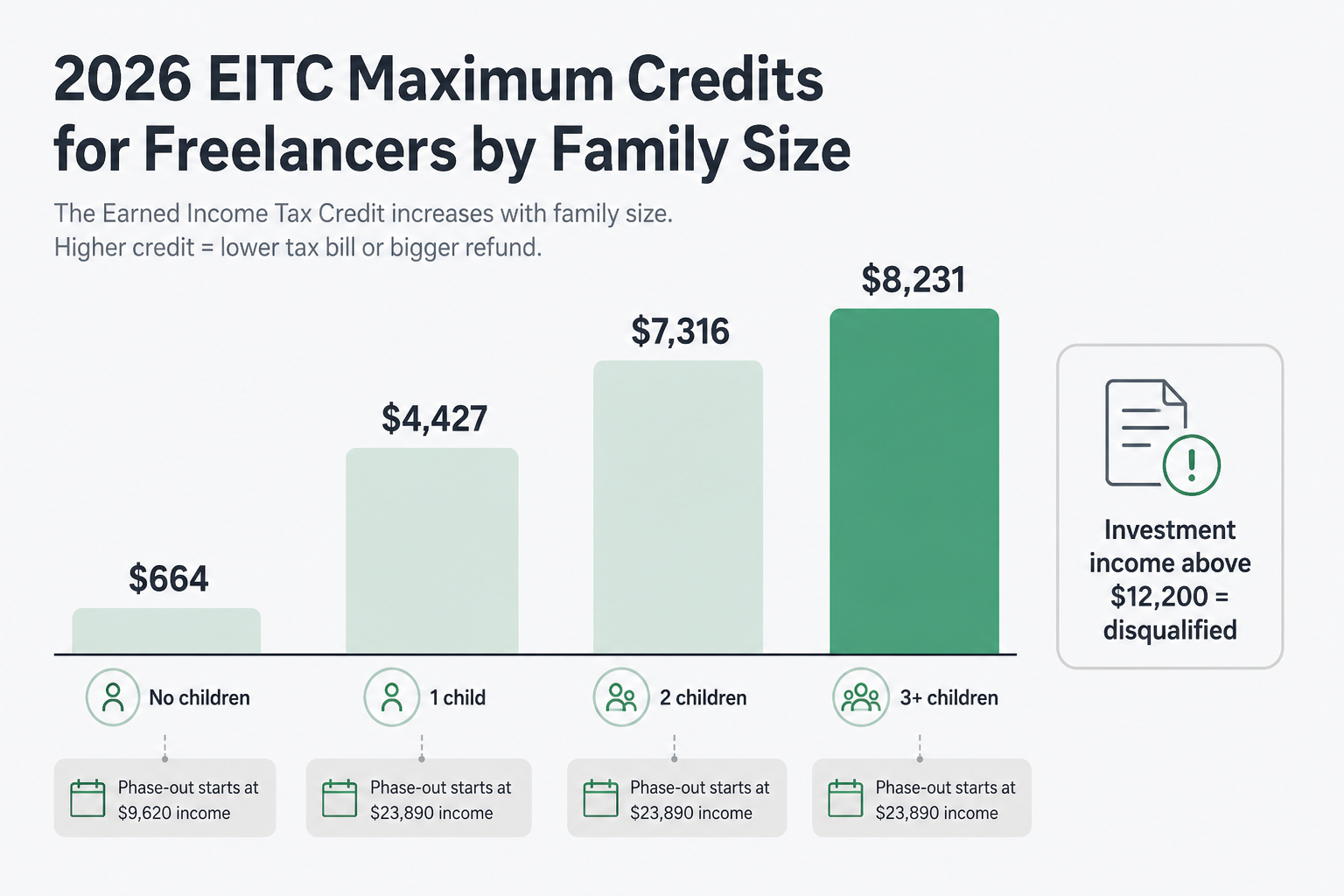
Qualifying children | Maximum credit | Phase-out begins (single/HoH) | Phase-out begins (MFJ) |
|---|---|---|---|
None | $664 | $9,620 | $16,890 |
1 child | $4,427 | $23,890 | $31,160 |
2 children | $7,316 | $23,890 | $31,160 |
3+ children | $8,231 | $23,890 | $31,160 |
Phase-out thresholds from IRS Revenue Procedure 2025-32. Verify exact complete phase-out amounts from IRS Publication 596 before filing.
The EITC is completely disqualified if investment income exceeds $12,200 in 2026 - regardless of how low your earned income is. Freelancers who have built investment portfolios alongside their business need to check this threshold carefully. Even a modest dividend-producing portfolio can push investment income past the limit without the freelancer realizing it.
What is the investment income trap that disqualifies freelancers from the EITC?
A freelancer is completely disqualified from the EITC if investment income - as defined under IRC §32(i), which includes interest, dividends, net capital gains, and certain other passive income - exceeds $12,200 in 2026, regardless of how low their earned income is.
The investment-income limitation is an important EITC eligibility screen for taxpayers with investment income. The $12,200 investment income disqualifier is indexed for inflation under IRC §32(i) - so the threshold changes each year, and the figure for any given year has to be confirmed from the current IRS guidance.
Capital gains from selling investments count toward the $12,200 threshold. A freelancer who sold appreciated stock during the year needs to add up all investment income - not just ongoing dividends or interest - before assuming EITC eligibility. One good year in the stock market can wipe out eligibility for a credit worth thousands of dollars.
Because EITC eligibility depends on earned income, AGI, filing status, qualifying-child rules, and investment income, self-employed taxpayers claiming the credit should keep clear records supporting Schedule C income and expenses, SE tax calculations, qualifying-child eligibility, and investment income totals. The IRS has reported significant improper-payment rates for the EITC, and a clean, well-documented return is the most practical protection for any taxpayer claiming the credit.
The practical advice: calculate your total investment income before assuming you qualify for the EITC. The statutory definition of "investment income" for EITC purposes (IRC §32(i)) includes interest, dividends (ordinary and qualified), net capital gains or net capital gain income, and certain other passive income - consult IRS Publication 596 for the complete list and the lines from Form 1040 that count toward the threshold. If the combined total exceeds $12,200, the EITC is off the table entirely - for any credit amount, with any number of qualifying children.
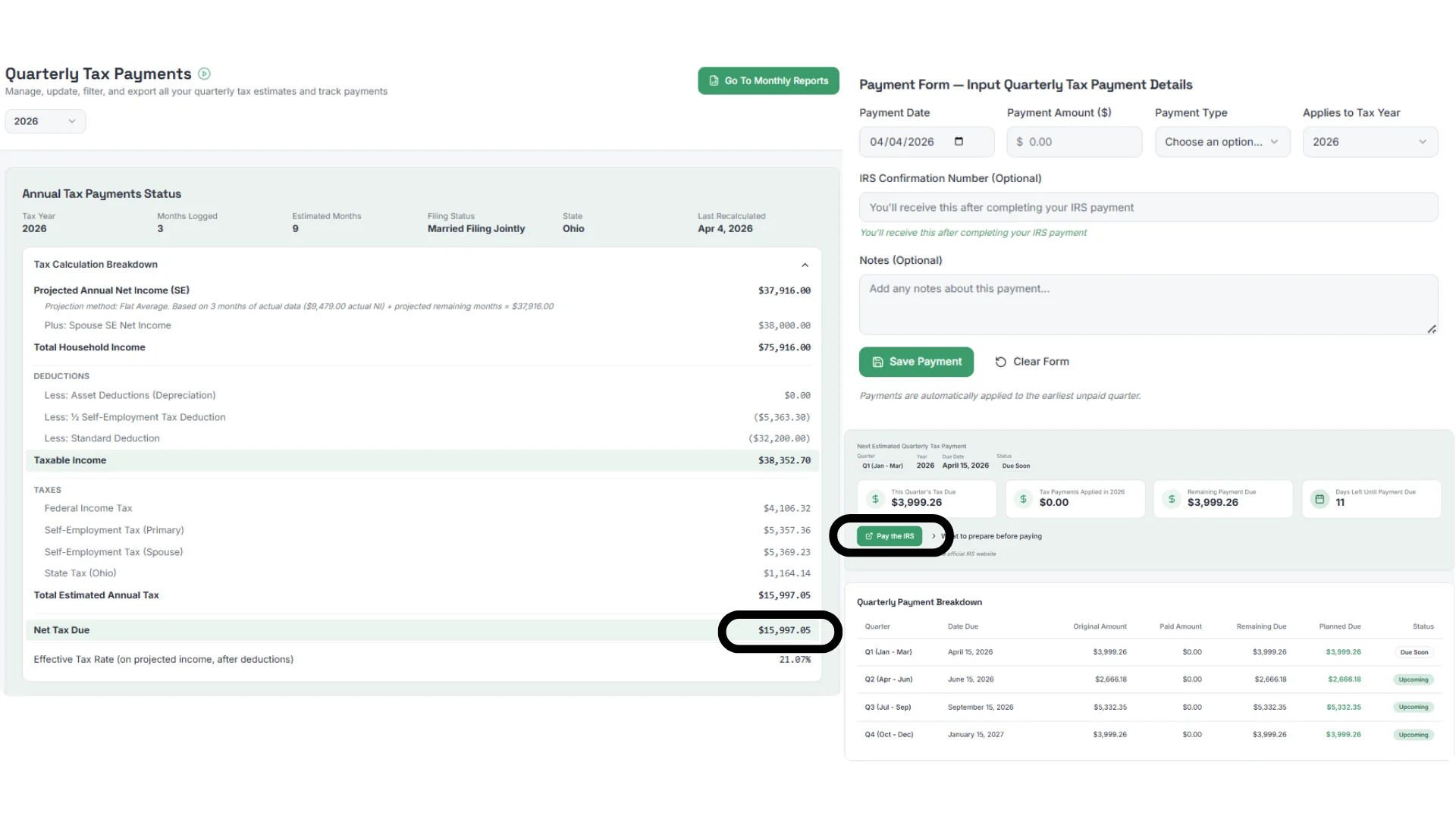
How do these tax credits affect a freelancer's quarterly estimated tax payments?
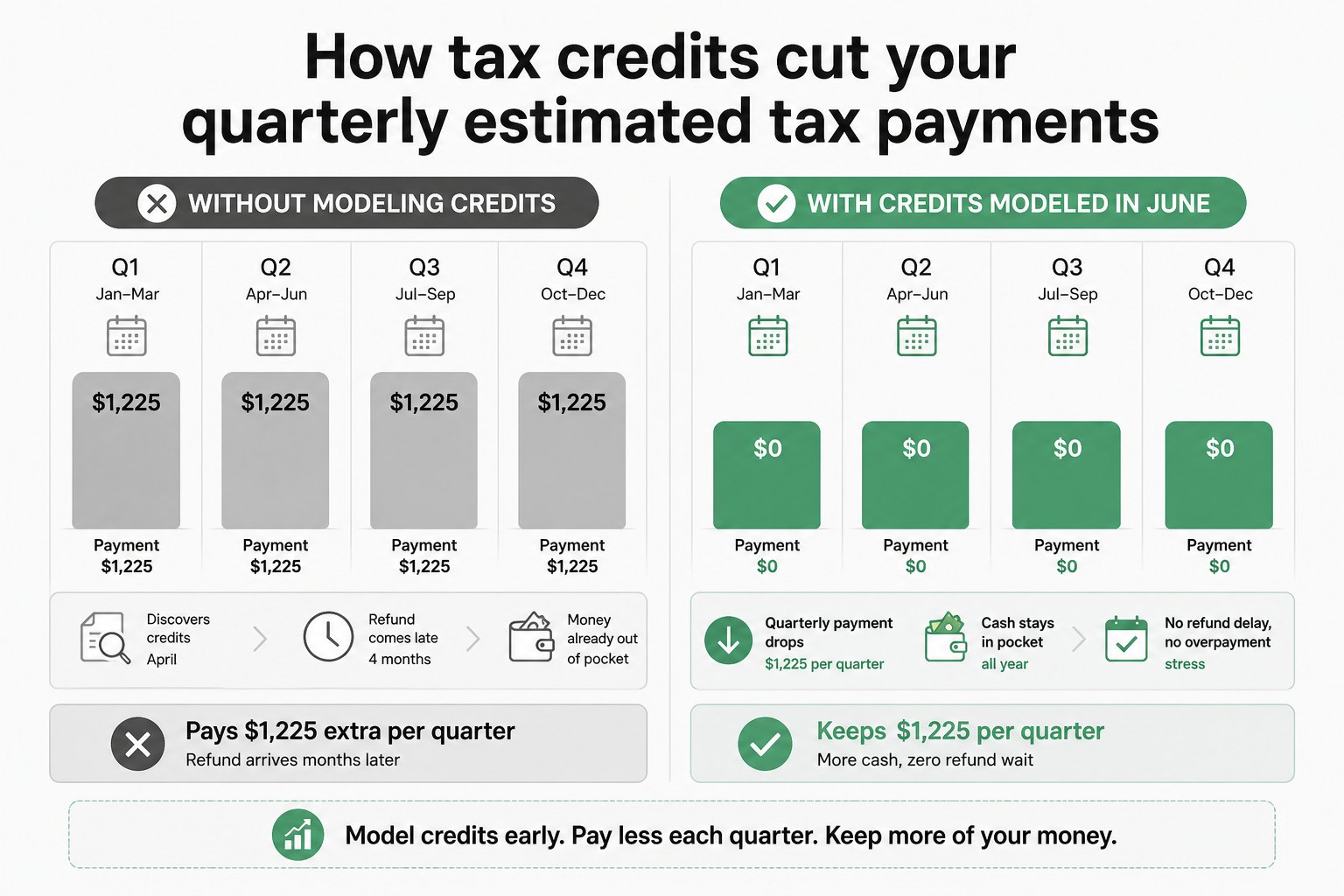
Tax credits can reduce projected federal income-tax liability, so they are relevant to quarterly estimated tax planning. The effect depends on the type of credit, whether it is refundable, eligibility facts, payment timing, self-employment tax, withholding, and the taxpayer's chosen estimated-tax method.
A few important distinctions: the CDCC and ODC are nonrefundable and reduce income-tax liability only - they don't reduce self-employment tax. The CTC can be partly refundable through the ACTC. The EITC is fully refundable. Freelancers calculating quarterly estimated payments still owe self-employment tax regardless of credit eligibility, and the appropriate quarterly payment depends on the full picture: projected income, deductions, applicable credits, SE tax, and the taxpayer's chosen calculation method (current-year projection, prior-year safe harbor, or annualized-income method).
Taxpayers using safe-harbor or annualized-income calculations should not simply divide expected credits equally among four payments without reviewing the complete calculation. A tax professional can help determine the right estimated-payment approach for a specific situation.
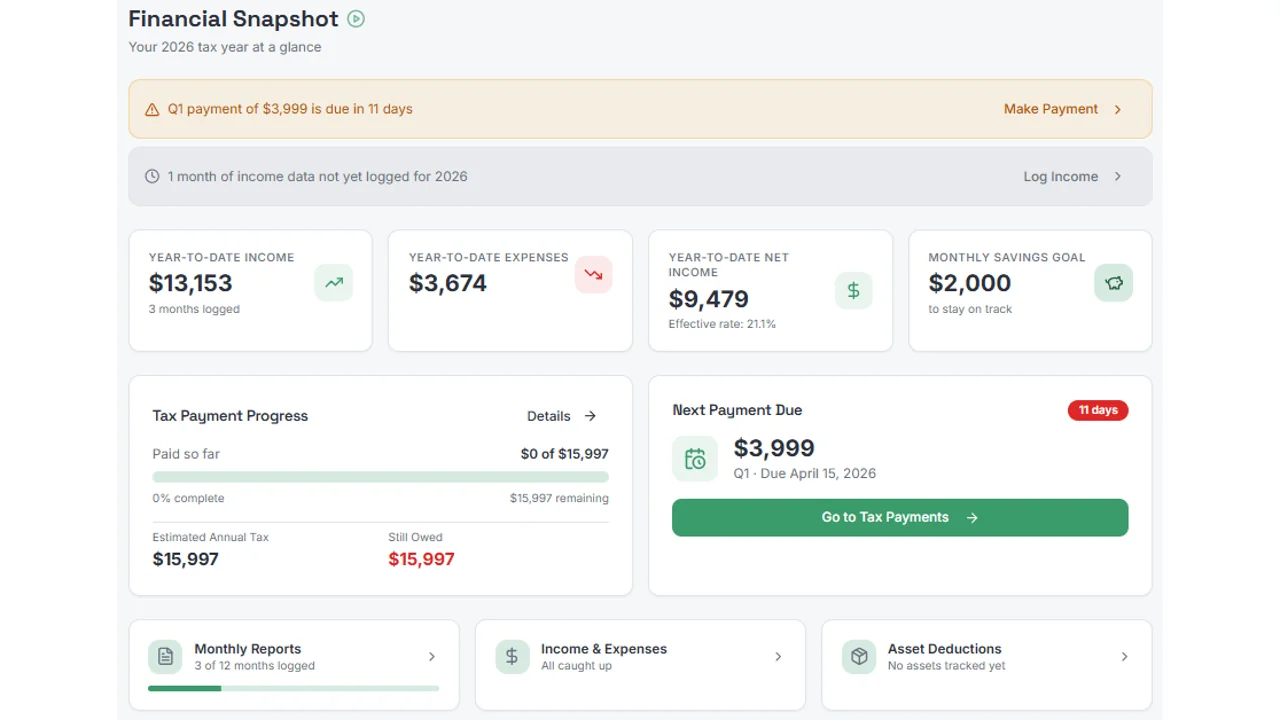
SnapTax Optimizer's Family Credits wizard gathers information about your family situation and income to help screen for CDCC, ODC, CTC, and EITC eligibility, using your net Schedule C income. Credit amounts you attest to are incorporated into the Tax Center estimate so they inform your quarterly planning during the year, not just at filing. SnapTax helps you model your tax picture proactively - but it does not determine final credit eligibility or guarantee a required estimated-tax payment amount. Material credit and estimated-payment decisions should be verified with a qualified tax professional. Try SnapTax Optimizer free at snaptaxapp.com - no credit card required.
What records does the IRS require to claim these credits?
Each credit requires specific documentation, and accurate records are essential regardless of which credits you're claiming.
For the CDCC, you generally must report each care provider's name, address, and taxpayer identification number on Form 2441. If a provider will not supply a TIN, retain documentation that you requested it - there is a due-diligence exception in some circumstances, but review the Form 2441 instructions before assuming it applies.
For the EITC, your Schedule C and Schedule SE need to be accurate and consistent. Clean books throughout the year are the most practical foundation - the EITC calculation depends on net self-employment earnings, and supporting documentation for qualifying-child eligibility (SSN, relationship, residency) and investment income (total below $12,200) is also required.
For CTC and ACTC, a qualifying child generally must have a valid SSN issued before the return due date. For the ODC, a qualifying dependent may be eligible with an SSN, ITIN, or ATIN - the identification-number requirements differ from those for the CTC. Consult IRS Publication 972 for the applicable rules by credit type.
Records needed for each credit:
CDCC:
Care provider name, address, and EIN or SSN
Total amount paid to each provider during the year
Statement or receipt from the provider showing dates and amounts
CTC / ODC:
Qualifying child's valid SSN for CTC/ACTC purposes, or the dependent's applicable taxpayer identification number (SSN, ITIN, or ATIN as applicable) for ODC purposes
Proof of relationship and residency (school records, medical records)
Proof of support if claiming a non-child dependent (receipts, financial records showing you provided more than half their support)
EITC:
Complete Schedule C with accurate net profit
Schedule SE showing self-employment tax calculation
Investment income documentation confirming total investment income is below $12,200
For qualifying children: SSN, birth certificate, and proof of residency
One note on the amended return window mentioned earlier: all of this documentation needs to be available for any year you're amending. The IRS can request it during review.
Try SnapTax Optimizer
SnapTax Optimizer is built specifically for freelancers and 1099 workers who want to stay on top of their tax picture throughout the year - not just at filing. The Family Credits wizard gathers information about your family situation and income to help screen for CDCC, ODC, CTC, and EITC eligibility, using your net Schedule C income. Credit amounts you attest to are incorporated into your Tax Center to inform quarterly estimated-tax planning. For final credit eligibility and estimated-payment requirements, verify with a qualified tax professional. Start free at snaptaxapp.com - no credit card required.
The CDCC, ODC, CTC, and EITC each have their own eligibility rules, income measures, and documentation requirements. None require W-2 income. None require itemizing - each may be claimed regardless of whether the taxpayer takes the standard deduction or itemizes, subject to the credit's own eligibility requirements. Net Schedule C profit is an important input for some of them, but not a single figure that drives eligibility across all four.
If you have qualifying children, dependent parents, or a college student on your return and you're not sure whether you're capturing all the credits available to you, reviewing the rules before the next quarterly deadline gives you time to incorporate attested credit amounts into your planning. The window to amend prior returns for missed credits from 2023 and 2024 may also still be open - Form 1040-X and the applicable amendment window (generally the later of three years after filing or two years after paying) are worth checking if you think credits may have been missed.
Frequently Asked Questions
Can freelancers claim the Earned Income Tax Credit?
Yes, self-employment income can count as earned income for the EITC. The final credit depends on filing status, earned income, AGI, number of qualifying children, each child's eligibility, and investment income. For 2026, the maximum EITC for an eligible taxpayer with three or more qualifying children is $8,231, and the credit is unavailable if investment income exceeds $12,200. Consult IRS Publication 596 or a tax professional for the complete eligibility calculation.
Does the Child and Dependent Care Credit require W-2 income?
No. The CDCC is available to self-employed filers with qualifying care expenses that enable them to work. On a joint return, both spouses generally need earned income unless a spouse is a full-time student or incapable of self-care. Eligible expenses are generally limited to $3,000 for one qualifying person or $6,000 for two or more, reduced by any dependent-care benefits received. The federal CDCC is nonrefundable - it reduces income-tax liability but generally does not offset self-employment tax.
What is the Credit for Other Dependents and who qualifies?
The ODC is a $500 nonrefundable credit per qualifying dependent who does not meet the Child Tax Credit requirements. Eligible dependents may include qualifying children aged 17 or older and qualifying relatives such as elderly or disabled parents you support. It phases out at the same thresholds as the CTC: $400,000 AGI for married filing jointly, $200,000 for all other filers. Unlike the CTC, ODC-eligible dependents may qualify with an SSN, ITIN, or ATIN - the identification-number rules differ from those for the CTC.
How do tax credits affect quarterly estimated tax payments?
Tax credits can reduce projected federal income-tax liability, so they may be relevant to quarterly estimated-tax planning. The effect depends on whether the credit is refundable, earned-income eligibility, self-employment tax still owed, and the taxpayer's calculation method. The CDCC and ODC are nonrefundable and do not offset self-employment tax. SnapTax Optimizer can incorporate user-confirmed credit assumptions into a projected tax estimate - verify material payment decisions with a qualified tax professional.
What income does the IRS use for EITC eligibility - gross revenue or net profit?
For self-employed filers, EITC earned income is generally based on net earnings from self-employment - not gross revenue. A freelancer with $80,000 in revenue and $50,000 in business expenses has approximately $30,000 in net Schedule C profit as a starting point. The actual EITC calculation also incorporates AGI, filing status, qualifying-child rules, and investment income. Gross revenue alone does not determine eligibility.
Estimate your taxes free: Use the free 1099 tax calculator to see your self-employment tax, federal income tax, and quarterly payment in minutes.
