Travel and Meal Deductions for Self-Employed Workers: What You Can Actually Write Off in 2026
Crystal Harrison · November 18, 2026 · 9 min read
Travel and Meal Deductions for Self-Employed Workers: What You Can Actually Write Off in 2026
What self-employed workers can deduct for travel and meals in 2026, how the 50% meal rule works, what counts as a business trip, and how to document it.
November 18, 2026 · 7 min read
Quick Answer: Are travel and meals deductible for self-employed workers?
Yes, but for freelancers, travel and meal deductions follow different rules. Qualifying away-from-home travel can include transportation, lodging, and meals, while a meal with a client can be deductible even without an overnight trip. Most business meals are 50% deductible, so keep the cost, date, business purpose, and records.
TL;DR
Business travel and business meals are separate deductions, and neither requires the other to qualify.
Away-from-home travel counts when your duties keep you away longer than an ordinary day's work and you need sleep or rest, not when you cross midnight.
A qualifying meal with a client can be deductible even locally; most business meals are 50% deductible, and client entertainment is not deductible.
Driving between work locations or to a client can be deductible transportation, while commuting to your regular workplace is not.
Records need the cost, date, business purpose, and supporting documents. Use an IRS allowance only when you qualify.
What counts as away-from-home travel for taxes?
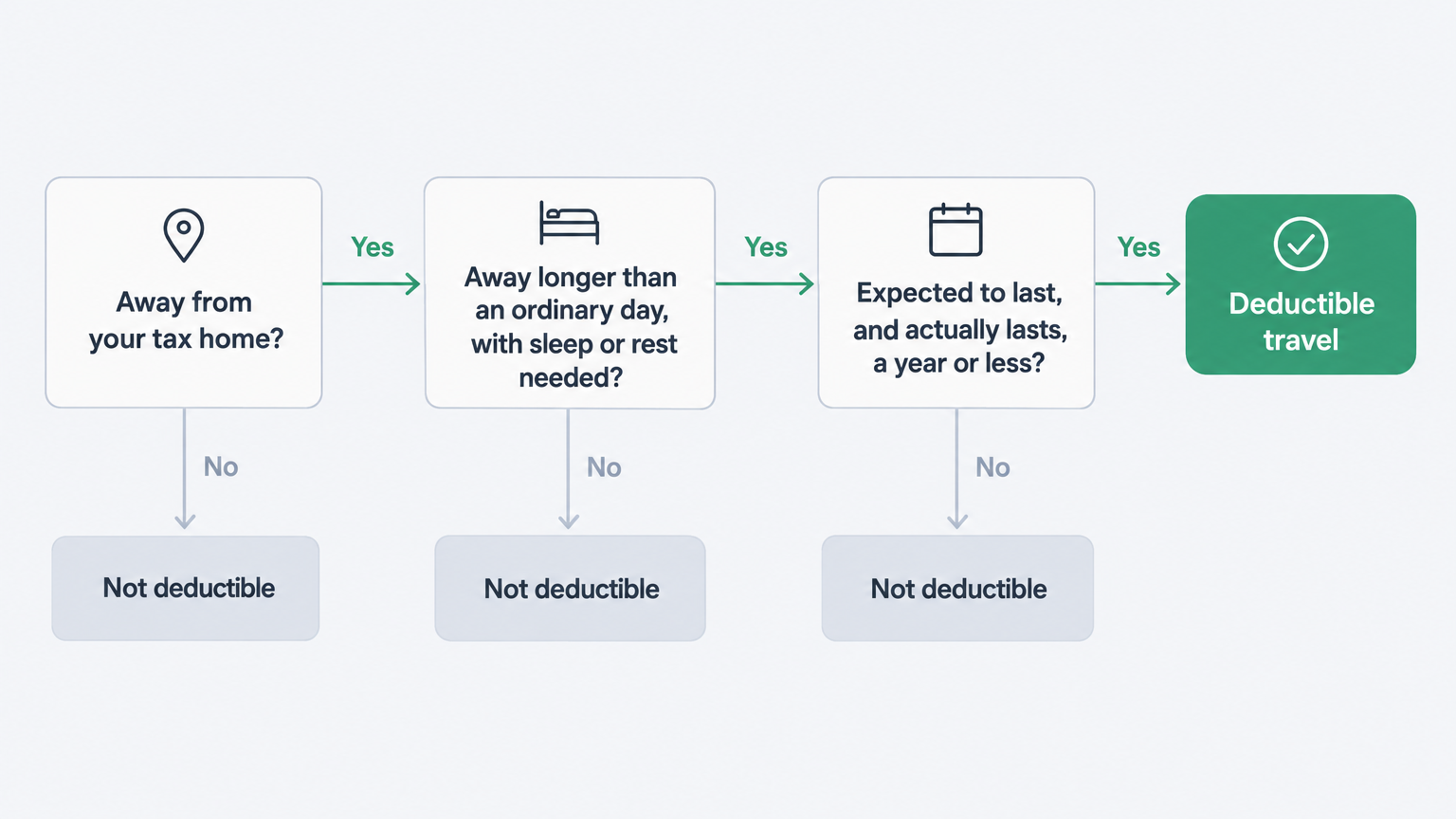
Away-from-home travel counts only when your duties keep you away from the general area of your tax home substantially longer than an ordinary day's work and you need sleep or rest. You do not have to cross midnight; necessary rest is the test (IRS Topic no. 511).
A same-day round trip with a quick lunch break does not qualify, because the break has to be long enough for necessary rest (IRS Publication 463).
Your tax home is your regular place of business or post of duty, no matter where your family home is (IRS Publication 463). So a freelancer who lives in one city but works regularly in another can only deduct away-from-home travel once past that regular work area, not the whole drive to get there.
The one-year rule decides the rest. An assignment expected to last, and that actually lasts, one year or less is generally temporary. If it is indefinite, the treatment changes from that point (IRS Topic no. 511).
Keep local driving separate. A trip does not have to qualify as overnight travel for the business driving to count. Driving between work locations or to a client can be deductible transportation, while driving from home to your regular workplace is generally commuting (IRS Publication 463).
What away-from-home travel expenses can you write off?
Once away-from-home travel qualifies, the ordinary and necessary costs of being away for business are deductible. The IRS lists the main categories in Publication 463 (IRS Publication 463).
Not every cost counts. Commuting between home and your regular workplace is out, and costs must be ordinary and necessary, not lavish or extravagant. Bringing someone along does not make their travel deductible: their expenses must independently meet the business-travel rules (IRS Publication 463).
Not sure where an expense belongs? The SnapTax "Is This Deductible?" wizard helps you work through it in plain English. You still review the facts and keep the proof.
Transportation between your tax home and the business destination, by plane, train, bus, or car.
Taxis or rideshares between the airport or station and your hotel, and between your hotel and the places you do business.
Baggage and shipping of samples or display material between work locations.
Your car at the destination, using actual costs or the standard mileage rate, plus business parking and tolls.
Lodging, and 50% of your meals.
Laundry and dry cleaning, business calls, and tips for any of these.
How does the 50% rule work for business meal deductions?
Most business meals are 50% deductible, and qualifying meals with business contacts can be deductible even when you are not traveling. Your ordinary personal meals do not qualify (IRS Topic no. 511).
For a local or traveling business meal to qualify, you or your employee must be present, the expense must serve a business purpose, and it cannot be lavish or extravagant (IRS Publication 463). That covers meals with current or prospective clients and other business contacts, not a solo lunch near your regular workplace.
On the amount, the IRS says meal deductions are "generally limited to 50% of the unreimbursed cost" (IRS Topic no. 511). Taxes and tips are part of the meal cost and fall under the limit; the cost of getting to the meal does not. On Schedule C, you enter only the deductible half on the meals line (Instructions for Schedule C).
Older articles still promise a 100% write-off for restaurant meals. That rule was real but temporary: it applied only to tax years 2021 and 2022 (IRS Notice 2021-25). For 2026, business meals are back to 50%.
Two exceptions matter. If you are subject to Department of Transportation hours-of-service limits, certain meals while traveling away from your tax home during those work periods qualify for an 80% deduction. And if a client reimburses your meal costs and you adequately account for those expenses, the meal-limit treatment generally shifts to the client; keep the expenses and reimbursements clearly documented (IRS Publication 463).
Client entertainment is separate. Taking a client to a game does not make the tickets deductible. Food purchased separately, or separately stated on a qualifying bill, may still qualify under the business-meal rules (IRS Publication 463).
These are general rules, not permission to deduct the personal part of a trip. The IRS separates primarily business from primarily personal travel, and mixed trips may require an allocation (IRS Publication 463).
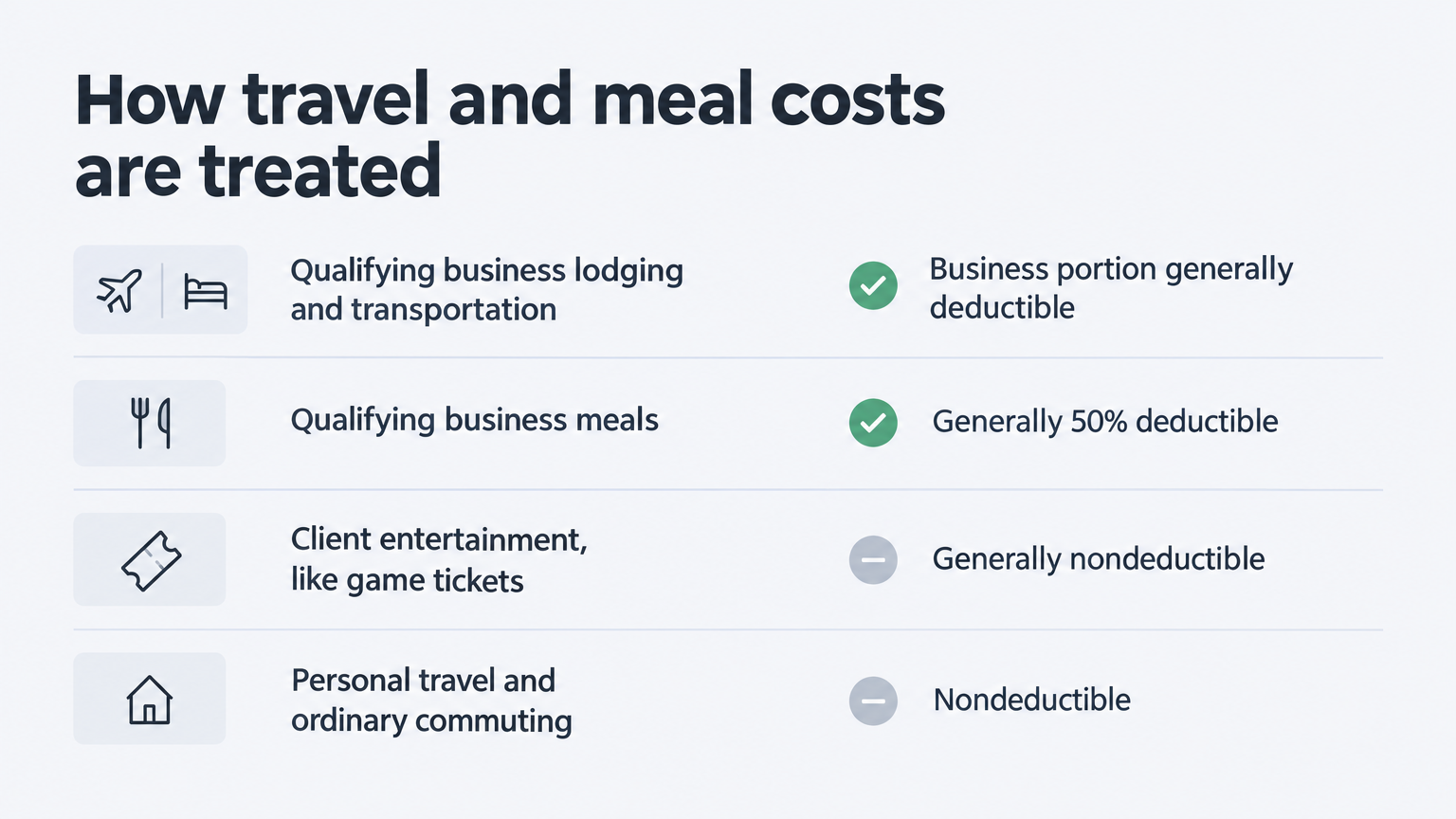
Expense | General treatment |
|---|---|
Qualifying business lodging and transportation | Business portion generally deductible |
Qualifying business meals | Generally 50% deductible |
Client entertainment, such as game tickets | Generally nondeductible |
Personal travel and ordinary commuting | Nondeductible |
How do you document travel and meals so they hold up?
You hold up by recording the required details for each expense as you go, or by using an IRS-authorized allowance when you qualify. Do not guess at actual expenses after the fact.
Publication 463's recordkeeping table asks for the amount, the time, the place, and the business purpose. When you eat with a client or guest, you also note the business relationship, meaning who was there (IRS Publication 463).
Under Publication 463, receipts are generally required for lodging and other covered expenses of $75 or more, subject to exceptions. An expense under $75 still needs a record of the required details; it is not record-free. A log kept weekly counts as timely (IRS Publication 463).
Keep the required records, or use an IRS-authorized allowance when you qualify. An approved mileage or meal allowance is not a made-up number. The IRS is direct:
"You can't deduct amounts that you approximate or estimate."
IRS Publication 463, Travel, Gift, and Car Expenses (publication)
A canceled check shows money moved, but not what you bought or why it was a business expense. The receipt fills that gap, which is why the two belong together.
Three years is a common starting point for keeping records, but longer retention periods can apply. Check the IRS guidance before clearing old records (IRS recordkeeping).
Record this | What it means in practice |
|---|---|
Amount | What each separate expense cost |
Time | The dates you left and returned, and the days spent on business |
Place | The destination, or where you ate |
Business purpose | Why the expense was for business |
Business relationship | Who was there, for a meal with a client or guest |
How do mileage and per diems simplify the math?
Two IRS allowances let you skip the receipt pile: the standard mileage rate for your car, and the standard meal allowance for meals.
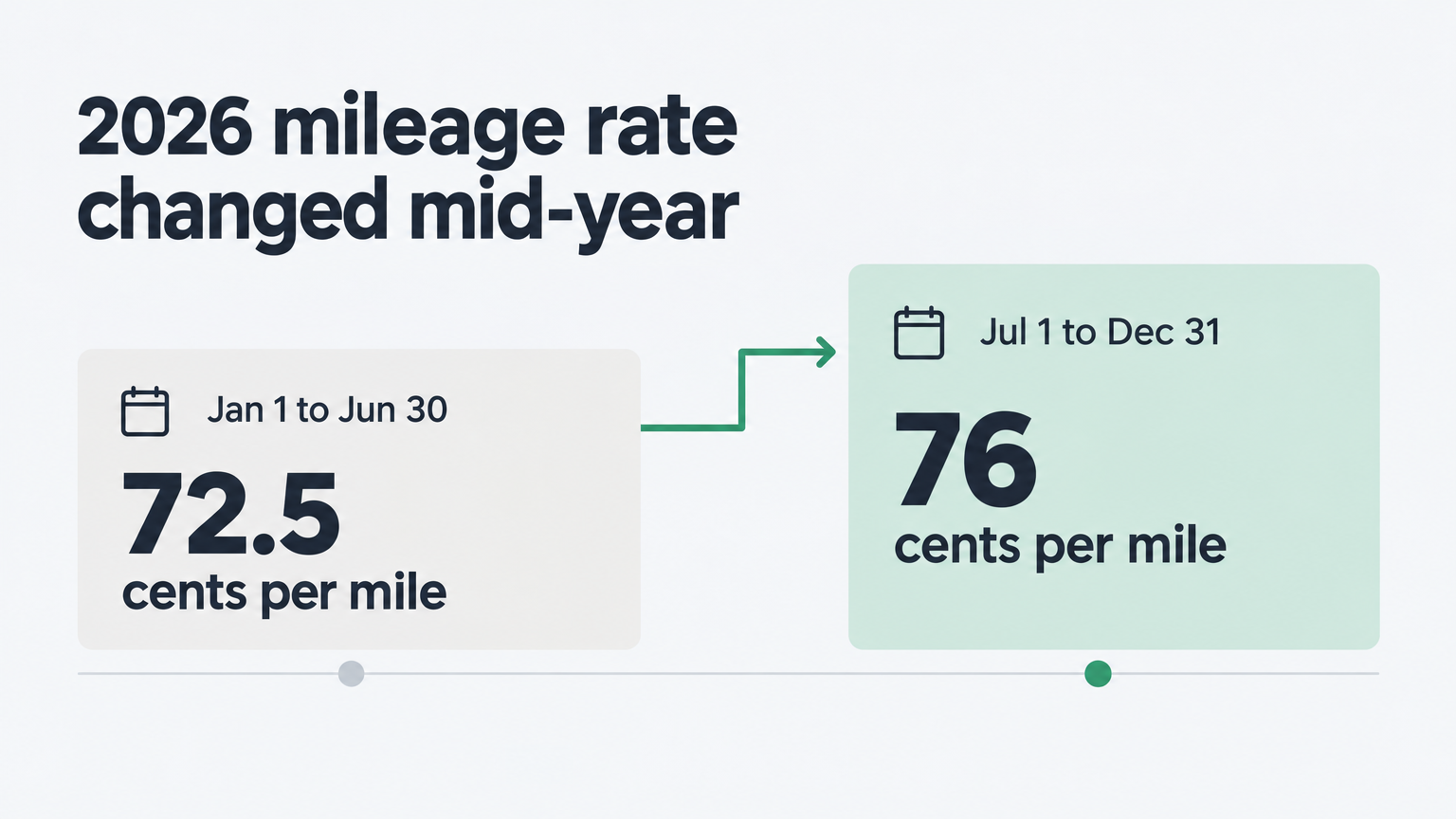
For 2026 the IRS set two business mileage rates: 72.5 cents per mile from January 1 to June 30, then 76 cents per mile from July 1 to December 31 (IRS standard mileage rates).
One condition comes with the mileage rate: if you use it, you cannot also deduct actual gas, repairs, insurance, or depreciation for that car, though you can still add business parking and tolls (IRS Publication 463).
The standard meal allowance lets eligible travelers use a location-based amount for meals and incidental expenses instead of adding up actual meal costs. You still document the trip, the usual 50% limit applies, and departure and return days generally use a reduced allowance. Self-employed travelers still substantiate actual lodging costs (IRS Publication 463).
Look up the rate for your destination and dates. Federal per diem tables follow an October to September fiscal year, so the table that applies can change during a calendar tax year (GSA per diem rates).
Try SnapTax
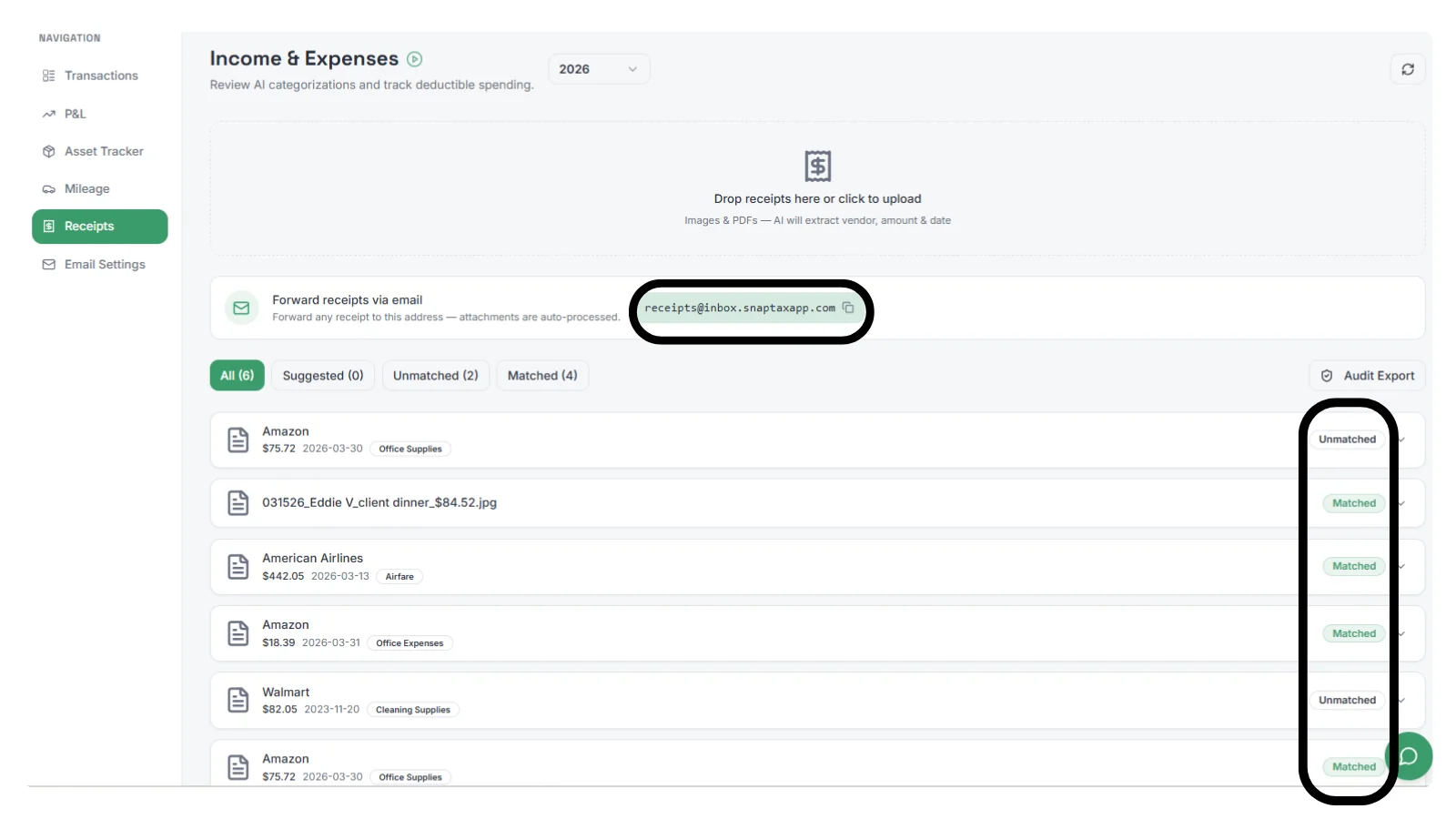
SnapTax is tax-planning software built for freelancers and 1099 workers. Start with SnapTax's free tax estimate, a basic quarterly-tax estimate with no credit card. If you want receipt capture, matching, and mileage tools, check out Builder or Optimizer; paid plans offer a 30-day trial (SnapTax pricing). SnapTax helps you organize and plan; you still file through your tax software or preparer.
Frequently Asked Questions
Can self-employed workers deduct meals?
Yes. Self-employed workers can deduct 50% of business meals on Schedule C line 24b, as long as the meals are eaten while traveling away from home on business or at a business convention. The IRS says meal deductions are "generally limited to 50% of the unreimbursed cost" (IRS Topic no. 511).
What counts as a business trip for taxes?
A trip counts as business travel only when it keeps you away from your tax home substantially longer than an ordinary day's work and you need sleep or rest to meet the demands of that work. An assignment you expect to last more than a year is indefinite, so the new location becomes your tax home and the travel deduction disappears (IRS Publication 463, IRS Topic no. 511).
What is the 2026 business mileage rate?
The 2026 business mileage rate is 72.5 cents per mile from January 1 to June 30, then 76 cents per mile from July 1 to December 31 (IRS standard mileage rates).
What records do I need for travel and meal deductions?
You need the amount, the time, the place, and the business purpose for each expense. When you eat with a client or guest, you also note the business relationship, meaning who was there. You do not need a receipt for a non-lodging expense under $75, and the IRS does not accept estimates (IRS Publication 463).
Are restaurant meals 100% deductible in 2026?
No. The 100% deduction for restaurant food and beverages applied only to tax years 2021 and 2022. For 2026, business meals are back to the 50% limit (IRS Notice 2021-25, IRS Topic no. 511).
