Year-End Bookkeeping Checklist for Freelancers: Close Your Books Before January
Crystal Harrison · November 22, 2026 · 9 min read
Year-End Bookkeeping Checklist for Freelancers: Get Ready in December, Finish Clean in January
This year-end bookkeeping checklist for freelancers walks through every step, from reconciling income to logging final receipts, so your books are clean before your accountant asks for them.
November 22, 2026 · 8 min read
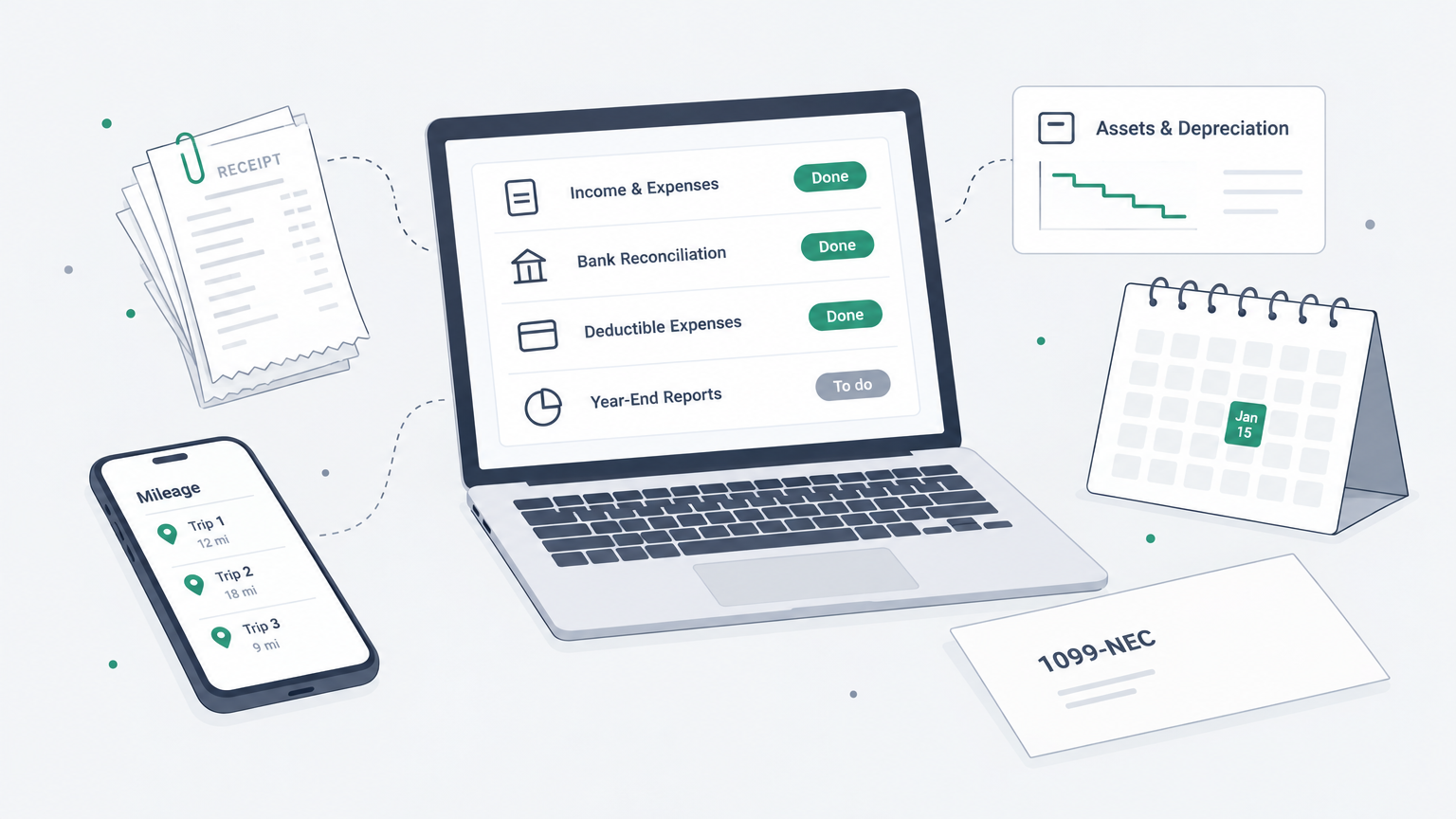
Quick Answer: What do I need to do to close my books at year end as a freelancer?
Start in December by catching up transactions, receipts, mileage, and asset records. Finish the close in January once your final statements arrive, then compare your books with any tax forms you receive. Work through this year-end bookkeeping checklist for freelancers in that order, and review your estimated tax position before the January 15, 2027 payment.
TL;DR
December is for catching up and January is for the close, because December activity and incoming 1099s do not exist yet.
Key 2027 dates: January 15 estimated payment, February 1 for Form 1099-NEC (January 31 is a Sunday), and April 15 for your return.
For 2026, business mileage is split: 72.5 cents per mile January to June and 76 cents July to December (IRS).
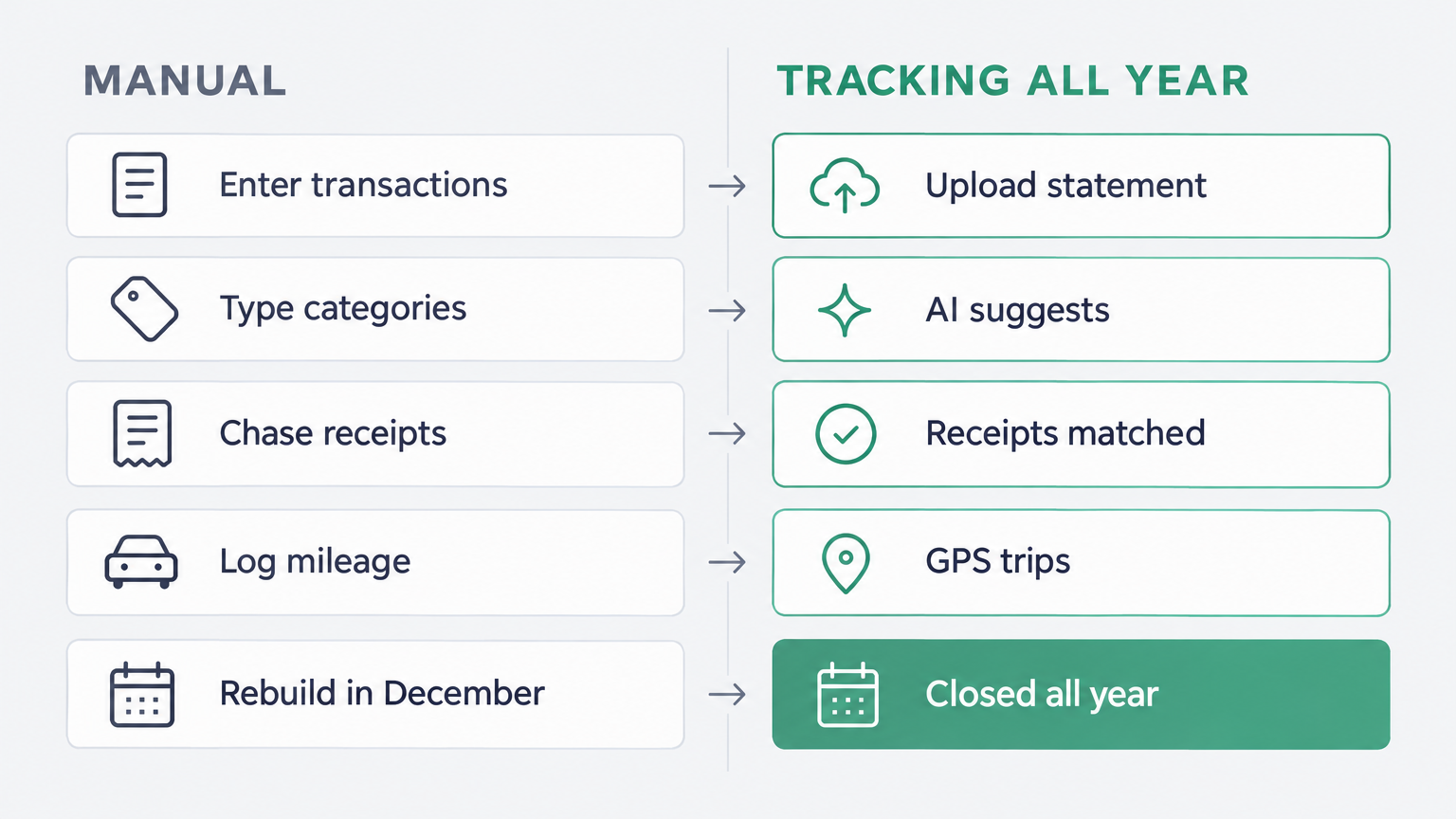
SnapTax tracks these items all year and includes a year-end close-out wizard, so January is a review rather than a rebuild.
Why does year-end bookkeeping matter more for a freelancer than for an employee?
Closing your books tells you where your fourth-quarter estimate landed, because nobody withholds tax for you. An employee's W-2 arrives already totaled; a freelancer's income arrives as Stripe, PayPal and Venmo payments nobody else adds up.
Self-employment tax is 15.3%, made up of 12.4% for Social Security and 2.9% for Medicare (IRS).
You file Schedule SE once your net earnings reach $400, and the employer-equivalent half of that tax is deductible (IRS).
What goes on a year-end bookkeeping checklist for freelancers?
Eight steps turn a pile of December statements into a net profit you would sign your name to. Do the catching-up steps first, then confirm in January.
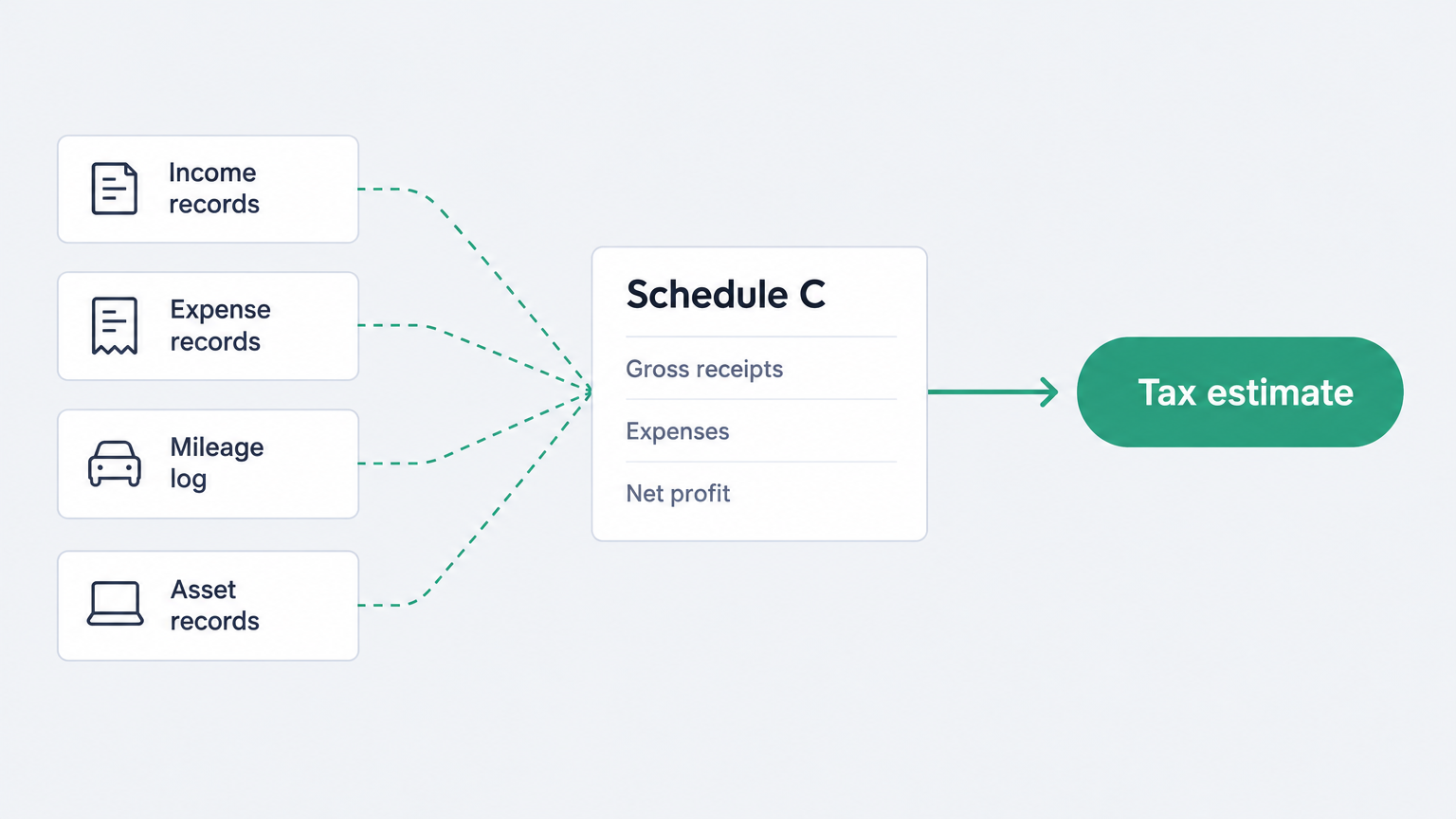
Reconcile every payment you received. Tie every payment received, through Stripe, PayPal, checks and cash, back to your invoices. Processor deposits may be net of fees, so reconcile processor reports to your deposits to capture gross receipts and the fees (IRS), and do not book the same sale twice when a 1099-K or 1099-NEC arrives. Gross receipts go on Schedule C, line 1 (Instructions for Schedule C).
Catch up expenses and attach supporting records. Show what you bought, the amount, when you paid, and why it was business (Publication 583). Travel, meals, gifts and vehicle expenses can require more, including the time, the place and the business purpose, plus a receipt (Publication 463). The 1099 freelancer deduction checklist lists 47 write-offs with the rule for each.
Group expenses into Schedule C categories and set business use. Expenses sit in Part II before the total carries to line 28, so uncategorized spending means missed or misreported deductions (Instructions for Schedule C). In a mixed account, exclude personal items, identify transfers, and allocate genuinely mixed-use costs with a supported percentage.
Close the mileage log through December 31. For 2026, separate business miles driven January to June from July to December, because the rates are 72.5 and 76 cents per mile (IRS). Keep trip details and total annual mileage to support the deduction. Report car and truck expenses on Schedule C, line 9, and complete the required vehicle information in Schedule C Part IV or Form 4562, as applicable (Instructions for Schedule C).
Review asset purchases while the elections are still open. Depreciation starts when an asset is placed in service, ready and available for business use, not the day you paid for it (Publication 946). Without an applicable financial statement, smaller purchases may fit the $2,500 de minimis safe harbor (IRS), while larger ones may qualify for 100% additional first-year depreciation if acquired after January 19, 2025 (IRS Newsroom). Section 179 requires more than 50% business use and is subject to other limits (Publication 946).
Review the 1099s on both sides. The Form 1099-NEC threshold rose to $2,000 for tax years beginning after 2025, so fewer clients will send one, but you report the income anyway (IRS). You may also have to issue one if you paid a contractor, such as a designer or developer, $2,000 or more (IRS). If a client's reported amount exceeds your line 1 income, attach a statement explaining the difference (Instructions for Schedule C).
Weigh a retirement contribution. A SEP-IRA can be funded up to your return due date including extensions (IRS), with a 2026 ceiling of $72,000 (IRS). Those are maximums: a SEP depends on eligible compensation and the self-employed calculation (Publication 560), and an IRA deduction can phase out if you or a spouse are covered by a plan at work (IRS). An IRA is capped at $7,500 for 2026, or $8,600 if you are 50 or older (IRS).
Review your final estimated-tax installment. Estimated payments are generally required when you expect to owe at least $1,000 after withholding and refundable credits and those amounts won't meet an applicable payment threshold (IRS). Compare projected tax, withholding, credits and payments already made before deciding what to pay by January 15, 2027 (IRS). All four dates sit on the 2026-2027 tax deadline calendar.
Which year-end dates should a freelancer circle?
Four dates matter, and three fall after the year ends.
A January payment can reduce an outstanding shortfall, but it does not automatically erase penalties from earlier missed installments. The IRS splits the year into four payment periods and checks whether enough was paid on time in each (IRS), and uneven income may qualify for the annualized-income method (IRS). Staying inside a safe harbor, 90% of this year's tax or 100% of last year's, or 110% above $150,000 of prior-year adjusted gross income ($75,000 married filing separately), beats guessing (IRS). Meeting the annual total is not enough if required installments were paid late (IRS).
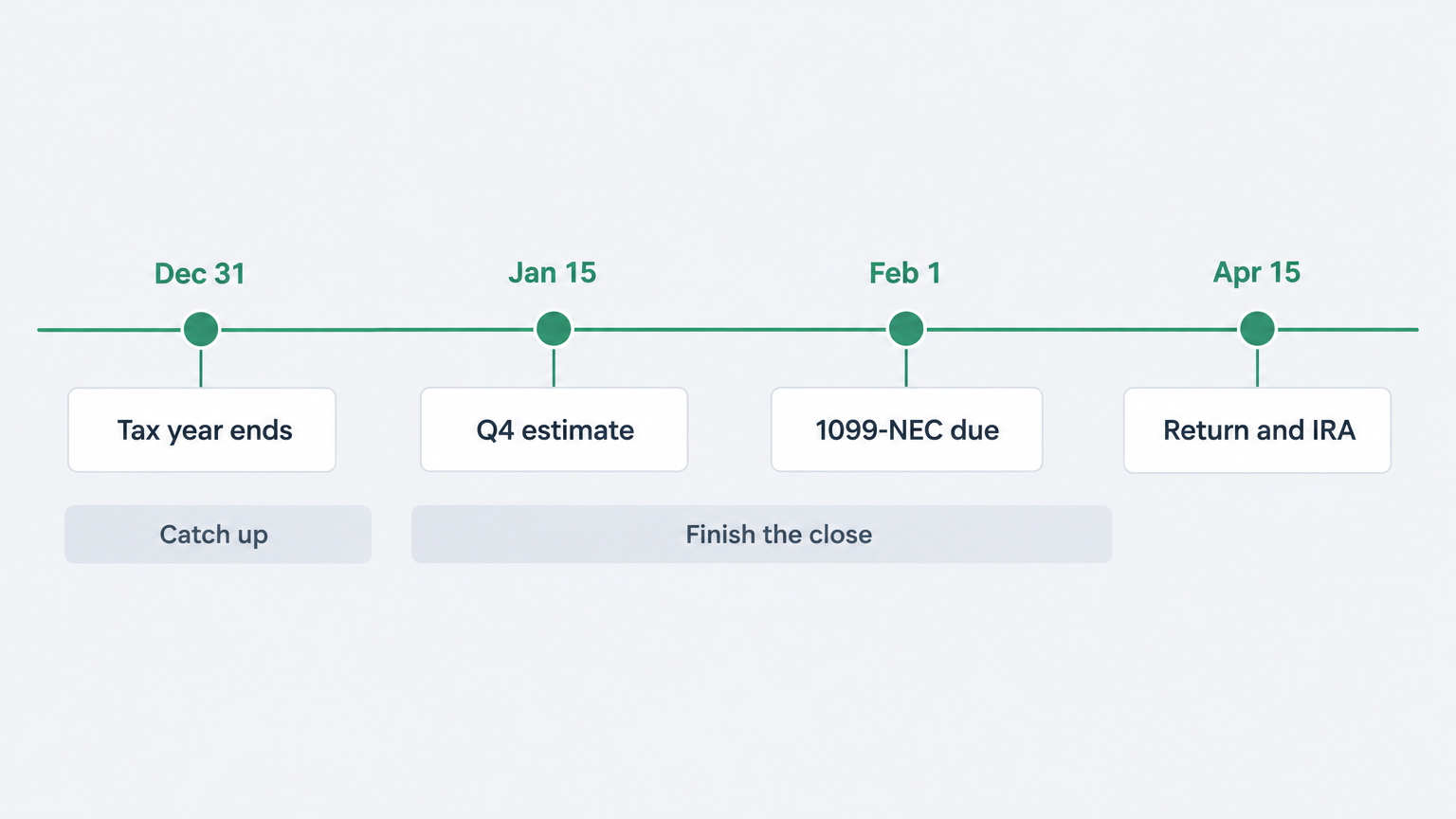
Date | What it means |
|---|---|
December 31, 2026 | Tax year ends; do anything that requires year-end execution (Instructions for Schedule C) |
January 15, 2027 | Final estimated-tax installment deadline for 2026 (IRS) |
February 1, 2027 | The usual January 31 Form 1099-NEC deadline shifts because it falls on a Sunday (IRS) |
April 15, 2027 | Individual return deadline; deadline for eligible 2026 IRA contributions (Publication 590-A) |
How long do you need to keep all of it?
Three years is a common federal retention period, generally measured from the return's due date or the date you filed, whichever is later. Longer periods can apply. Keep asset records through the applicable retention period for the year of disposal (IRS). Electronic records count too; the same requirements apply as to paper (Publication 583). For expenses under the travel rules, a receipt may not be needed below $75, except for lodging, but you still need records of the amount and purpose (Publication 463). That is not a blanket exemption for small purchases.
What do freelancers say actually goes wrong at year end?
The same story comes back every time: the system works in theory and disappears by April.
The cost lands later. Crystal Harrison, the bookkeeper who founded SnapTax, describes a client who paid about $2,000 to rebuild a year of missing receipts (Thriving Through).
Every year I think I'll be more organized... and every year when tax season hits, I'm digging through random folders for old statements, receipts, and invoices.
Reddit, r/personalfinance, u/Ok_Garbage6916, Apr 29, 2025. See the thread on Reddit.
What should you hand over if you work with a bookkeeper?
Hand over one folder a stranger could follow.
A profit and loss statement for the year, not a bank export.
Every transaction categorized, with personal transactions excluded and mixed-use expenses allocated.
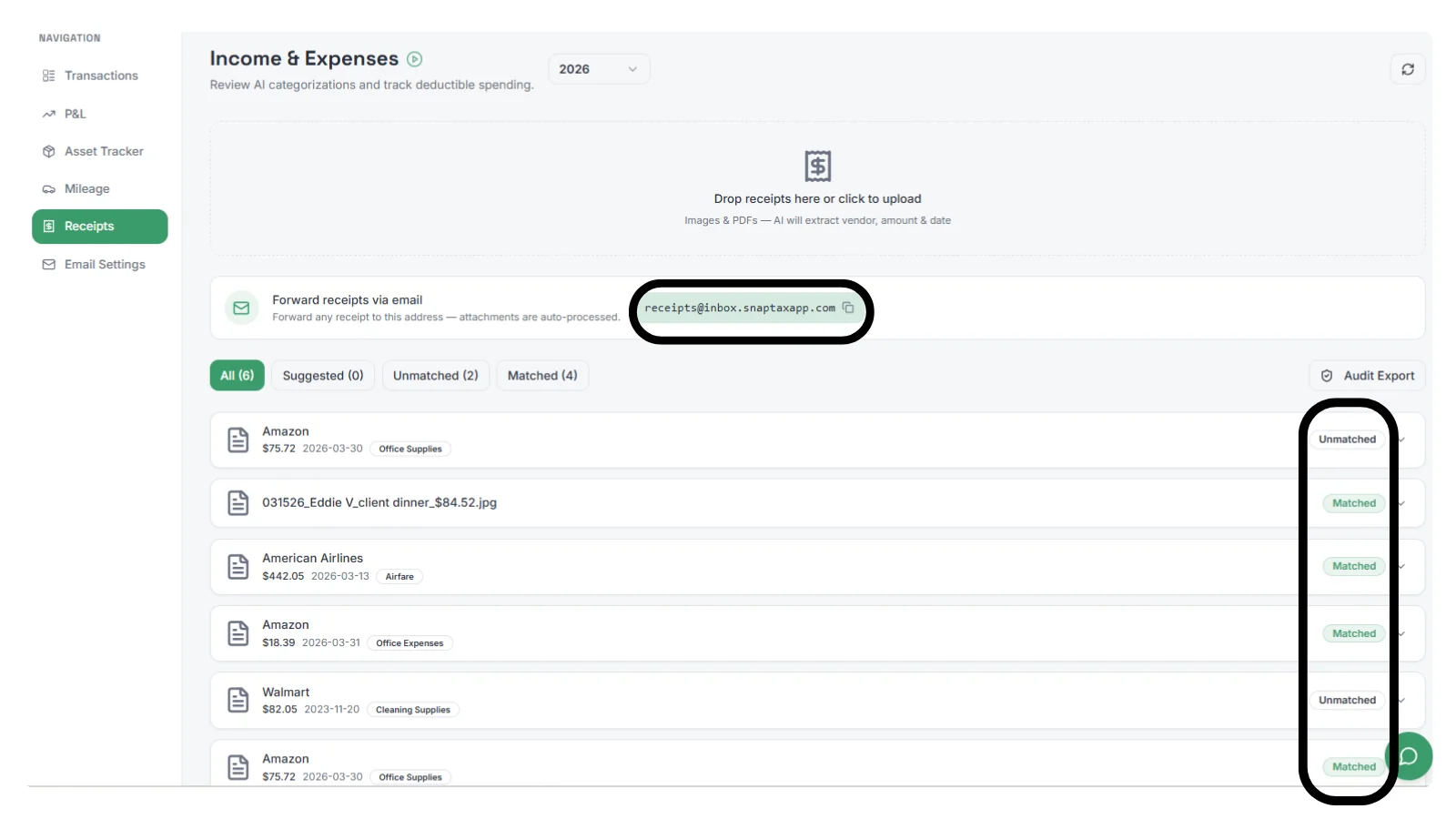
Receipts attached to matched transactions, with unmatched ones flagged.
A mileage log with year totals and vehicle details.
An asset list with purchase and placed-in-service dates, costs, business use, prior depreciation, and any sales or disposals.
The 1099s you received, any you issued, and your estimated payments already made.
Try SnapTax
SnapTax is tax planning software built for freelancers, and most of this checklist is done by the time December arrives. Upload a bank statement and AI suggests categories you review, match receipts as you capture them, and log mileage from your phone, so your estimate stays current. A year-end close-out wizard then locks the completed year, and you can unlock a year if you need to change something (SnapTax pricing). For the full system, read the independent contractor accounting guide.
There is a free tier that gives you a basic quarterly-tax estimate and never expires, and each paid plan has a 30-day trial you can cancel any time.
Frequently Asked Questions
What do I need to do to close my books at year end as a freelancer?
Run the close in two stages. In December, catch up transactions, receipts, mileage, and asset records. In January, reconcile the final statements as they arrive. Review your estimated-tax position before January 15, 2027 using your own records, and don't wait for every tax form. Compare incoming 1099s with your books afterward, and separately prepare any forms you must issue.
When is the year-end deadline for freelancers?
December 31 ends the calendar tax year. Three important deadlines follow. January 15, 2027 is generally the final estimated-tax installment deadline for 2026. February 1, 2027 is generally the deadline to furnish and file required Forms 1099-NEC for 2026, because January 31 falls on a Sunday; this can apply to forms your clients issue to you and forms you must issue to contractors. April 15, 2027 is generally the individual return deadline and the deadline for eligible 2026 IRA contributions.
Do freelancers need to keep receipts at year end?
You need enough records to show what you bought, the amount, when you paid, and why it was business, as Publication 583 describes. Travel, meals, gifts and vehicle expenses can require more, including the time, the place and the business purpose, per Publication 463. For certain travel-rule expenses a receipt may not be required below $75, except for lodging, but you still need records supporting the amount and business purpose.
Do freelancers need to issue Forms 1099-NEC?
Sometimes. Clients may send a form to you, but you may also need to issue forms for qualifying business payments you made to contractors, as the IRS explains. For tax years beginning after 2025 the general threshold is $2,000, subject to the reporting rules and exceptions. Review both sides: forms you expect to receive and forms you may need to send.
How long should a freelancer keep bookkeeping records?
Three years is a common federal retention period, generally measured from the return's due date or the date you filed, whichever is later. Longer periods can apply. Keep asset records through the applicable retention period for the year of disposal, per the IRS. Electronic records count too, since the same requirements apply as to paper.
