Freelancer LLC Taxes Explained (2026): How LLC Taxes Work + How to Pay Less
Crystal Harrison · April 1, 2026 · 12 min read
Freelancer LLC Taxes Explained (2026): How LLC Taxes Work + How to Pay Less

If you are a freelancer with an LLC, freelancer LLC taxes probably feel confusing, unpredictable, and expensive. You are not alone. Most independent contractors share the same fears: overpaying taxes, missing deductions they qualify for, and not knowing what to save each quarter.
The good news? Understanding how LLC taxes work is not as complicated as it seems. This guide breaks down exactly how LLC taxes work for freelancers in 2026 (using current rates and rules) and shows you how to legally pay less while staying compliant.
What you'll learn
How freelancer LLC taxes work
How much freelancers should save for taxes
Quarterly tax deadlines for 2026
Tax deductions freelancers often miss
When an S-Corp election makes sense

What an LLC Means for Your Taxes as a Freelancer
What an LLC actually is (and isn't)
An LLC (Limited Liability Company) gives you legal protection, but it is not a tax type by default. Many freelancers form LLCs thinking they will automatically get tax benefits, but that is not how it works.
By default, the IRS treats single-member LLCs as "disregarded entities" (taxed as sole proprietors). Multi-member LLCs are taxed as partnerships. Either way, you get pass-through taxation, which means business income flows directly to your personal tax return. The LLC itself does not pay federal income tax.
Why freelancers choose LLCs
Despite no automatic tax benefits, freelancers form LLCs for three main reasons:
Liability protection: Your personal assets (house, car, savings) are generally protected from business debts and lawsuits
Credibility: Clients often view LLCs as more professional than sole proprietorships
Flexible tax options: You can elect to be taxed as an S-Corp or C-Corp later if it makes sense financially
How Freelancer LLC Taxes Actually Work
Here is where many freelancers get surprised. Your LLC does not change your tax rates, but you do face additional taxes that employees do not pay.
Self-employment tax: This is the big one. You pay 15.3% on 92.35% of your net earnings, which breaks down to:
12.4% for Social Security (capped at $184,500 of net earnings for 2026)
2.9% for Medicare (no cap)
Additional 0.9% Medicare surtax on earnings over $200,000 ($250,000 married filing jointly)
Federal income tax: Your business profit gets added to any other income and taxed at progressive rates (10% to 37% depending on total income).
State income tax: Varies by location, ranging from 0% (no income tax states) to over 13%.
Self-employment tax is one of the biggest surprises in freelancer LLC taxes. When you are an employee, your employer pays half of Social Security and Medicare. As an LLC owner, you pay both portions yourself.
Biggest Freelancer LLC Tax Mistakes to Avoid
Even experienced freelancers make expensive tax mistakes. Here are the most common ones to avoid:
Common expensive mistakes
Not separating business and personal finances: Using one bank account for everything makes tracking expenses nearly impossible and raises audit flags unless you have a great tool like SnapTax to help you keep things separate.
Not tracking expenses throughout the year: Waiting until tax time means forgetting deductible expenses
Guessing tax payments: Many freelancers either overpay (hurting cash flow) or underpay (triggering penalties)
Ignoring quarterly estimated taxes: Thinking you can just pay everything in April
Missing deductions: Not claiming home office, mileage, or qualified business income deductions
Why these mistakes cost you
The IRS charges penalties that add up quickly:
Underpayment penalty: 0.5% of unpaid taxes per month, up to 25%
Failure-to-file penalty: 5% per month, up to 25%
Interest: Accrues daily on unpaid balances at the federal short-term rate plus 3%
Plus, missing deductions means paying more tax than you legally owe. A freelancer earning $75,000 who misses just $10,000 in deductions could overpay by $3,000 or more.
Quarterly Taxes for Freelancers (2026 Guide)
What are quarterly estimated taxes?
Quarterly estimated taxes are payments freelancers make four times per year to cover income tax and self-employment tax since no employer withholds taxes for them.
The IRS operates on a "pay-as-you-go" system. Since no employer withholds taxes from your LLC income, you must make quarterly estimated tax payments covering both income tax and self-employment tax.
You are required to make quarterly payments if you expect to owe $1,000 or more in taxes for the year.
2026 quarterly due dates
Mark these dates on your calendar:
Quarter | Period Covered | Due Date |
|---|---|---|
Q1 | January 1 - March 31 | April 15, 2026 |
Q2 | April 1 - May 31 | June 17, 2026 |
Q3 | June 1 - August 31 | September 16, 2026 |
Q4 | September 1 - December 31 | January 15, 2027 |
Note that Q2 covers only two months, and Q4 covers four months. This uneven schedule confuses many freelancers.

How to calculate quarterly payments
Many people use the "safe harbor" rule, because it is generally acceptable to the IRS:
Pay 100% of your prior year's total tax liability (110% if your adjusted gross income was over $150,000), OR
Pay 90% of your current year's estimated tax liability
Use Form 1040-ES to calculate your payments. If your income fluctuates significantly, adjust each quarter rather than paying equal amounts.
Rule of thumb: Set aside 25-30% of every payment you receive. This covers federal income tax, self-employment tax, and most state taxes. Although this can hurt if you get it wrong, either you end up with a surprise tax bill at the end of the year or you end up over paying, which can hurt your cash flow.
Read our full breakdown of quarterly taxes for freelancers.
Key takeaway: Many freelancers wing it and just set aside 25–30% of their income and update their tax estimate monthly to avoid penalties and surprises.
How Freelancers Can Pay Less in Taxes (Legally)
Deductions freelancers should never miss
Deductions reduce your taxable income, which lowers both income tax and self-employment tax. Here are the big ones:
Home office deduction: $5 per square foot (simplified method, max 300 sq ft = $1,500), or actual percentage of home expenses
Business mileage: Track every mile driven for business (2026 IRS rate TBD, was $0.70/mile for 2025)
Equipment and software: Computers, phones, subscriptions, tools needed for work
Internet and phone: Business-use percentage of your bills
Professional services: Accountants, lawyers, consultants
Health insurance premiums: 100% deductible if self-employed and not eligible under a spouse's plan
Retirement contributions: SEP-IRA or Solo 401(k) contributions reduce taxable income
50% of self-employment tax: Deductible as an adjustment to income
Learn more in our full guide to freelancer tax deductions.
The QBI deduction
The Qualified Business Income (QBI) deduction lets eligible LLC owners deduct up to 20% of qualified business income. This is huge for freelancers.
To qualify, your total taxable income must generally be under $191,950 (single) or $383,900 (married filing jointly) for 2026. Even above those thresholds, you may still qualify depending on your business type.
This deduction applies to pass-through entities including LLCs, but it reduces income tax only (not self-employment tax).
S-Corp election: when it makes sense
Once your LLC consistently earns profits above $50,000 to $100,000, electing S-Corp status could save you money.
How it works:
You pay yourself a "reasonable salary" (subject to payroll taxes)
Remaining profits are distributed as dividends (not subject to self-employment tax)
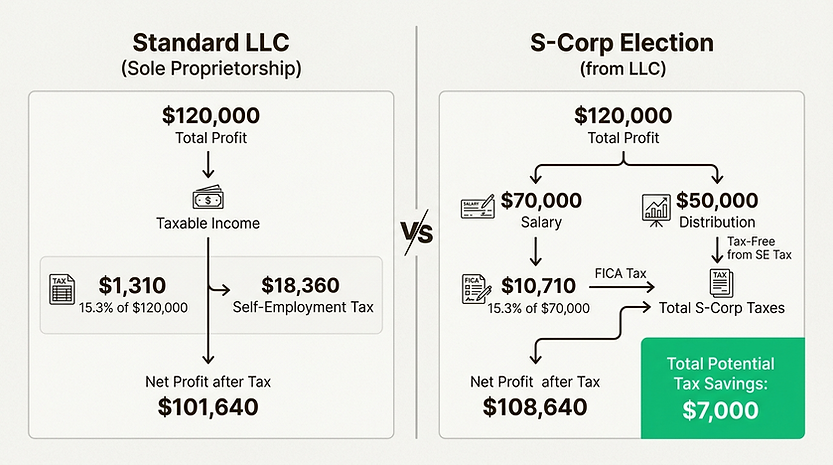
Example: Your LLC earns $120,000 in profit. As a sole proprietor, you pay self-employment tax on the full amount (about $17,000). As an S-Corp, you might take a $70,000 salary (paying payroll tax on $70,000) plus $50,000 in distributions (no self-employment tax). The savings could be $7,000+ annually.
The catch:
You must pay yourself a "reasonable salary" based on industry standards (IRS scrutiny area)
Additional complexity: payroll processing, Form 1120-S filings, K-1s
Payroll service costs ($50-200/month) offset some savings
Bottom line: Run the numbers. S-Corp election usually makes sense when your profit consistently exceeds what you would reasonably pay yourself as a salary by at least $40,000.
Simple System for Managing Freelancer LLC Taxes Year-Round
Most tax advice focuses on what to do at filing time. The freelancers who pay less and stress less follow a simple system throughout the year.
A practical approach for freelancers
1. Track income automatically
Connect your business bank account and payment processors (Stripe, PayPal, Venmo) to accounting or tax planning software. Every transaction should be captured without manual entry.
2. Categorize expenses with business-use percentages
Do not just track expenses. Track the business-use percentage for items like your phone, internet, and vehicle. SnapTax automatically calculates these percentages based on your usage patterns.
3. Maintain a live P&L
Know your profit and loss in real time, not just at year-end. This helps you adjust quarterly payments as income fluctuates.
4. Estimate taxes continuously
Update your tax estimate monthly, not quarterly. This prevents surprises and helps you set aside the right amount.
5. Set aside money weekly
Instead of scrambling to find money for quarterly payments, transfer a percentage of every payment received to a separate tax savings account. Weekly transfers are easier on cash flow than monthly or quarterly lump sums.
Record-keeping best practices
The IRS can audit returns for up to three years (six years if you underreport income by 25% or more). Keep these records:
All business income (invoices, 1099s, payment processor statements)
Receipts for business expenses
Mileage logs
Home office documentation
Bank and credit card statements
Digital records are preferred and hold up better in audits. Take photos of paper receipts immediately and store them in the cloud. Or find a good application to help you organize and store them.
Stop guessing your taxes with SnapTax
You started freelancing to do work you enjoy, not to become an accountant. Yet most tax software still treats you like you have an accounting degree.
How we simplify freelancer LLC taxes
SnapTax is designed specifically for freelancers and 1099 contractors who need a simple way to manage LLC taxes without complex accounting software.
Our approach:
AI expense categorization: Connect your accounts and we automatically categorize transactions (no spreadsheets)
Auto business-use percentages: We calculate the exact business percentage for your phone, internet, home office, and vehicle based on actual usage
Live P&L updates: See your real-time profit and loss as transactions occur
Real-time tax estimates: Know exactly what you owe in federal and state taxes at any moment
Quarterly payment reminders: Never miss a deadline again
Monthly savings goals: Know exactly what to set aside each month.
Asset tracking with depreciation: Automatically track equipment purchases and calculate depreciation and se the immediate tax benefit in your tax estimate.
Built for non-accountants
We believe independent contractors were not meant to become accountants or bookkeepers. That is why we focus on clarity, not complexity:
No accounting jargon
No complex setup (get going in minutes)
No learning curve
Built by bookkeepers with more than two decades of experience helping freelancers
Who SnapTax is for
We designed SnapTax specifically for:
1099 contractors and freelancers with simple income streams
Solo business owners who find traditional accounting software overwhelming
Anyone who wants visibility into their finances without the headache
If you are tired of guessing what to save for taxes, scrambling to find money for quarterly payments, or worrying about April surprises, we built SnapTax for you.
Get started free today and download our 2026 Independent Contractor Tax Playbook for a complete guide to quarterly taxes, deductions, and systems for staying ahead of tax liabilities.
By Crystal Harrison
Founder SnapTax and Former Professional Bookkeeper
Disclaimer: The information provided on this site is for educational purposes only and does not constitute tax, legal, or financial advice. Consult a qualified tax professional for advice specific to your situation.
Frequently Asked Questions
What are freelancer LLC taxes?
Freelancer LLC taxes refer to how LLC income is taxed as pass-through income, meaning profits are reported on your personal tax return and subject to income tax and self-employment tax.
Do freelancers with LLCs pay more taxes than sole proprietors?
No, freelancers with single-member LLCs pay the exact same taxes as sole proprietors by default. Both are pass-through entities subject to income tax and the 15.3% self-employment tax. The LLC structure provides liability protection but does not change your tax rates unless you elect S-Corp or C-Corp taxation.
How much should I save for taxes as a freelancer with an LLC?
Set aside 25-30% of your net income (revenue minus expenses) for federal and state taxes combined. This covers both income tax and self-employment tax. If you live in a high-tax state or have significant other income, aim for the higher end. Setting aside money weekly prevents quarter-end scrambles. Or use SnapTax to help you know exactly what to save.
Do I need an accountant for my LLC taxes?
Not necessarily. Many freelancers successfully handle their own taxes using software like SnapTax, especially if they have simple income streams and good record-keeping habits. Consider hiring an accountant if your situation is complex (multiple income sources, employees, significant investments) or if you are electing S-Corp status for the first time.
Can an LLC reduce my taxes compared to being a sole proprietor?
By default, no. A single-member LLC is taxed exactly like a sole proprietorship. However, an LLC gives you the flexibility to elect S-Corp taxation later, which can reduce self-employment taxes once your profits consistently exceed $50,000 to $100,000. The LLC structure itself does not provide tax savings, but it enables tax strategies that sole proprietorships cannot access.
What is the difference between an LLC and an S-Corp for tax purposes?
An LLC is a legal entity; an S-Corp is a tax election. By default, LLC owners pay self-employment tax (15.3%) on all net profits. With S-Corp election, you split income into a 'reasonable salary' (subject to payroll tax) and distributions (not subject to self-employment tax). S-Corp election typically saves money once profits exceed what you would reasonably pay yourself as a salary by about $40,000 or more.
When are quarterly taxes due for freelancers with LLCs in 2026?
The 2026 quarterly estimated tax due dates are April 15, June 17, September 16, and January 15, 2027. You must make quarterly payments if you expect to owe $1,000 or more in taxes for the year. Use Form 1040-ES to calculate your payments or use tax software that estimates them automatically based on your real-time income.
What deductions can freelancers with LLCs claim?
Freelancers with LLCs can claim home office expenses, business mileage, equipment and software, internet and phone (business-use percentage), professional services, health insurance premiums (if self-employed), retirement contributions, and 50% of self-employment tax. The Qualified Business Income (QBI) deduction may also let you deduct up to 20% of qualified business income. Keep detailed records and receipts for all deductions.
