Self-Employed Tax Deductions Checklist 2026: Year-End Guide
Crystal Harrison · November 27, 2026 · 8 min read
Last updated:
Self-Employed Tax Deductions Checklist for 2026: What to Do Before the Year Closes
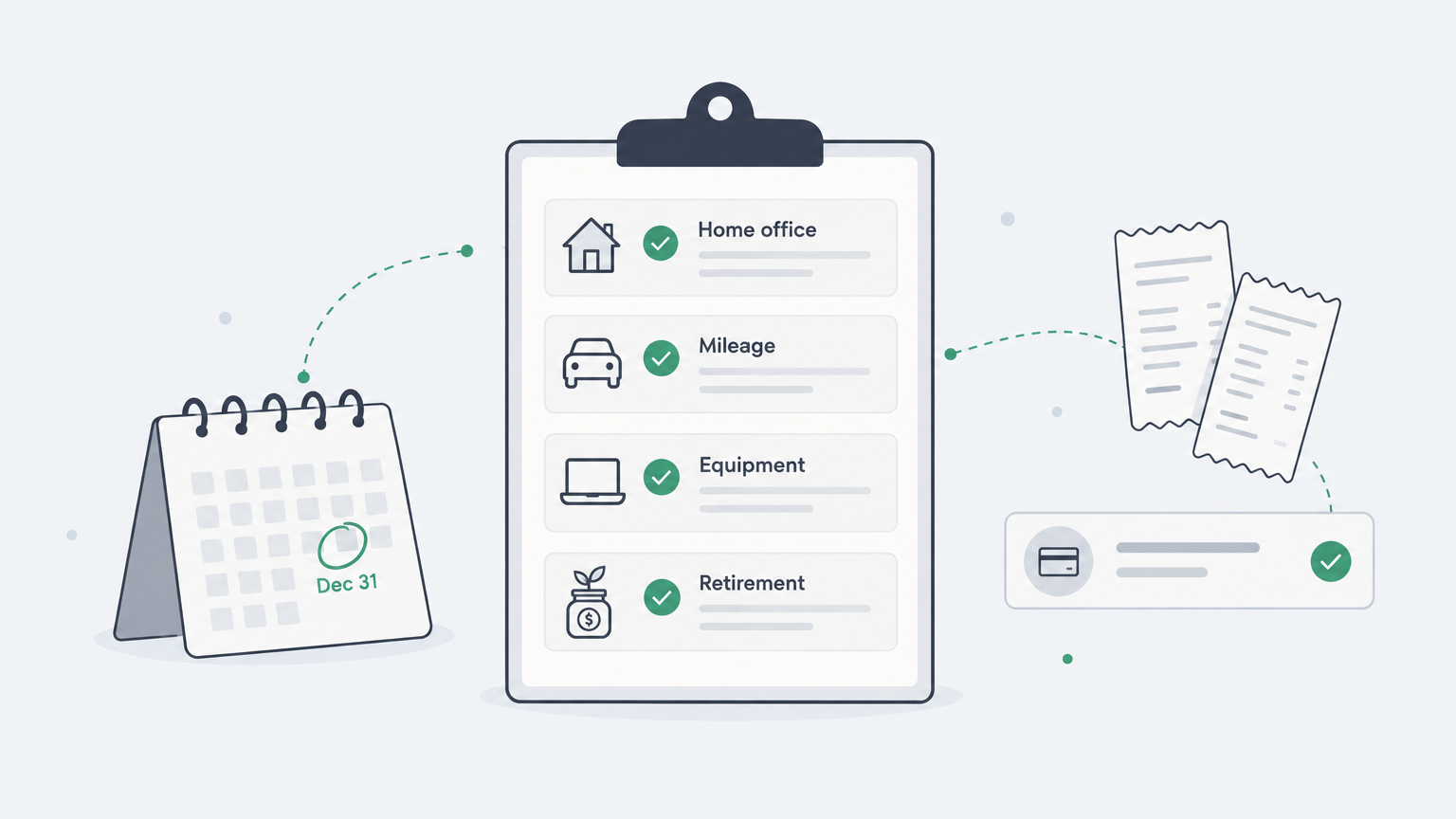
This self-employed tax deductions checklist for 2026 covers the categories you can still act on before December 31: home office, vehicle, equipment purchases, retirement contributions, and more.
November 27, 2026 · 5 min read
By the SnapTax Team · 5 min read
Quick Answer: Which self-employed tax deductions can I still claim before December 31?
Most self-employed tax deductions still count before December 31, 2026, but some have a hard cutoff. Equipment counts when placed in service by December 31, and most expenses count in the year you pay. A sole proprietor with no employees starting a first-year solo 401(k) may adopt it as late as the filing deadline; other owners need a plan by December 31.
TL;DR
Most deductions count in the year you pay them; equipment counts when placed in service.
A sole proprietor with no employees starting a first-year solo 401(k) may adopt it as late as the filing deadline; other owners need a plan by December 31.
SEP-IRA and IRA contributions can wait until you file; 2026 mileage is 72.5 cents per mile (January to June) and 76 cents (July to December).
Key 2027 dates: January 15, February 1 (Form 1099-NEC) and April 15.
SnapTax can help manage all of this! Emails before deadlines, checklists to ensure everything is covered and automations that makes monthly tracking easy and complete coverage for businesses, capital gains and retirement planning.
How the 2026 year-end deduction window actually works
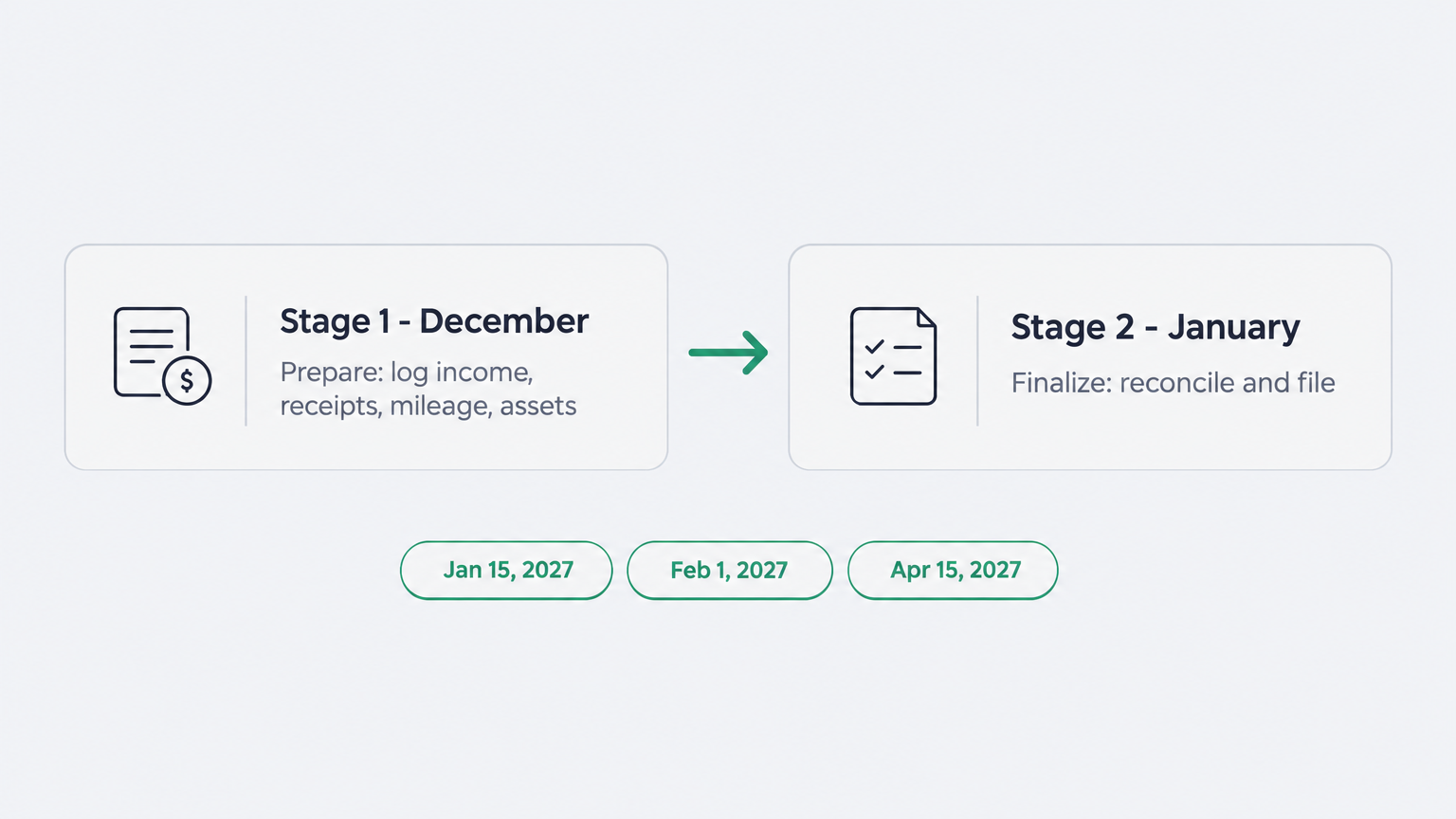
The year-end deduction window runs in two stages, and treating it as one costs money. December is for catching up on transactions, receipts, mileage and asset purchases; January is for reconciling, once final statements and tax forms arrive.
Three dates close out the 2026 tax year:
January 15, 2027 - the final 2026 estimated-tax installment (IRS).
February 1, 2027 - the Form 1099-NEC deadline, moved from the usual January 31 because that date is a Sunday (IRS).
April 15, 2027 - your return and the last day for 2026 traditional or Roth IRA contributions (IRS); a SEP-IRA can run later, up to the return due date including extensions.
SnapTax estimates your quarterly tax as income comes in, so the December review is a check, not a scramble.
Which 2026 self-employed tax deductions can I still claim?
You can still claim every category below for 2026, as long as you pay the cost, or place the asset in service, by December 31.
Deduction | How to lock it in | 2026 figure or rule |
|---|---|---|
Home office | Used regularly and exclusively for business, including your principal place of business | $5 per square foot up to 300 sq ft, or actual costs by percentage (IRS) |
Vehicle and mileage | Every business mile logged | 72.5 cents per mile January to June 2026; 76 cents July to December 2026 (IRS) |
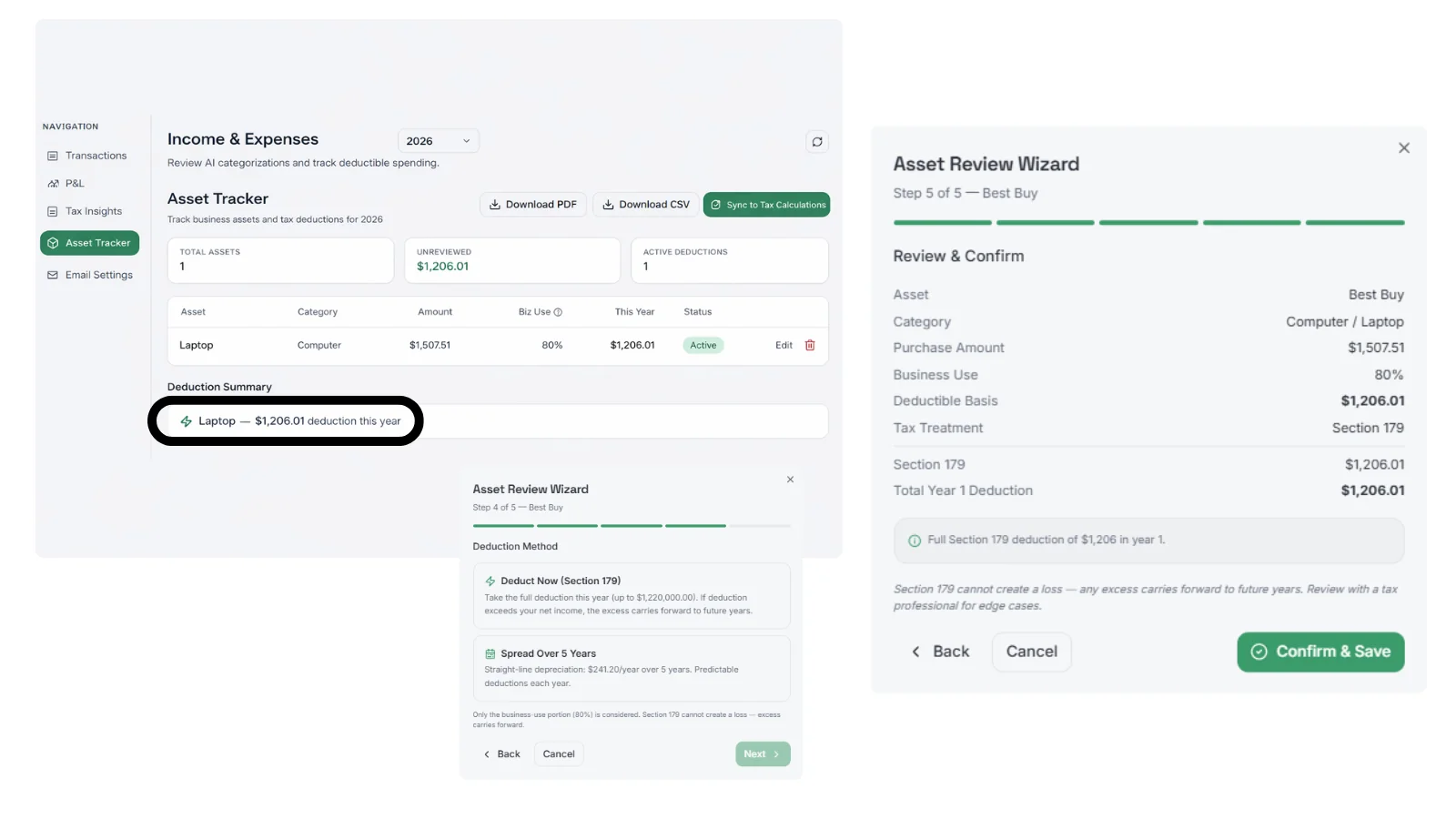
Equipment and large purchases | Placed in service by December 31 | Up to $2,500 per item under the de minimis safe harbor (election required), or Section 179 or 100% bonus depreciation (IRS) |
Health insurance | Premiums paid this year | Premiums for you, your spouse and dependents, when the business has net profit; not allowed if you were eligible for an employer plan, including a spouse's (IRS) |
Retirement contribution | Solo 401(k) generally by December 31 | 2026 ceilings: solo 401(k) $72,000, including a $24,500 deferral; SEP $72,000; IRA $7,500. Actual limits depend on net earnings and age (IRS) |
Business travel and meals | Trips and meals for the business | Travel is deductible; meals are 50% deductible for a business purpose, and entertainment tickets are not (IRS) |
What has to happen by December 31, and what can wait until you file?
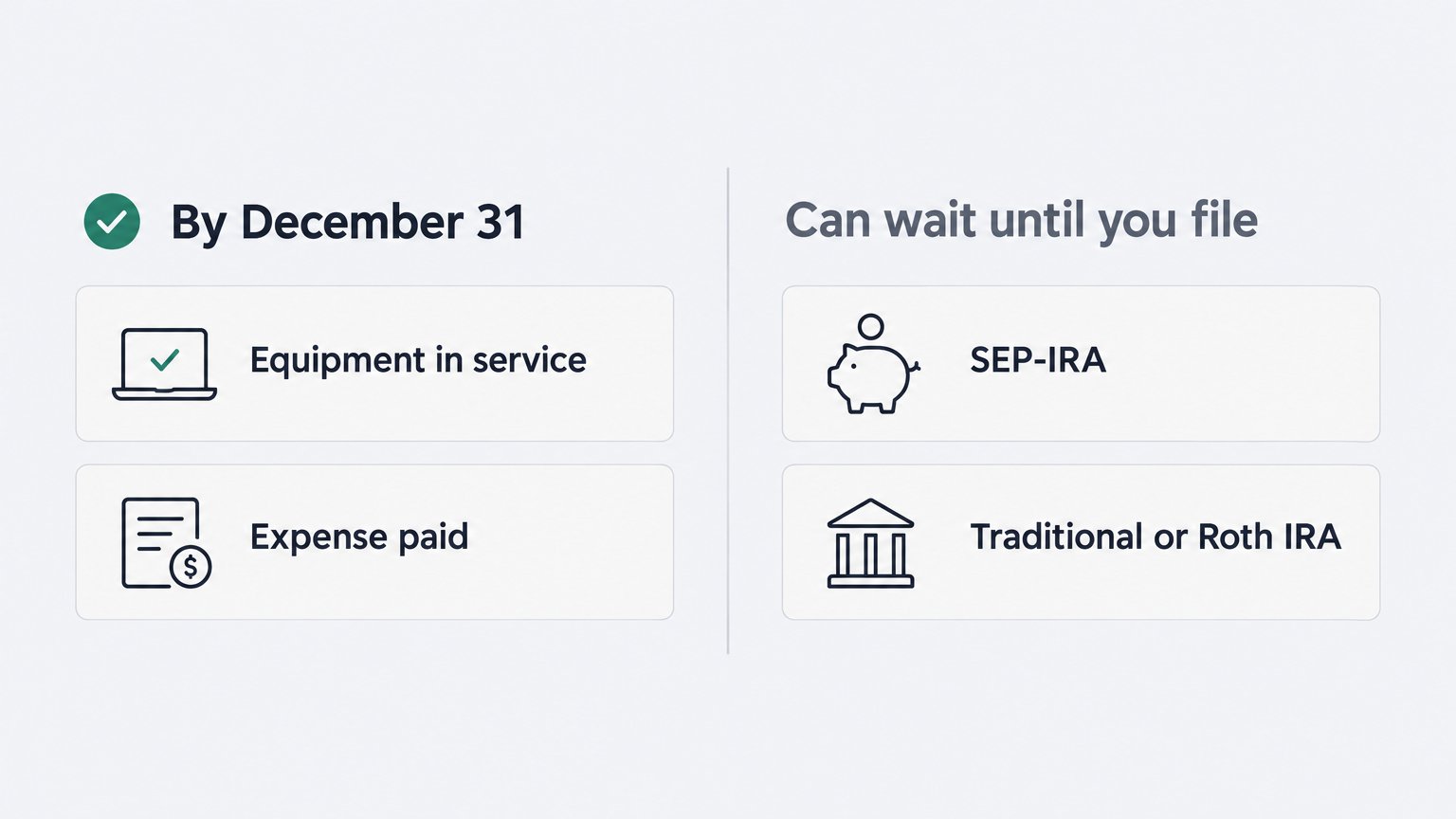
Some deductions have a hard December 31 cutoff; others can wait until you file.
Act by December 31, 2026:
Place equipment in service. You deduct property for the year you place it in service, so a January delivery is a 2027 deduction (IRS).
Pay for it, or charge it. Most freelancers deduct expenses in the year they pay them, including by credit card, not when the bill is issued. Prepaying multi-year expenses has special rules, so pay what you owe now rather than accelerating costs.
Adopt a solo 401(k), with one exception. A solo 401(k) generally has to be adopted by December 31 to deduct contributions for that year. A sole proprietor with no employees starting a first-year plan may be able to adopt it as late as the tax filing deadline (April 15, 2027, without extensions) and still make 2026 deferrals. S corporation and partnership owners do not get it. Confirm your situation with your plan provider or a tax professional (IRS).
Can wait until you file:
SEP-IRA. Set up and fund a SEP as late as your return due date, including extensions (IRS).
Traditional or Roth IRA. Contributions for 2026 can be made up to April 15, 2027 (IRS).
How do you decide how to write off a big purchase?
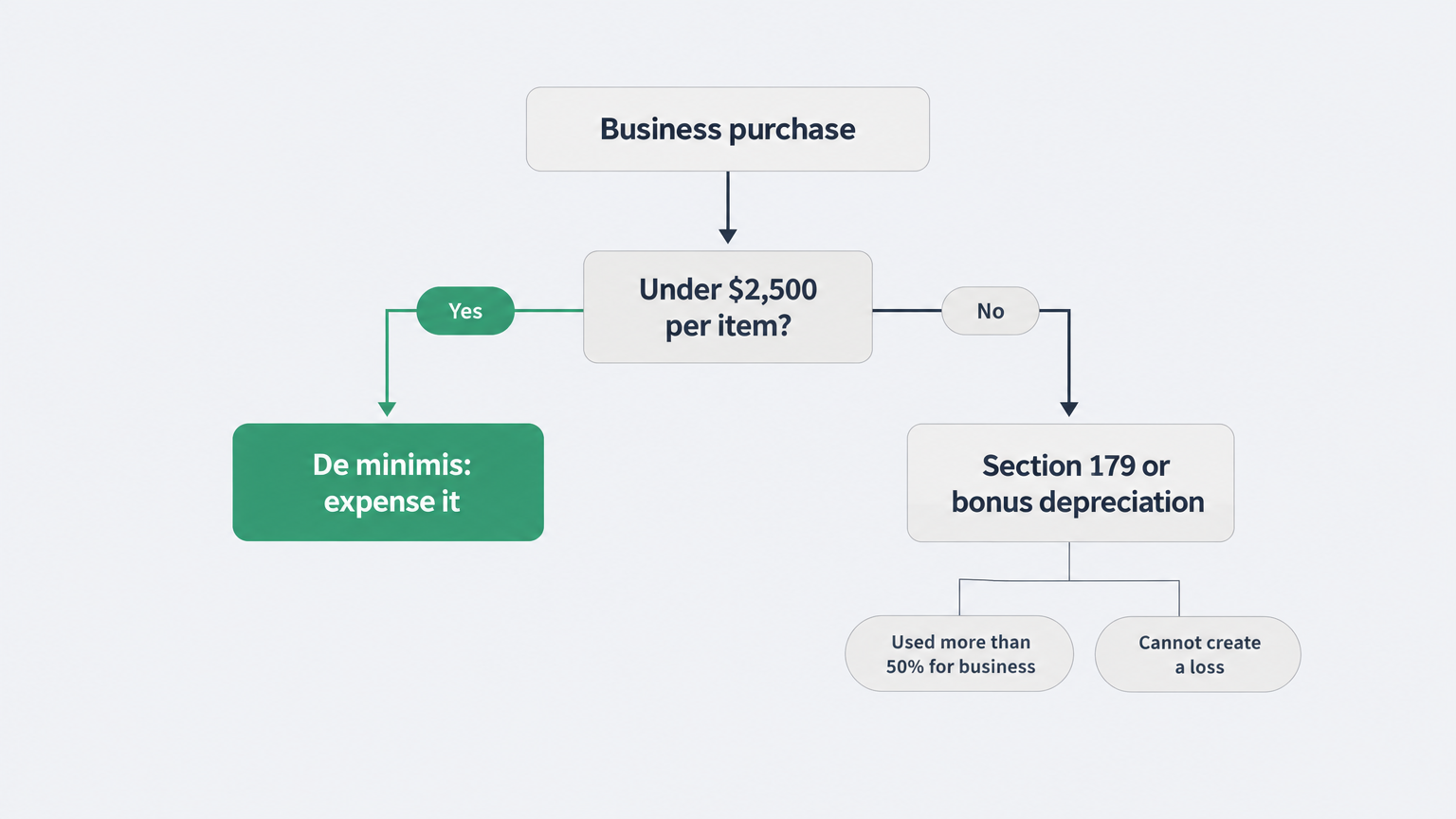
You decide by the size of the purchase and whether it qualifies. Check the de minimis safe harbor first, then Section 179 or bonus depreciation, then a multi-year schedule.
The de minimis safe harbor lets you expense up to $2,500 per item or invoice without capitalizing it, but it is an annual election and your books must expense those amounts the same way (IRS).
Section 179 lets you expense qualifying property used more than 50% for business (IRS). It cannot create a loss, so the deduction is capped at your business income with the excess carried forward, and if business use later falls to 50% or less, part of the benefit is reported back as income.
Bonus depreciation is 100% for property acquired after January 19, 2025, and applies unless you elect out (IRS).
Neither route applies to a car claimed with the standard mileage rate, which already includes depreciation (IRS).
Which deductions does this checklist not cover?
This list covers year-end timing, so it leaves out a few: half of your self-employment tax, the qualified business income deduction (up to 20%, subject to income and other limits), HSA contributions, business insurance, professional fees, skill-maintaining education, and the qualified tips deduction, if eligible, which is a federal income tax deduction that does not reduce self-employment tax.
How do you keep a deduction from slipping through the cracks?
A deduction is only as strong as the record behind it, so make it a habit. A bank statement shows money moved, not what you bought or why; the receipt or invoice fills that in (IRS). Three years is a common retention period, measured from the return's due date or the date you filed, whichever is later; longer periods can apply (IRS).
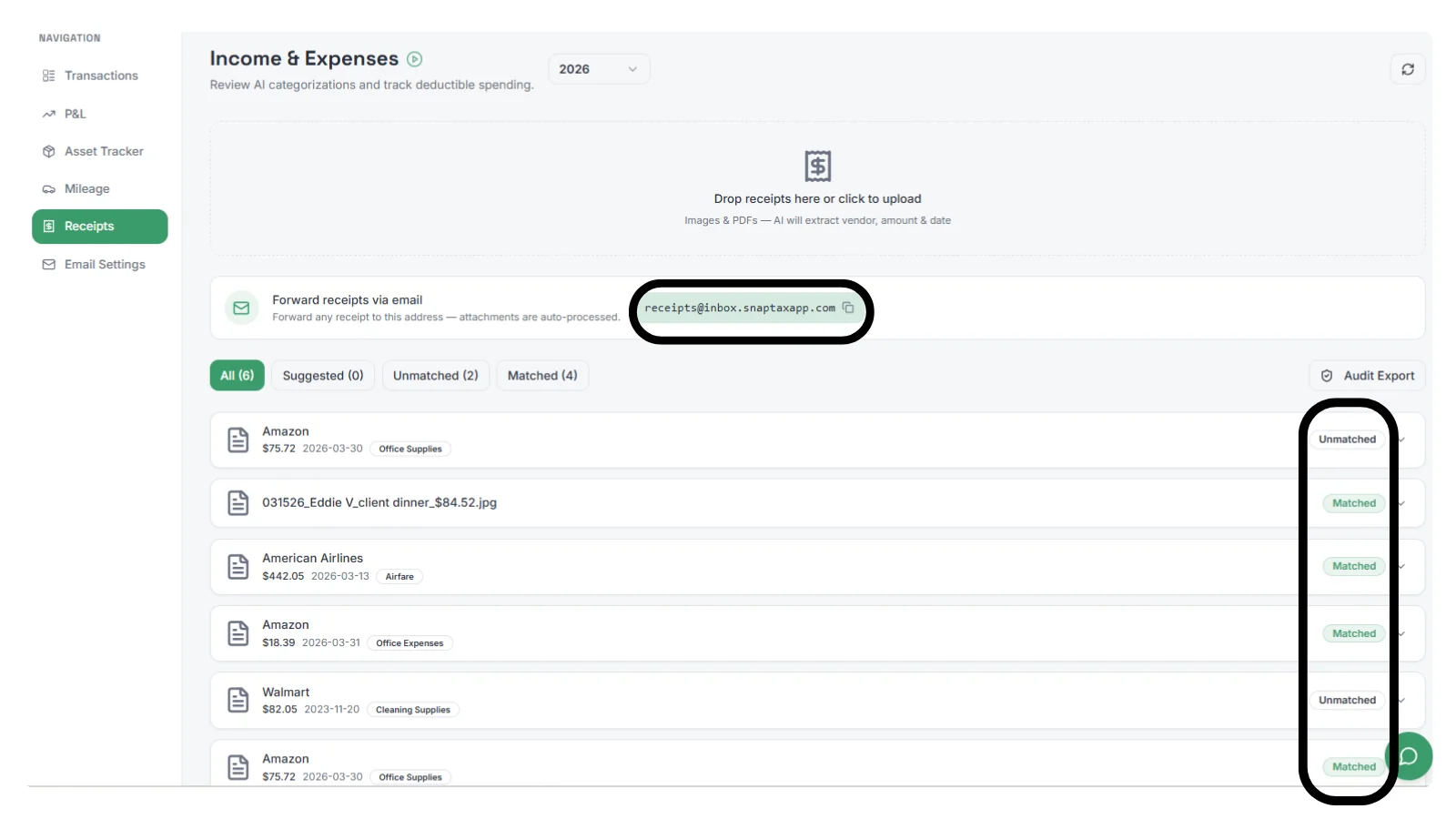
This is the part SnapTax is built for: receipts captured and matched to transactions, a business-use percentage on each, and purchase records kept in the Asset Tracker.
Try SnapTax
SnapTax is built for freelancers who would rather track deductions through the year than rebuild them in December. It uses statement uploads with AI-suggested categories you review before saving, and the Asset Tracker on the Builder and Optimizer plans applies Section 179, bonus depreciation and MACRS schedules (SnapTax features). SnapTax provides tax estimates and planning tools; it does not file your tax return. Start on the free plan, or try a paid plan for 30 days and cancel anytime (SnapTax pricing).
Frequently Asked Questions
How many self-employed tax deductions can I claim for 2026?
There is no fixed number. If an expense is ordinary and necessary for your business, it can generally count, from home office and mileage to retirement contributions and health insurance premiums. SnapTax tracks these through the year so fewer are missed at close.
Can I claim tax deductions after December 31?
Some can wait, and some cannot. A 2026 traditional or Roth IRA contribution can be made until April 15, 2027, and a SEP-IRA can be set up as late as your return due date including extensions. Equipment has to be placed in service by December 31, and a solo 401(k) generally has to be adopted by then, though a first-year plan for a sole proprietor with no employees may run to the filing deadline.
Is the standard mileage rate or the actual expense method better for a self-employed vehicle?
It depends on the car and how much you drive. The standard rate is simpler to keep, while actual expenses can be larger for a high-cost vehicle. You generally choose in the first year the car is used for business, and choosing actual expenses with accelerated depreciation or Section 179 usually prevents a later switch to the standard rate. A leased car generally locks in the standard rate for the whole lease.
Do I need receipts to deduct a business expense?
Not every expense needs a receipt, but every deduction needs a record. A bank statement shows money moved; the receipt or invoice shows what you bought and why it was business. A missing receipt does not automatically lose the deduction, so look for a duplicate invoice or order confirmation. Three years is a common retention period, measured from the return's due date or the date you filed, whichever is later, and longer periods can apply. Travel, meals, gifts and vehicle expenses have stricter substantiation rules.
Does a large purchase have to be written off over several years?
Not necessarily. Up to $2,500 per item can be expensed under the de minimis safe harbor, and larger qualifying property may be expensed under Section 179 or 100% bonus depreciation. SnapTax's Asset Tracker applies these so the deduction lands in your tax plan.
