DoorDash Taxes 2026: Your 1099, Mileage, and What to Set Aside
Crystal Harrison · November 26, 2026 · 16 min read
Last updated:
DoorDash Taxes 2026: Your 1099, Mileage, and What to Set Aside
How DoorDash taxes work in 2026: no withholding, a Form 1099-NEC at $2,000, the mileage rate that decides your bill, and what to set aside each week.
November 26, 2026 · 12 min read
By Crystal Harrison, Founder of SnapTax
Quick Answer: How do DoorDash taxes work in 2026?
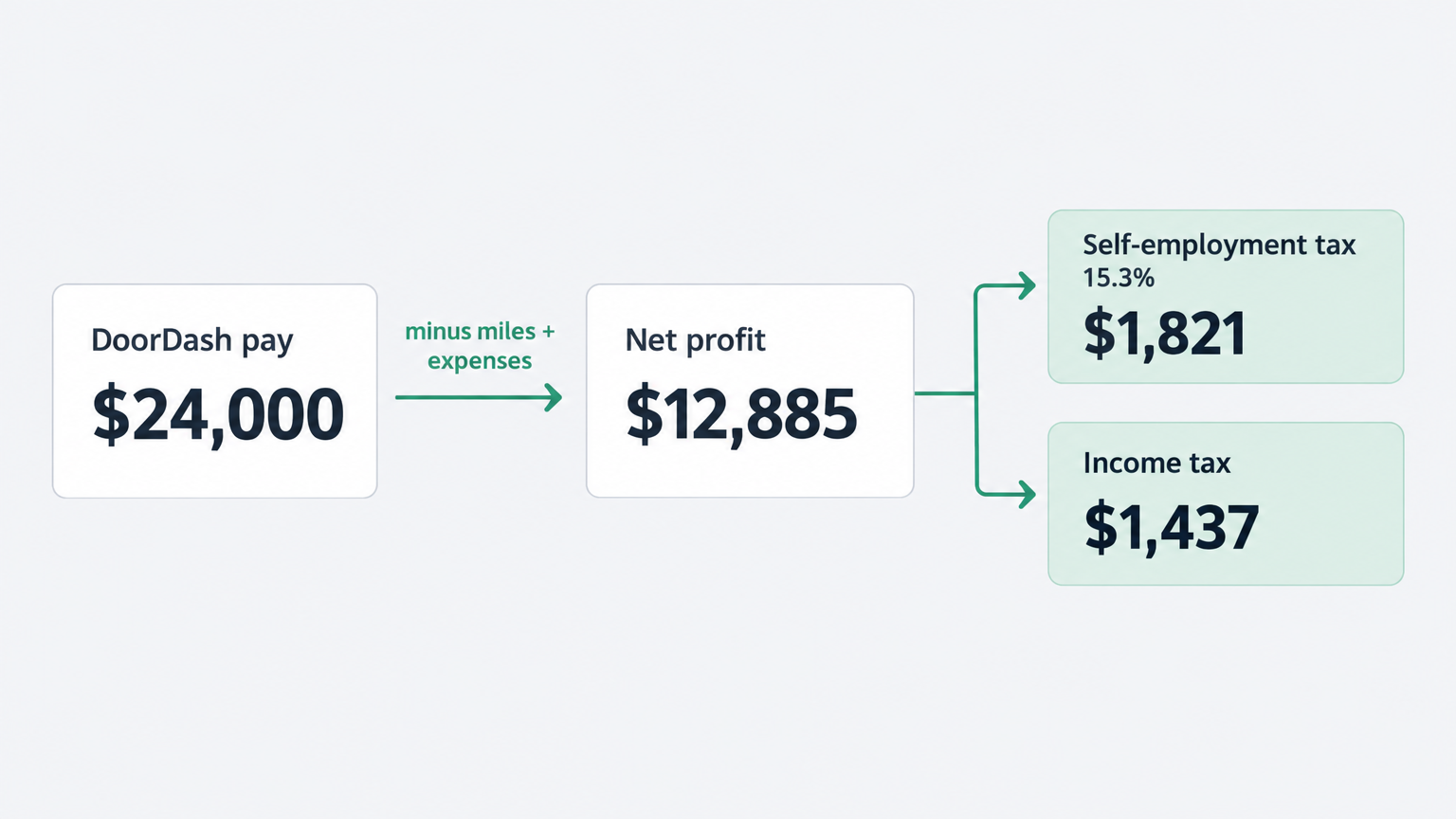
DoorDash does not withhold any tax, so you owe the full bill yourself. You owe self-employment tax on your net profit plus income tax after deductions, and mileage is usually the biggest deduction. In one example below, a Dasher with a $50,000 day job sets aside about 14% of gross DoorDash pay with a mileage log and 27% without one.
TL;DR
Dashers get a Form 1099-NEC, not a W-2, once they earn $2,000 or more in 2026. It is available in the Dasher app, and the 2026 form is due by February 1, 2027 (the usual January 31 date falls on a Sunday).
You owe self-employment tax of 15.3% on 92.35% of your net profit once net earnings from self-employment reach $400 or more, plus income tax on what is left.
Business miles are worth 72.5 cents each from January to June 2026 and 76 cents from July to December. A mileage log is usually the largest deduction.
Delivery tips can qualify for a deduction of up to $25,000 a year through 2028, but they are still subject to self-employment tax.
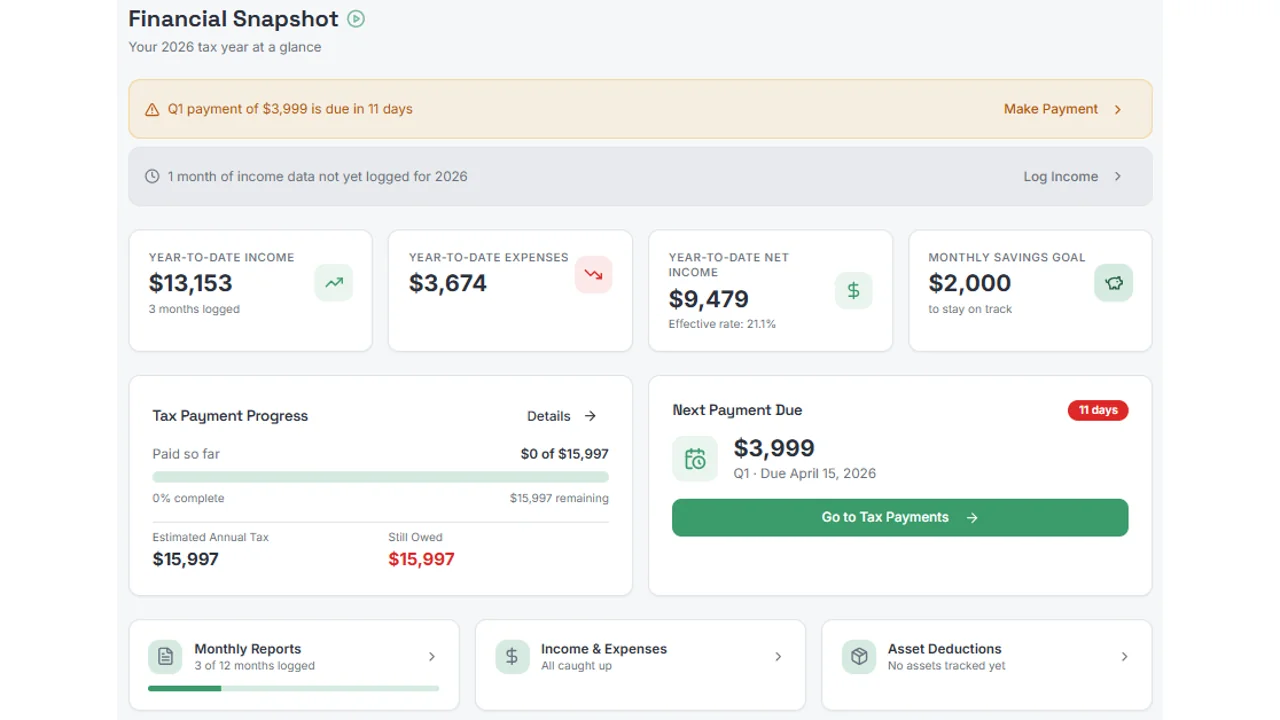
SnapTax logs your drives and turns your dashing income, miles and expenses into a running quarterly estimate, so January is a transfer rather than a surprise.
Does DoorDash take taxes out of your pay?
No. DoorDash does not withhold federal or state tax from a Dasher's pay, so every payout is gross. DoorDash states this plainly on its Dasher tax guide: DoorDash "does not automatically withhold taxes from independent contractors."
That missing withholding is the whole story of the tax bill. A paycheck job takes tax out every week, so the number in your account already has the bill handled. Dashing pays you in full and leaves the timing to you. The tax still gets paid, just later, and usually through quarterly payments.
This is the gap SnapTax was built to close. It keeps a running estimate of what you owe, based on the income you have actually earned, so the number is not a mystery when the deadline lands. You can see how that adds up on the real-time quarterly tracking page.
What tax form does DoorDash send Dashers?
Dashers get a Form 1099-NEC, not a W-2 and not a 1099-K. A 1099-NEC reports what a business paid an independent contractor, and DoorDash files it with the IRS and, where required, your state, per the same Dasher tax guide.
Here is what to know about the form you get in January:
Where to find it. It is in the Dasher app, under Earnings, then View payout details, then Tax documents. DoorDash does not use Stripe Express for current forms; Stripe Express only holds 2023 and earlier, per Stripe.
When it arrives. DoorDash makes your copy available in the Dasher app, and the IRS deadline for the 2026 form is February 1, 2027, because the usual January 31 date falls on a Sunday (IRS). DoorDash files the form with the IRS and, where required, your state.
The threshold changed. For payments made in 2026, the federal threshold is $2,000, up from $600, per the IRS. Earn under that and you may get no form at all, but DoorDash lets Dashers opt in to receive one in the app by updating their tax preferences.
No form does not mean no tax. The IRS expects you to report all your income whether or not you receive a 1099, and your weekly pay statements in the Dasher app are your backup record. One more detail catches people out: the number on your 1099-NEC is gross pay, before any expenses. It is the starting line for your return, not the amount you are taxed on.
How is DoorDash income taxed?
Your Dasher pay is business income, so it is taxed two ways: self-employment tax for Social Security and Medicare, and income tax like anyone else pays. Both are figured on your net profit, which is gross pay minus your business expenses. That is why every deductible mile matters.
Tax | What it is | How it is figured |
|---|---|---|
Self-employment tax | Social Security (12.4%) and Medicare (2.9%) for people who work for themselves | 15.3% of 92.35% of net profit, once net earnings from self-employment reach $400 or more (IRS, Publication 505) |
Federal income tax | The same tax a W-2 employee pays | Your bracket, applied to your total income after deductions (IRS) |
State income tax | Depends on where you live | Some states have none, others add several percent |
Two details lower the bill a little. You can deduct the employer-equivalent half of your self-employment tax when figuring adjusted gross income (IRS). Eligible Dashers may also qualify for the qualified business income deduction, which the 2025 law made permanent but which is subject to income limits; our guide to the QBI deduction runs through who qualifies.
If you also have a W-2 job, your Dasher profit lands on top of your salary, which usually puts it in a higher bracket than you expect. Our guide on combining W-2 and 1099 income walks through that math, and the self-employment tax rate guide covers the 15.3% in detail.
Why is mileage the deduction that decides your DoorDash tax bill?
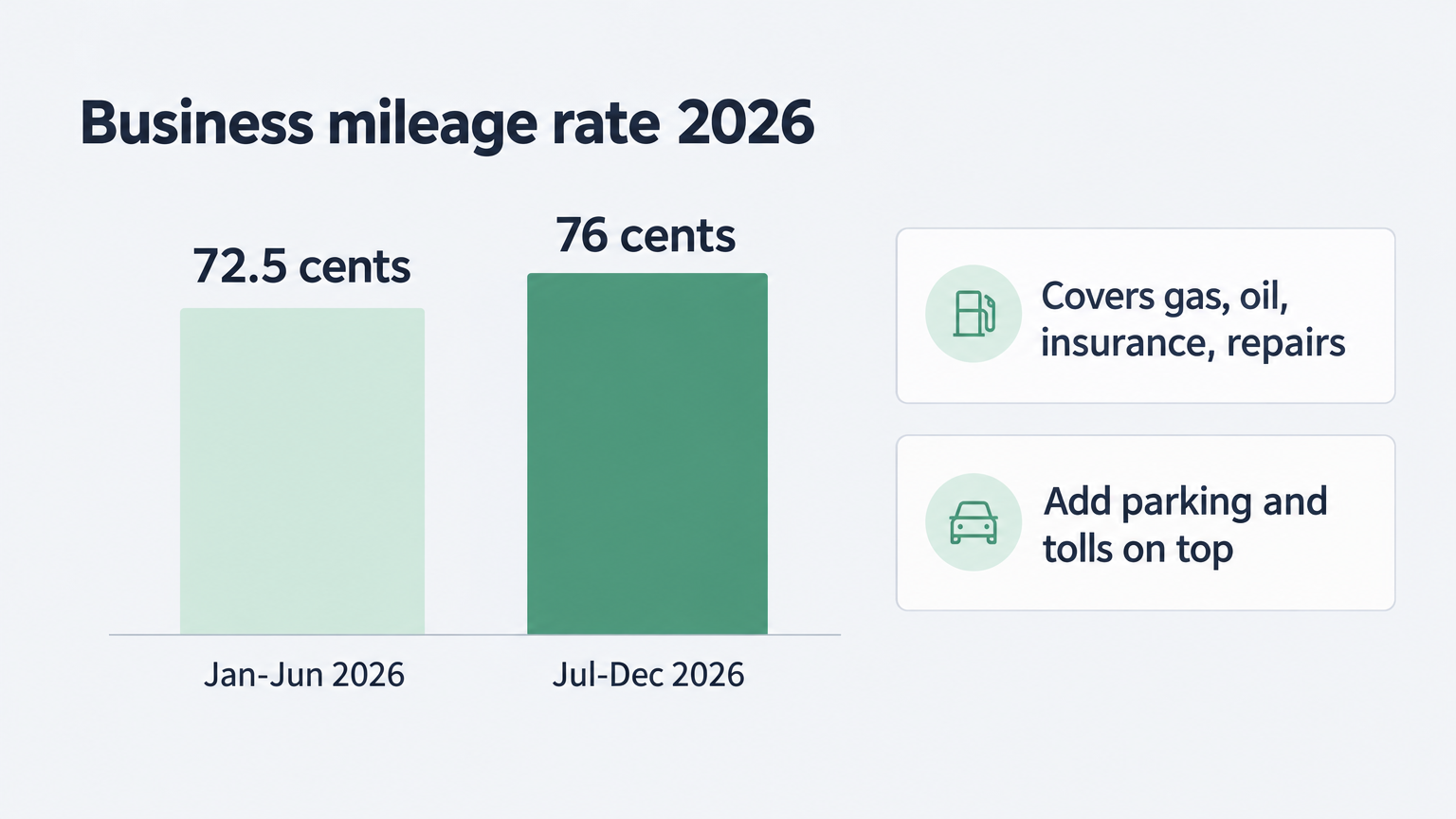
For most Dashers, the car is the business, so the standard mileage rate is usually the largest deduction on the return. The 2026 rate is 72.5 cents per business mile from January 1 to June 30, and 76 cents per mile from July 1 to December 31 (IRS).
At those rates, 10,000 business miles, split evenly across the year, is a deduction of about $7,425. The standard rate already covers gas, oil, insurance, repairs and depreciation, so you do not deduct those separately. Business parking and tolls are the exception: you add those on top (IRS).
Three catches are worth knowing:
The first-year choice sticks. You must choose the standard rate in the first year the car is used for business; afterward you can pick either method, subject to the depreciation rule below.
Actual expenses can close the door. Choosing actual expenses with accelerated depreciation or Section 179 generally blocks a later switch to the standard rate, though straight-line depreciation may still allow it. A leased car has its own rule: if you use the standard rate, you generally must use it for the whole lease. Our guide to mileage versus actual expenses runs both methods side by side.
DoorDash's mileage number is not your log. DoorDash emails a mileage estimate, but treat it as a sanity check, not your record. It generally counts on-delivery mileage only and misses the driving between orders, so the IRS expects your own log, made at or near the time of each trip.
One more point about basis. Because the standard rate includes a depreciation component, it lowers the car's basis. When you sell, a lower basis means a larger gain or a smaller loss on the business portion.
Which DoorDash miles count?
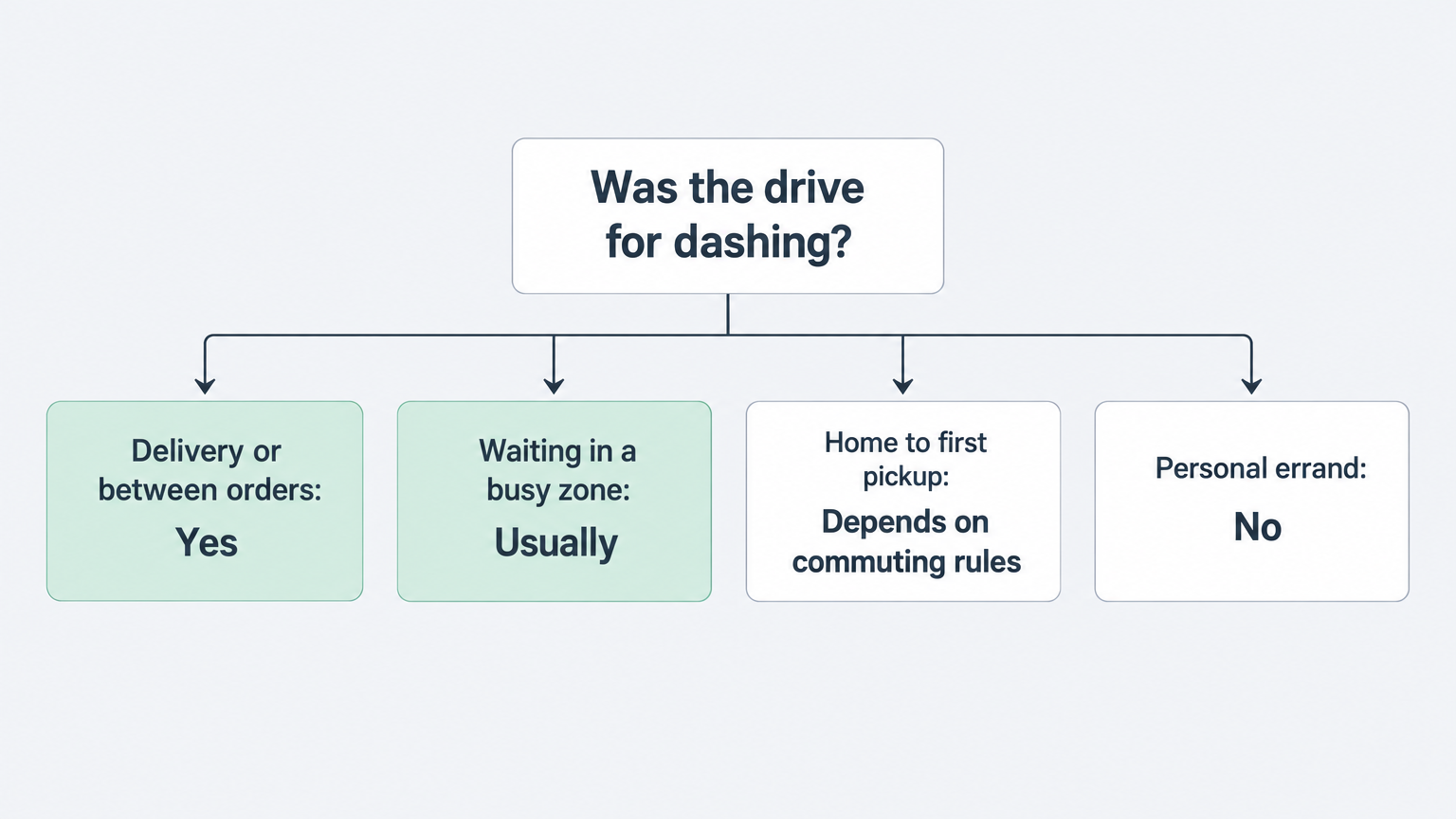
The home-to-first-pickup drive depends on the IRS commuting rules, so that is the one not to assume. Everything you drive for the delivery itself counts, and your drive home from the last drop-off usually follows the same rule as the drive that started the day.
Drive | Generally deductible? |
|---|---|
Restaurant to customer | Yes |
Customer to the next pickup | Yes |
Moving to a busier zone while online and waiting for orders | Usually, with a clear business purpose |
A trip to buy delivery supplies, like an insulated bag | Yes |
Home to your first pickup, and last drop-off back home | Depends on the commuting rules for your situation |
Personal errands during a shift | No |
The home-to-first-pickup question turns on whether you have a regular work location and whether your home is your principal place of business (IRS). If those drives are a big share of your miles, it is worth asking a tax professional.
For every business trip, the log needs the date, the destination, the business purpose and the miles driven. Our list of seven drives freelancers often miss and our 2026 mileage deduction guide go deeper.
What else can a Dasher deduct?
Beyond mileage, you can deduct ordinary and necessary business expenses, meaning costs that are common in delivery work and helpful for doing it. Anything you use partly for personal life only counts at its business-use share (IRS).
Expense | How it is deducted |
|---|---|
Phone and data plan | Business-use percentage only, for example 60% of the bill |
Insulated delivery bags, phone mount, car charger | Full cost, if used for dashing |
Business parking and tolls | Full amount, on top of standard mileage |
Tax software or a preparer for your Dasher income | The business share of the fee |
Gas, insurance, repairs | Only if you use the actual expense method instead of standard mileage |
A category alone is not proof. "Phone bill" is a label; "60% of my phone bill, used for the Dasher app and customer calls" is a business purpose. Write that down once and keep it with the records. Our post on business use percentage explains how to work out the split, and the $75 receipt rule covers what proof you need.
Do Dashers pay tax on tips in 2026?
Yes, tips are still income and still subject to self-employment tax, but a new federal deduction lets eligible workers deduct up to $25,000 a year in qualified tips from taxable income for tax years 2025 through 2028 (IRS).
Keep your weekly earnings breakdowns from the Dasher app, which list customer tips apart from base pay. They are the easiest way to support the number if your 1099 shows one total. Four things to know:
Delivery work is on the list. The final regulations, published April 13, 2026, name app-based delivery workers under goods delivery people (Federal Register).
The tips must be on a tax form. For the self-employed, tips have to be included in the amounts reported on a Form 1099-NEC, 1099-K or 1099-MISC (IRS). That is one more reason to opt in to a 1099-NEC if you earn under the threshold.
The tips must be voluntary and in an eligible occupation. The deduction covers tips a customer leaves of their own choice, in a job the IRS lists as one that customarily received tips on or before December 31, 2024, and delivery work is on that list.
The deduction is capped by your profit. A self-employed Dasher can deduct qualified tips only up to the net income from the work that earned them, and it phases out at higher incomes, over $150,000 for single filers and $300,000 for joint filers. In the example below, the $5,000 of tips qualifies in full only because her net profit from dashing is more than that.
How much should a Dasher set aside for taxes?
There is no single right percentage, because the answer depends on your own numbers: your other income, your deductions and your bracket. Here is one Dasher worked through three ways, using 2026 federal figures.
The Dasher: single, a $50,000 W-2 day job with normal withholding, and $24,000 of DoorDash pay in 2026, including $5,000 in tips. She drives 14,000 business miles, split evenly across the year, and spends $720 on her phone's business share, delivery bags, parking and tolls.
Illustrative example | With a mileage log | With a mileage log + tips deduction | No mileage log |
|---|---|---|---|
Mileage deduction | $10,395 | $10,395 | $0 |
Net profit from dashing | $12,885 | $12,885 | $23,280 |
Self-employment tax | $1,821 | $1,821 | $3,289 |
Extra federal income tax | $1,437 | $837 | $3,110 |
Total extra tax | $3,258 | $2,658 | $6,399 |
Set aside per week | $63 | $51 | $123 |
Share of gross DoorDash pay | 14% | 11% | 27% |
The mileage log alone is worth about $3,100 in tax here. The tips deduction trims another $600, and notice it leaves self-employment tax untouched.
How the numbers were built: miles at 72.5 cents for 7,000 and 76 cents for 7,000. Self-employment tax at 15.3% of 92.35% of net profit (Publication 505). Income tax uses the 2026 standard deduction of $16,100 and the 2026 single-filer brackets, after deducting half the self-employment tax (IRS).
Illustrative only. The example leaves out the qualified business income deduction, state tax and credits, which can move the result in either direction. Your own numbers decide your number.
A part-time Dasher with no other income sees a different picture. With the same $12,885 profit and nothing else, taxable income falls below the standard deduction, so federal income tax is $0. The $1,821 of self-employment tax is still due.
To run your own version, the free 1099 tax calculator handles the self-employment and income tax math, and our guide on how much freelancers should save explains why a flat 30% often overshoots. You can also use our free Mileage Calculator to see how much your miles can save you.
Do Dashers have to pay quarterly taxes?
Yes, you generally have to pay estimated tax if you expect to owe at least $1,000 in tax for the year after withholding and refundable credits, and your withholding and credits fall short of the safe-harbor target. Each payment covers a slice of income, and the periods are not evenly spaced (IRS).
Income period | Payment due |
|---|---|
January 1 to March 31, 2026 | April 15, 2026 |
April 1 to May 31, 2026 | June 15, 2026 |
June 1 to August 31, 2026 | September 15, 2026 |
September 1 to December 31, 2026 | January 15, 2027 |
The 2026 dates come from the 2026 Form 1040-ES and Publication 505. This article covers federal estimated tax; many states have their own rules and dates.
The next one is the Q4 payment, due January 15, 2027. You are generally protected from an underpayment penalty if your timely payments cover 90% of this year's tax or 100% of last year's, which becomes 110% if last year's adjusted gross income was above $150,000 (Publication 505).
Dashers with a W-2 job have one extra option: raise the withholding at the day job to cover the dashing tax. For everyone else, the routine before each deadline is:
Total your DoorDash pay since the last payment, using the Dasher app earnings history.
Subtract the business miles from your log and your other expenses to get profit for the period.
Work out the tax on that profit, or open your running estimate if you track it in an app.
Pay through IRS Direct Pay, EFTPS or your IRS online account, choosing estimated tax and the right tax year.
Save the confirmation number with your tax records.
Check your state's rules, since many states have their own estimated payments.
Our quarterly tax calculator estimates the amount, the tax deadline calendar adds every date to your calendar, and the guide to avoiding IRS quarterly tax penalties covers the safe-harbor math.
What records should a Dasher keep?
Keep enough to show what you earned, what you spent, and why each cost belonged to the business (IRS).
Your 1099-NEC and the weekly earnings history from the Dasher app.
A mileage log with the date, destination, purpose and miles for every business trip.
Receipts or statements for bags, accessories, parking and tolls.
A note of your phone's business-use percentage and how you worked it out.
Confirmation numbers for every estimated payment.
How does SnapTax turn a week of dashing into a quarterly number?
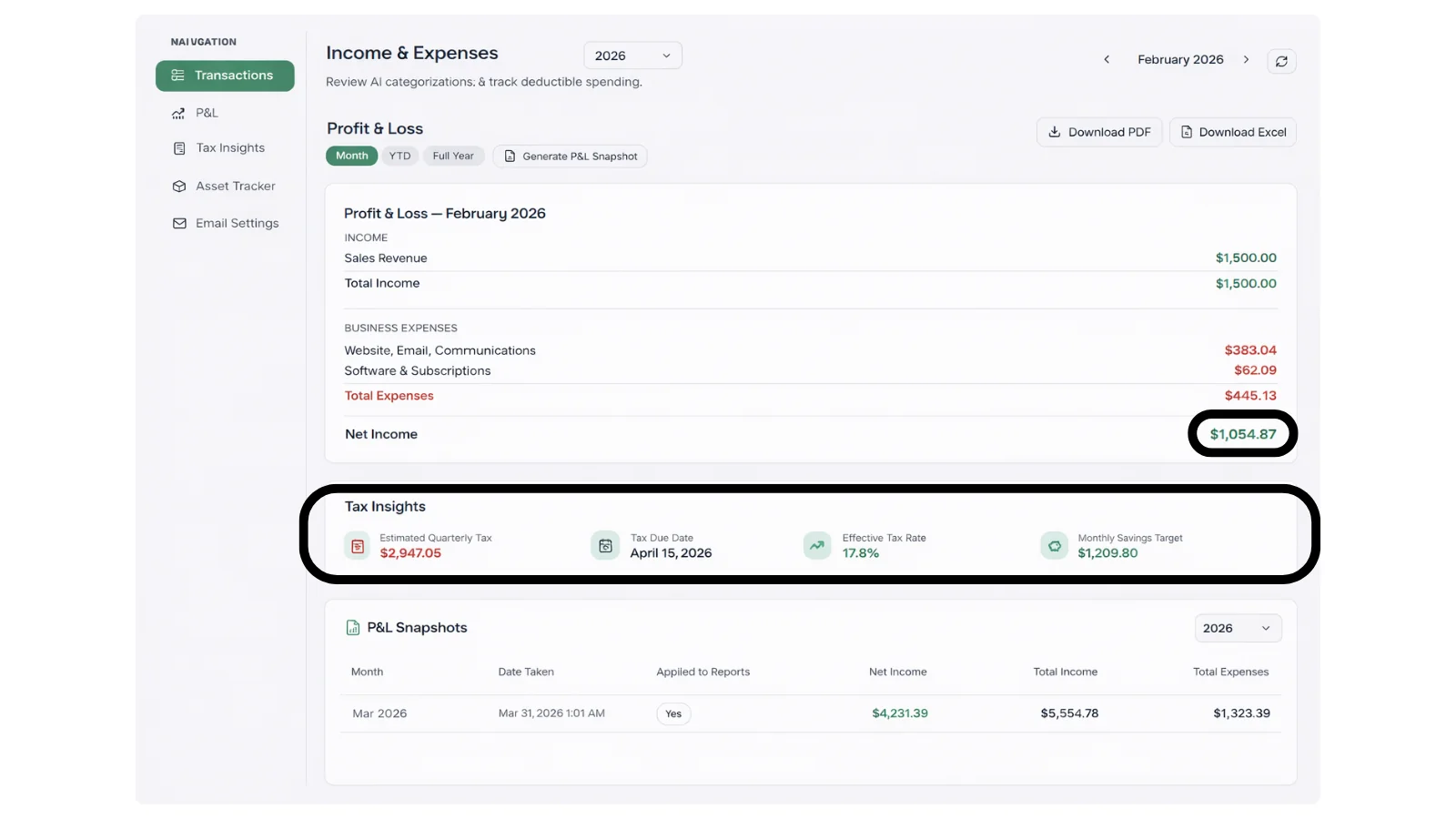
Picture a Tuesday dinner shift. You run six orders, wait in a busy zone for twenty minutes, and drive home. On a spreadsheet, those miles exist only if you remember them on Sunday. In SnapTax, the GPS mileage tracker records your trips, you set the purpose and business category on each one, and the deduction flows into your profit and loss report.
The usual Dasher setup | With SnapTax |
|---|---|
Miles rebuilt from memory or DoorDash's estimate | GPS trip log with the business purpose on each drive |
A 1099 total and a guess in April | Income and expenses feeding a running quarterly estimate |
Phone bill deducted at 100%, or not at all | A business-use percentage applied to each transaction |
Day job and dashing figured separately | W-2 and 1099 income combined in one estimate |
SnapTax reads uploaded bank statements, so there is no live bank connection to set up, and it suggests categories you confirm. It was built by Crystal Harrison, a bookkeeper with more than two decades of experience keeping books for the self-employed. It estimates and plans; you still file through your tax software or a preparer.
Try SnapTax for your dashing taxes
SnapTax is tax planning software for freelancers and 1099 workers. It turns a week of dashing into a running estimate you can act on, and its mileage tracker records the drives for you. Start with the free plan for a basic quarterly-tax estimate, based on an annual net income figure you enter and can update any time. It also gives you estimates for all four quarters and email reminders before each deadline. Or try a paid plan with a 30-day trial; a card is required for the trial, and you can cancel anytime.
DoorDash taxes are not complicated. They are just late: the bill shows up months after the miles. Log the drives as you go, set aside a share of every payout, and the January 15 payment becomes a transfer instead of a surprise.
This article is educational only and is not tax, legal or financial advice. Talk to a qualified tax professional about your own situation.
Frequently Asked Questions
Does DoorDash take taxes out of my pay?
No. DoorDash does not withhold federal or state tax from a Dasher's pay, so every payout is gross and the tax is a bill you settle later, usually through quarterly estimated payments. DoorDash states this on its Dasher tax guide.
What tax form will DoorDash send me for 2026?
You get a Form 1099-NEC if you earned $2,000 or more on the platform in 2026, up from the old $600 threshold. It is available in the Dasher app under Earnings, then View payout details, then Tax documents, and the 2026 form is due by February 1, 2027 (the usual January 31 date falls on a Sunday). DoorDash also lets Dashers below the threshold opt in to receive one. See the IRS reporting threshold.
How much should a Dasher set aside for taxes?
There is no single percentage, because it depends on your other income, deductions and bracket. In one example, a Dasher with a $50,000 W-2 day job sets aside about 14% of gross DoorDash pay with a mileage log, and about 27% without one. A Dasher with no other income would owe $0 federal income tax on the same profit, so the set-aside is not a fixed rule. Run your own numbers with the free 1099 tax calculator.
Can I deduct gas if I use the standard mileage rate?
No. The standard mileage rate already covers gas, oil, insurance, repairs and depreciation, so those costs are not deducted again on top. Business parking and tolls are the exception, and you can add those separately. See IRS Publication 463.
Are DoorDash tips tax-free in 2026?
No. Tips are still income and still subject to self-employment tax, but eligible workers can deduct up to $25,000 a year in qualified tips from taxable income for tax years 2025 through 2028. The tips must be voluntary, in an occupation the IRS lists as one that customarily received tips, and reported on an information return, and for a self-employed Dasher the deduction is capped at the net income from the work that earned the tips. See the IRS.
